Evan Hunter - Streets of Gold
Здесь есть возможность читать онлайн «Evan Hunter - Streets of Gold» весь текст электронной книги совершенно бесплатно (целиком полную версию без сокращений). В некоторых случаях можно слушать аудио, скачать через торрент в формате fb2 и присутствует краткое содержание. Город: New York, Год выпуска: 1975, ISBN: 1975, Издательство: Ballantine Books, Жанр: Современная проза, на английском языке. Описание произведения, (предисловие) а так же отзывы посетителей доступны на портале библиотеки ЛибКат.
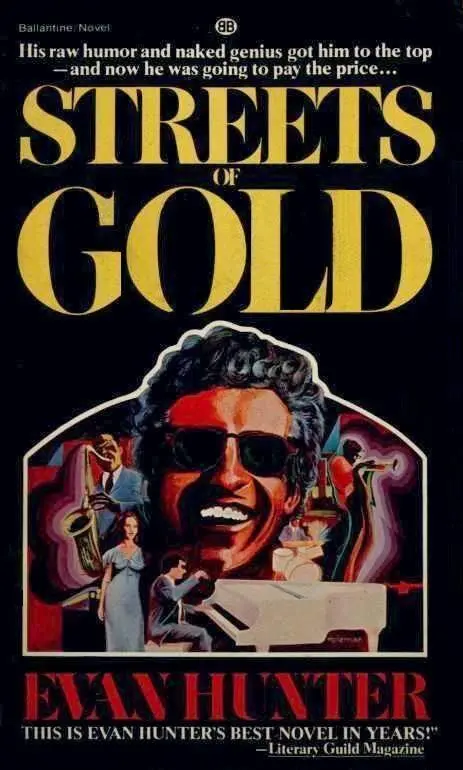
- Название:Streets of Gold
- Автор:
- Издательство:Ballantine Books
- Жанр:
- Год:1975
- Город:New York
- ISBN:978-0-345-24631-8
- Рейтинг книги:4 / 5. Голосов: 1
-
Избранное:Добавить в избранное
- Отзывы:
-
Ваша оценка:
Streets of Gold: краткое содержание, описание и аннотация
Предлагаем к чтению аннотацию, описание, краткое содержание или предисловие (зависит от того, что написал сам автор книги «Streets of Gold»). Если вы не нашли необходимую информацию о книге — напишите в комментариях, мы постараемся отыскать её.
Streets of Gold — читать онлайн бесплатно полную книгу (весь текст) целиком
Ниже представлен текст книги, разбитый по страницам. Система сохранения места последней прочитанной страницы, позволяет с удобством читать онлайн бесплатно книгу «Streets of Gold», без необходимости каждый раз заново искать на чём Вы остановились. Поставьте закладку, и сможете в любой момент перейти на страницу, на которой закончили чтение.
Интервал:
Закладка:
“Tell them dry cleaning is a lousy business.”
“Well, they don’t think so, Pop. They really want to get in it, Pop.”
“So let them get in it,” my grandfather said.
“These guys, Pop, they had your business in mind.”
“They want to buy my business? Ma perchè? Sono pazzi questi tuoi amici? ”
“Not buy.”
“Then what?”
“They want to come in with you, Pop.”
“Come in?”
“In the business. They want to be your partners.”
“I don’t need partners. I got a partner already. Tessie’s my partner. I don’t need no more partners.”
“Well, they think you do, Pop. Need some partners.”
“Tell them I don’t.”
“They want fifty percent.”
“I’ll give them fifty percent of shit ,” my grandfather said.
“Pop... they could make trouble.”
“Let them make it.”
“You don’t know these guys.”
“No only you know them, Matty.”
“Look, they might be willing to talk, you know? Settle maybe for forty percent, or even thirty.”
“Of what?” my grandfather asked. “My life? This shop is my life. Tell them to go to hell, all of them.”
“Pop, you’re making a mistake.”
“ They’re making the mistake,” my grandfather said. “These guys don’t fool around. They want something...”
“I came from the other side with nothing thirty-six years ago,” my grandfather said. “ Senti? Nothing. I was twenty years old; I came with nothing, I found nothing. Now I have something. And I’m not giving fifty percent of it to anybody — or forty percent, or thirty percent, or anything. Tell them no. You hear me. Tell these cafoni that Di Lorenzo the tailor said no.”
My grandmother listened, and then said, “Give them what they want, Frank.”
“I’ll give them nothing,” he said.
“Frank...”
“Nothing.”
They came back the very next morning, a Sunday, and smashed the plate-glass window of the shop. When they called my grandfather on the telephone Monday morning, he told them the answer was still no. So on Monday night, they pried loose the boards my grandfather had nailed across the broken window, and they went into the shop with cans of paint, and spilled the paint all over the clothes hanging on the racks, and all over the Salvation Army uniforms he’d been cutting in the back of the shop, paint as red as blood. He told them no again. On Saturday night, a week after they had first visited his shop, they broke in again and slashed the pads on the pressing machine, and broke the treadle on the sewing machine, and put the blades of his big cutting shears between the floorboards and snapped them off, and shattered the face of the hanging wall clock, and ripped down the flowered curtain dividing the front of the shop from the back, and pinned a Salvation Army jacket to the counter with a knife sticking up just below the left breast pocket, where the heart was. When they called my grandfather again on Monday morning, he told them the answer was still no. He told them there was nothing left for them to do but cripple him or kill him, and if they did that there would be no more tailor. And if there was no more tailor, there was no more business. And forty percent of nothing was nothing. They left him alone after that. I guess they considered him small potatoes, a waste of their valuable time. In frustration, they beat up my Uncle Matt, and stopped playing cards with him, and made it impossible for him to get a medallion for his own cab, even though he’d been saving for one and had been assured a fix was in.
I tell this story not to illustrate the wisdom of my mother’s “There are good and bad in every kind.” I am not a press agent for the good wops in America, who know as well as I that most of the men in organized crime are bad wops. Nor do I have any desire to disprove the specious reasoning in the syllogism (1) All men are crooks; (2) Most crooks are Italians; (3) Therefore all Italians are crooks. I’ll leave that to the politicians massaging the voters in Italian ghettos. I’ll leave that to the men who compile the long lists of marvelous contributions Italians have made to American life, starting all the way back with Amerigo Vespucci, and continuing on upward through Cristoforo Colombo, and Frank Sinatra and Mario Puzo and, according to my father, Burt Lancaster. (“Burt Lancaster is Italian, did you know that, Ike?”) Dwight Jamison is Italian, did you know that, Pop? Who the hell cares what they are?
Nor does this anecdote have much to do with the care and feeding of the myth, except perhaps tangentially, since the myth was nurtured by the Eighteenth Amendment, which made it a crime for Americans to manufacture or to consume alcoholic beverages, thereby creating a nation of lawbreakers dedicated to the pursuit of booze and unifying us on a level somewhat removed from Ken Maynard’s horse. A side effect of prohibition was the emergence and spectacular rise of a gangster elite who supplied the booze drunk by the honest lawbreakers in the speaks. Those men went out of the whiskey and beer business in December of 1933, when the amendment was repealed. This was February of 1937, and that was all water under the bridge (so to speak), and who could blame those erstwhile distillers and distributors for seeking other business opportunities like the one my grandfather’s shop seemed to offer, and besides, that’s not the point at all, not even tangentially.
Well, then, Ike, you’re the one with the selective memory, you’re the one differentiating between the strong left-hand chords and the wispy sprinklings in the right hand. Why does this particular event (which happens to be true, but no matter) seem overwhelmingly important to the development of your theme, whereas Aunt Bianca’s corset shop got the ethereal “September in the Rain” treatment? Are you trying to demonstrate that your grandfather was a courageous man, which undoubtedly he was? Are you trying to indicate that his act of defiance was uncommonly risky in that it might just as easily have led to his untimely demise, causing him to wake up one dismal February morning with an ice pick sticking out of his ear? What are your motives, Ike baby?
Ulterior, I’m sure.
Jane Austen is reputed to have said, “I write about love and money. What else is there to write about?” Maybe that’s all there is to write about in England, lady. This is America. I played the head chorus back there in 1901, when my grandfather came to these shores, but that was only to identify the tune. This is the second chorus, this is where you have to start paying attention. I’m transposing and improvising at the same time. And in America, we have transposed the word love to mean sex, we have transposed the word money to mean power, and power means violence, and sex and violence often mean the same damn thing. Those nice guys who smashed my grandfather’s window and spilled paint on the clothes and ripped up the pressing machine and broke the sewing machine (and later Matty’s head) were just learning to be American, that’s all, and were perhaps more foresighted than all the rest of us who were learning to be American at the same time. If they had been true forerunners, of course, true innovators, true seminal figures, they’d have taken the next logical step, thereby distilling sex and violence into its purest native essence. For reasons known only to themselves, however, they stopped short of buggery.
Richard Palumbo didn’t.
We moved to the Bronx in April of 1937, three weeks after Richard Palumbo buggered Basilio Silese in the locker room of the Boys’ Club on 110th Street.
Coincidentally, my father was appointed a regular at about the same time Richard decided to broaden the scope of his sexual activity; I’m not sure which of the two events motivated the move to the Bronx. I rather suspect it was the buggery, which my brother Tony was obliged to report in detail to my mother when we got back to the apartment on 120th Street. I did not know until then that my brother’s nose was bleeding, or that his left eye was swollen and partially closed. I had sat on a bench in the locker room throughout the entire terrifying experience, still dripping wet from the swimming pool, a towel draped over my lap, listening to sounds; jerking my head from left to right, trying to understand what was happening, knowing only that it was something unspeakably horrible, and realizing suddenly that my brother Tony had become involved. Now, in the kitchen of our apartment on 120th Street, I listened to my mother’s terse interrogation and Tony’s reluctant responses, and began to piece together the story and became frightened all over again.
Читать дальшеИнтервал:
Закладка:
Похожие книги на «Streets of Gold»
Представляем Вашему вниманию похожие книги на «Streets of Gold» списком для выбора. Мы отобрали схожую по названию и смыслу литературу в надежде предоставить читателям больше вариантов отыскать новые, интересные, ещё непрочитанные произведения.
Обсуждение, отзывы о книге «Streets of Gold» и просто собственные мнения читателей. Оставьте ваши комментарии, напишите, что Вы думаете о произведении, его смысле или главных героях. Укажите что конкретно понравилось, а что нет, и почему Вы так считаете.