Evan Hunter - Streets of Gold
Здесь есть возможность читать онлайн «Evan Hunter - Streets of Gold» весь текст электронной книги совершенно бесплатно (целиком полную версию без сокращений). В некоторых случаях можно слушать аудио, скачать через торрент в формате fb2 и присутствует краткое содержание. Город: New York, Год выпуска: 1975, ISBN: 1975, Издательство: Ballantine Books, Жанр: Современная проза, на английском языке. Описание произведения, (предисловие) а так же отзывы посетителей доступны на портале библиотеки ЛибКат.
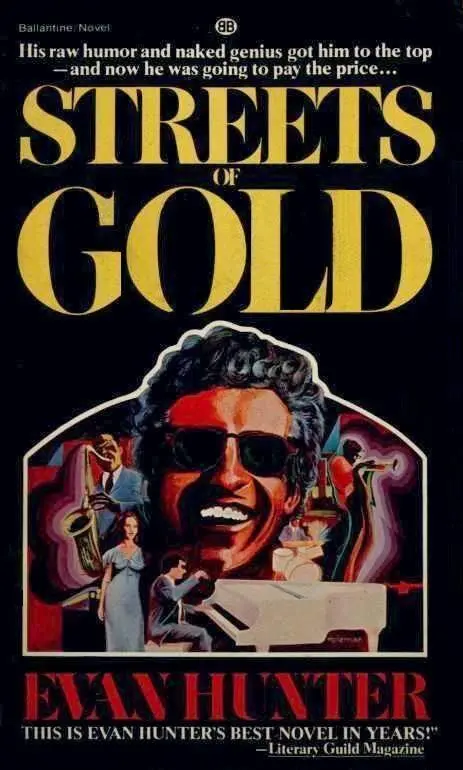
- Название:Streets of Gold
- Автор:
- Издательство:Ballantine Books
- Жанр:
- Год:1975
- Город:New York
- ISBN:978-0-345-24631-8
- Рейтинг книги:4 / 5. Голосов: 1
-
Избранное:Добавить в избранное
- Отзывы:
-
Ваша оценка:
Streets of Gold: краткое содержание, описание и аннотация
Предлагаем к чтению аннотацию, описание, краткое содержание или предисловие (зависит от того, что написал сам автор книги «Streets of Gold»). Если вы не нашли необходимую информацию о книге — напишите в комментариях, мы постараемся отыскать её.
Streets of Gold — читать онлайн бесплатно полную книгу (весь текст) целиком
Ниже представлен текст книги, разбитый по страницам. Система сохранения места последней прочитанной страницы, позволяет с удобством читать онлайн бесплатно книгу «Streets of Gold», без необходимости каждый раз заново искать на чём Вы остановились. Поставьте закладку, и сможете в любой момент перейти на страницу, на которой закончили чтение.
Интервал:
Закладка:
Though insufficient data exists to support this premise, it is reasonable to posit that male’s sibling soon tired of the game, his blind brother being expert at it, and abandoned the externally circumscribing space in favor of the outdoors. Male and female remained hidden in the spontaneously created control space, waiting for the absentee sibling to discover them. By all accounts (the male’s), he was standing directly to the rear of and adjacent to the female. Female, it should be noted, was wearing a thin cotton dress and cotton panties. After fifteen minutes and thirty-two seconds of anterior-posterior proximity, male discovered, much to his surprise and amazement, an unaccustomed and totally unexpected engorgement of erectile tissue, producing a state of rigidity normally associated with arousal of the male organ of copulation in higher vertebrates. Simultaneously (and on the basis of unsubstantiated data supplied by male), female demonstrated involuntary skeletal activity of the dorsally located area of juxtaposition, experienced as “wiggling” and “rubbing” motor responses accompanied by seemingly unrelated verbalizations and frequent eruptions of muted laughter. Postulating on the James-Lange Theory, it would appear that sensory fibers in the aroused structures of male and female alike had been activated, causing visceral and skeletal contributions as the impulses passed back to the cortex. What had previously been nonemotional perceptions were augmented by “feelings,” which (as described by the male in post-laboratory discussions) were multi-leveled and altogether discombobulated.
As previously stated, female subject did not contribute data, but when male subject reported to his mother the visceral/skeletal responses and the “feelings” accompanying them, she said, “You didn’t touch her, did you?” When subject responded in the negative, she then said, “Your father will tell you all about these things when he gets home.”
Subject’s sibling explained the phenomenon thusly: “Iggie, that was nothing but a Russian hot iron.”
Subject’s father chose not to comment later that night. Or any other night, for that matter.
It had been a sin to develop a hard-on while standing behind Tina, who was after all my Uncle Dominick’s sister-in-law. (I learned to call it a hard-on and not a hot iron at about the same time I learned it was a sin to have one.) It was a sin to throw away bread, according to my mother. She always kissed a crust of stale bread before throwing it into the garbage can. She still does. It was a sin not to eat what was on my plate while people in China were starving. It was a sin to make fun of anybody.
“Then why do they make fun of me in the street,” I asked, “and call me blind names and make believe they pinned something on my back, when they didn’t?”
“What blind names?” she asked.
“They call me Orbo the Kid.”
“What?” my mother asked. “What’s that supposed to mean? Who’s Orbo the Kid?”
“Orbo means blind.”
“Who told you that?”
“Grandpa.”
“What does he know, he’s a greaseball,” my mother said.
“Mama, orbo is an Italian word. Orbo . It means blind.”
“So what?” she said. “What’s wrong being called Orbo the Kid? It’s like Vinny the Mutt.”
“It’s different,” I said.
“How is it different?”
“Vinny works for Western Union, don’t he? And a guy who delivers telegrams is called a mutt, and that’s why he’s Vinny the Mutt.”
“So you’re blind, and orbo means blind, and you’re Orbo the Kid. I don’t see any difference at all.”
“You know who picks on me the most?”
“Who?”
“Rocco, who’s crippled.”
“Well,” my mother said.
“You know what I’m gonna do? I’m gonna call him Gimpy.”
“What for?”
“That means when you limp.”
“No,” my mother said, “don’t do that. That’s a sin, Iggie.”
My brother had started a collection of records he jealously guarded, running over to my grandfather’s house to play them in private on the big wind-up Victrola in the front room. I think if my mother knew Tony took Letitia up there with him every Friday afternoon, she would have considered that a sin, too. I kept bothering him to let me hear his records, and finally he told me why he couldn’t.
“Letitia says I shouldn’t let you hear them.”
“Why not?” I asked.
“Because it’s personal.”
“What is?”
“Hearing the records.”
“Well, you let her hear the records, don’t you?”
“That’s right, that’s what’s personal.”
“Well, I’m your own brother,” I said.
“That’s right.”
“Blood is thicker than water,” I said, quoting my mother.
“Yeah, but this is different, Igg.”
If truth be known, I was more interested in hearing about all the things Tony and Letitia did together than I was in hearing his latest Count Basie single. Tony rarely talked about her anymore, though, and I could only imagine what was going on in my grandfather’s front room each Friday while the curved speaker blared Glen Gray and the Casa Loma. My fantasies were invariably the same. In them, Tony was standing behind Letitia and rubbing up against her while he reached around with both hands and unbuttoned her blouse button by button and then unclasped her brassiere, which I already knew how to do with brassieres that didn’t have girls inside them because I handled a lot of brassieres in my Aunt Bianca’s shop. Since his records were intimately linked with those Friday-afternoon sessions, Tony must have feared that if he let me listen to them I might catch a whiff of early-adolescent musk mixed in with the sound of Duke Ellington’s “In a Sentimental Mood.”
Or maybe he was afraid I’d disparage the music he loved so much. It occurs to me that this was a real danger at the time. Only once had I asked Passaro to get me the sheet music for a song I’d heard on the radio, during one of Benny Goodman’s Saturday-night broadcasts. The tune was “You Turned the Tables on Me.” Helen Ward sang it, and I’ll never forget it as long as I live, not because it’s a great tune but because of the storm it fomented. Passaro dismissed it as inconsequential, and in fact went so far as to say it was not music at all.
“It makes me sad,” he said, “to think you would even consider suggesting to me that I get a piece for you that could be played not only by an organ grinder, but possibly by his monkey as well.”
“Okay, Mr. Passaro,” I said.
“It makes me more than sad,” he said. “It grieves me, it hurts me here, ” he said, and realized I couldn’t see what he was doing, and quickly added, “It pains me in my heart ,” and struck his chest with his closed fist so that I could hear the grieving, painful, hollow thump, “to think that perhaps I’m wrong about you, Ignazio, perhaps you are not serious about the piano after all, perhaps you are not willing to sacrifice yourself to your destiny.”
“All right, Mr. Passaro,” I said.
“No, it’s not all right,” he said, his voice rising. He was pacing, his heels clicking along the parquet floor; I sat at the piano with my hands in my lap, and wished I’d never heard of Benny Goodman. “ Not all right at all , Ignazio! For what have we been studying and practicing these past two years, more than two years? For what ? So you can come to me with a request for trash, ask me to procure for you a piece of junk I would not allow in my house except to start a fire in the stove with! Am I a procurer of trash for you, of junk , am I a man who would insult my own integrity and be unfaithful to your promise as a musician by allowing you to...”
Читать дальшеИнтервал:
Закладка:
Похожие книги на «Streets of Gold»
Представляем Вашему вниманию похожие книги на «Streets of Gold» списком для выбора. Мы отобрали схожую по названию и смыслу литературу в надежде предоставить читателям больше вариантов отыскать новые, интересные, ещё непрочитанные произведения.
Обсуждение, отзывы о книге «Streets of Gold» и просто собственные мнения читателей. Оставьте ваши комментарии, напишите, что Вы думаете о произведении, его смысле или главных героях. Укажите что конкретно понравилось, а что нет, и почему Вы так считаете.