Evan Hunter - Streets of Gold
Здесь есть возможность читать онлайн «Evan Hunter - Streets of Gold» весь текст электронной книги совершенно бесплатно (целиком полную версию без сокращений). В некоторых случаях можно слушать аудио, скачать через торрент в формате fb2 и присутствует краткое содержание. Город: New York, Год выпуска: 1975, ISBN: 1975, Издательство: Ballantine Books, Жанр: Современная проза, на английском языке. Описание произведения, (предисловие) а так же отзывы посетителей доступны на портале библиотеки ЛибКат.
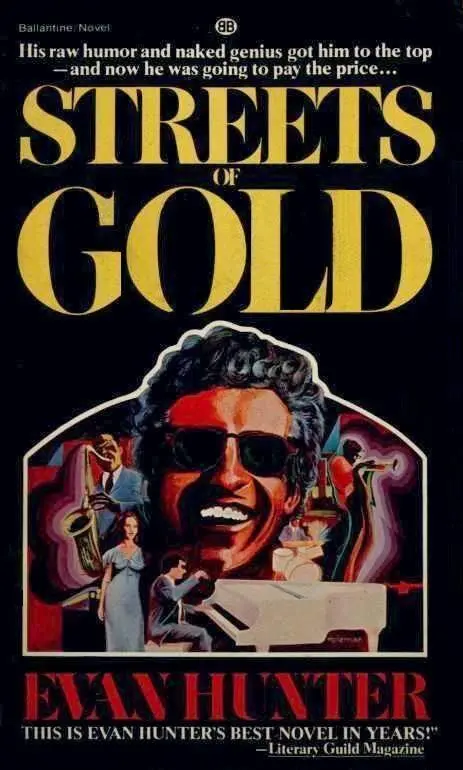
- Название:Streets of Gold
- Автор:
- Издательство:Ballantine Books
- Жанр:
- Год:1975
- Город:New York
- ISBN:978-0-345-24631-8
- Рейтинг книги:4 / 5. Голосов: 1
-
Избранное:Добавить в избранное
- Отзывы:
-
Ваша оценка:
Streets of Gold: краткое содержание, описание и аннотация
Предлагаем к чтению аннотацию, описание, краткое содержание или предисловие (зависит от того, что написал сам автор книги «Streets of Gold»). Если вы не нашли необходимую информацию о книге — напишите в комментариях, мы постараемся отыскать её.
Streets of Gold — читать онлайн бесплатно полную книгу (весь текст) целиком
Ниже представлен текст книги, разбитый по страницам. Система сохранения места последней прочитанной страницы, позволяет с удобством читать онлайн бесплатно книгу «Streets of Gold», без необходимости каждый раз заново искать на чём Вы остановились. Поставьте закладку, и сможете в любой момент перейти на страницу, на которой закончили чтение.
Интервал:
Закладка:
“All right, all right,” I said. “I’m sorry.”
“ More than sorry is what you must be!” Passaro shouted. “I hear that junk , that trash, and it gives me pains in the chest,” he said. “The drums, ba- dohm , ba- dohm , ba- dohm , and the cornets making noise, and the saxophones, ah-waah, waah, waah! Never!” he shouted. “ Giammai!” reverting to Italian, which he rarely did. “And the piano? Is that how to treat a piano? A piano ? What is it they do with the piano? Is that what you wish to do with the piano, Ignazio? Do you wish to tinkle? Then go tinkle in the bathroom, not here, not where we study music ! Do you want to play in Carnegie Hall, or do you want to play in the Paramount movie house downtown? Decide. Decide now. I have no time to waste with ungrateful people to whom I am devoting all of my energy and all of my years of musical experience. Decide , Ignazio!”
“I already decided,” I said.
“And what is your decision?”
“I want to play in Carnegie Hall.”
“Then never again ask me to...”
“I won’t, I promise.”
“Never.”
“I promise, really.”
“All right,” he said. He cleared his throat. “Did you practice this week? Or were you too busy listening to Benny Goodmans?”
“I practiced a lot.”
“How long?”
“Three hours every day.”
“Did you learn the Mozart?”
“Yes, Mr. Passaro.”
“All ten variations?”
“Yes, Mr. Passaro.”
“Clean? Or sloppy as usual?”
“Clean,” I said.
“Play them.”
The swing bands were, of course, as binding an ingredient in the mortar of the myth as were the radio and the movies and the comic strips and the jive talk already filtering its way into the streets (“That’s icky , Iggie”), all of them reinforcing the sense of unity of a nation that was coping with the more serious business of pulling itself slowly out of the pit. I might have been as captured by the new sound as my brother Tony, had it not been for Passaro. Nor am I talking about his aversion to swing. Any classical musician might have been put off by swing. I am talking about an idea he implanted in my head, an idea intricately bound up with a myth entirely alien to him, and in keeping with everything I believed to be American.
Passaro thought I was a musical genius.
It’s a common feeling for blind musicians to believe they’re more talented than musicians who can see, but when this fallacy is reinforced by a teacher who’s beginning to believe you’re Busoni reincarnated, and telling your mother you’re going to burst upon the performing world in ten years (make it eight, make it six !) with such dynamic force that the reverberations will be felt and heard all over the world; and when you couple this with the only proposition in the American Dream that is still valid (but only if you’re free, white, and thirty-five), phrased for simplicity’s sake as “ Anyone can become President of these United States!” — why, man, you have got to begin believing you are something special.
I was something special.
Me.
Ignazio Silvio Di Palermo.
I was already into stuff like Bact’s French and English Suites (not all the movements, but some of them), and his two-part inventions, and able to analyze them harmonically as I played them. I knew every chord on that keyboard (or thought I did until I began playing jazz), knew their primary, secondary, and tertiary functions, knew their patterns of progression and their categories of motion, knew modulation and transposition, and was improvising my own little tunes, upon which I was already writing variations. I was playing movements from Beethoven sonatas while working simultaneously on Chopin’s Opus 72, Number 1 in E Minor, and I was pounding my Czerny and my Hanon like crazy, and I was going to prove that in America all men are created equal, and even the blind grandson of a poor but humble tailor could rise to spectacular heights and achieve fame and fortune if only I ate my Wheaties and faithfully decoded Little Orphan Annie’s messages, and didn’t rub up against plump little girls in coat closets, which was a sin, and didn’t say “nigger” or “Jew,” which was un-American and probably also a sin, and practiced the piano hard, and stopped bringing Passaro requests for trash and junk, and just stuck to being what I was and what I was destined to become — a goddamn musical genius !
I’m now forty-eight years old, and I know I’m not a genius. I also know that even shleppers and shmucks are rewarded in this great land of ours. But then? Ah, then.
Where else but in America? I thought
Where else.
When the Muscular Action Federation to Intensify Anxiety came around to see my grandfather, I was in the shop telling him and my grandmother about two new pieces Passaro had given me. I was sitting in the window seat, as usual. The bell over the door tinkled, and a man said, “Mr. Di Lorenzo?”
“Yes?” my grandfather answered.
I turned toward the door. Whoever the man was, he had not closed the door behind him. He was standing just inside it, and a cold February wind was swirling into the shop.
“We’d like to talk to you, Mr. Di Lorenzo,” another man said.
“Close the door,” my grandfather said.
The men did not close the door. The one who had spoken first now said, “Mr. Di Lorenzo, we’ll make this short and sweet, okay? Your son-in-law tells us you ain’t interested in our proposition.”
“That’s right,” my grandfather said.
“What proposition?” my grandmother asked.
“Mr. Di Lorenzo, you’d better get interested, okay?”
“Why? So I can give you fifty percent of what I...”
“We’ll take forty.”
“No. I give you nothing.”
“Mr. Di Lorenzo, you wouldn’t believe the things that could happen to a tailor shop.”
“Are you Italian?” my grandfather asked.
“I was born right here in Harlem,” the man answered.
“You didn’t answer my question.”
“I’m Italian, yeah.”
“Then leave me alone.”
“This is nothing personal, Mr. Di Lorenzo.”
“To me, it’s personal,” my grandfather answered.
“It can get a lot more personal, believe me,” the other man said. “What do you say?”
“I say no.”
“We’ll be back, Mr. Di Lorenzo, okay?” the first one said.
“You can expect us,” the other one said, and they went out of the shop and closed the door.
“Tell me,” my grandmother said.
So he told her.
My Uncle Matt had come to him two weeks back and said he wanted to discuss a private matter. The way my grandfather reported the conversation, it had gone something like this:
“These guys I play cards with... you know the guys?”
“The crooks,” my grandfather said.
“Well, they ain’t bad guys, Pop. They gave back the stuff that time, didn’t they?”
“If they hadn’t taken it in the first place,” my grandfather said, “they wouldn’t have had to give it back.” “Well, they didn’t know it was Luke and Dom, you know how it is. Anyway, we were playing the other night, and... they had a sort of idea.”
“What idea?”
“They were thinking they might want to get in the dry-cleaning business, you know what I mean?”
“What for?”
“It’s a good business,” Matty said
“Who says?”
“Well, you ain’t exactly starving, are you, Pop?”
“I’m a tailor , that’s why I’m not starving.”
“Yeah, Pop, I know, but...”
Читать дальшеИнтервал:
Закладка:
Похожие книги на «Streets of Gold»
Представляем Вашему вниманию похожие книги на «Streets of Gold» списком для выбора. Мы отобрали схожую по названию и смыслу литературу в надежде предоставить читателям больше вариантов отыскать новые, интересные, ещё непрочитанные произведения.
Обсуждение, отзывы о книге «Streets of Gold» и просто собственные мнения читателей. Оставьте ваши комментарии, напишите, что Вы думаете о произведении, его смысле или главных героях. Укажите что конкретно понравилось, а что нет, и почему Вы так считаете.