Evan Hunter - Streets of Gold
Здесь есть возможность читать онлайн «Evan Hunter - Streets of Gold» весь текст электронной книги совершенно бесплатно (целиком полную версию без сокращений). В некоторых случаях можно слушать аудио, скачать через торрент в формате fb2 и присутствует краткое содержание. Город: New York, Год выпуска: 1975, ISBN: 1975, Издательство: Ballantine Books, Жанр: Современная проза, на английском языке. Описание произведения, (предисловие) а так же отзывы посетителей доступны на портале библиотеки ЛибКат.
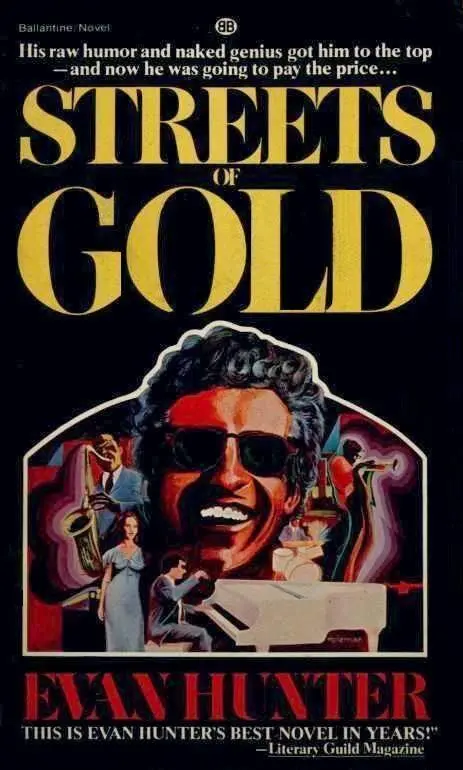
- Название:Streets of Gold
- Автор:
- Издательство:Ballantine Books
- Жанр:
- Год:1975
- Город:New York
- ISBN:978-0-345-24631-8
- Рейтинг книги:4 / 5. Голосов: 1
-
Избранное:Добавить в избранное
- Отзывы:
-
Ваша оценка:
Streets of Gold: краткое содержание, описание и аннотация
Предлагаем к чтению аннотацию, описание, краткое содержание или предисловие (зависит от того, что написал сам автор книги «Streets of Gold»). Если вы не нашли необходимую информацию о книге — напишите в комментариях, мы постараемся отыскать её.
Streets of Gold — читать онлайн бесплатно полную книгу (весь текст) целиком
Ниже представлен текст книги, разбитый по страницам. Система сохранения места последней прочитанной страницы, позволяет с удобством читать онлайн бесплатно книгу «Streets of Gold», без необходимости каждый раз заново искать на чём Вы остановились. Поставьте закладку, и сможете в любой момент перейти на страницу, на которой закончили чтение.
Интервал:
Закладка:
I still think back with horror upon what happened in that locker room thirty-seven years ago — thirty-seven years! And I know that Richard Palumbo’s assault upon Basilio Silese’s backside is linked in memory to my own innocent (Stop claiming it was so innocent! You got a hot iron, didn’t you? And a Russian one at that!) rubbing up against Tina, my aunt’s plump little sister. I don’t know much about writing, but I do know how to play the piano, and there are some tunes I won’t touch. Come to me with a request for “I Don’t Know Why,” and I’ll turn you down cold, and not only because it’s a lousy tune. For me it conjures Poe Park in the Bronx, where Tony took me just before he got sent overseas, telling me he’d fix me up with a girl, and indeed finding a big-breasted sixteen-year-old for me, who kept saying over and over again, “It’s amazing, it’s truly amazing, I never before realized a blind person could dance,” while leading me around the packed dance floor girdling the band shell, her guiding hand firm in the small of my back as we avoided collision after collision, Bobby Sherwood blowing the tune on his horn, and singing the lyrics in a lulling monotone. I sat on a bench with her later, and she said, “Take off your glasses, I want to see what a blind person’s eyes look like.” I got off the bench, and stumbled through the crowd, groping, until I reached the Grand Concourse and found the lamppost Tony had told me to wait by, in case we got separated.
Don’t ask me to play “I Don’t Know Why.” My fingers lock on the keyboard, and I can’t get through the first bar. And I guess if you ask me to play “Tina in the Closet,” another old favorite, I won’t play it as the passionate, enclosed, excruciatingly ecstatic awakening it was, but will play it exactly as I did earlier — as a takeoff on a tune, a facetiously scientific, emotionless rendering. Why? I don’t know why, but I do know why: because of what Richard Palumbo did.
If you’re still alive, Richard, and if by now you realize you’re dealing with Ignazio Silvio Di Palermo, and not Dwight Jamison, and if you further realize that it was my dear dead brother Tony who punched you in the mouth that day, I’m going to tell you that I also link his death to you and what you did. You’re a time machine, Richard. I climb into you climbing into Basilio, and I’m transported backward to my own excitement that day with Tina and am embarrassed by it, and then somebody wrenches the control switch and I’m propelled forward to the year 1943, and my brother Tony is now a full-fledged hero in the greatest homosexual enterprise ever invented, and he is killed, he is screwed, he is fucked in the ass at the age of nineteen years, six months, and six days.
Thanks for the memories, Richard.
The woman downstairs is named Stella Locchi. To differentiate her from Stella Di Palermo, who is my mother, the women on 217th Street call her Stella the Baker, which is her husband’s occupation. My mother becomes Stella the Mailman. I don’t think she likes this too much. In Harlem, where the name Mary was as common as the name Sarah on the Lower East Side, there had been a Mary the Street Cleaner, and a Mary the Barber, and a Mary the Electric Company, and a Mary the Mutt (who had married Vinny the Mutt), and a plethora of other Marys, including Mary the Virgin, who was not la Madonna but instead a spinster lady of eighty-seven, who lived alone in a room behind Carlo Fiaci’s candy store, and who was labeled with her own occupation rather than that of any kin, all of whom had predeceased her. But Stella was a very special name; there had not been a single other Stella in all the streets of the vicinanza , none that my mother knew, at least, and it irks her now to have to share her stardom with a Stella who owns the building we are living in, and from whose husband we buy our daily bread on White Plains Avenue. If my mother had known her prospective landlady would be a Stella, she would not have taken the apartment, even though it was close to the Santa Lucia School for the Blind.
Mrs. Locchi pointed this out to my mother the Saturday we went to see the apartment.
“I notice the little boy is blind,” she said. “There’s a blind school on Paulding Avenue, you know. It’s very good. He could walk there. Can he walk places by himself?”
“Yes, he can walk places by himself,” my mother said. I think her tone was lost on Stella the Baker, whose name and husband’s occupation we did not yet know; my mother can be as subtle as a pit viper when she so chooses. “He can also play the piano very nicely, and is being trained for Carnegie Hall,” she added, putting away the stiletto and bringing out the machete.
“My, my,” Mrs. Locchi said.
“I hope you don’t mind hearing the piano,” my mother said. “He practices sometimes three, four hours a day.”
“I love the piano,” Mrs. Locchi said. “My own son, Gerardo, plays the clarinet, and he’s only seven. He’s not blind, of course.”
“So few people are,” my mother answered.
“Your hubby is a mailman, is that right, Mrs. Di Palermo?”
“He’s a letter carrier,” my mother said, which probably sounded more American to her.
“There’s a post office on Gun Hill Road,” Mrs. Locchi said. “I’m not trying to push you into taking the apartment, but he could walk to work every morning. The Williamsbridge post office. Right on Gun Hill Road.”
“Well, right now, my husband is working as a regular at the Tremont station,” my mother said.
“But he could get a transfer, couldn’t he?” Mrs. Locchi asked.
“Yes, maybe.”
“How old are you, young man?” Mrs. Locchi said.
“Me?” I said.
“No, your brother here.”
“I’ll be thirteen in June,” Tony said.
“My, my, you’re big for your age,” Mrs. Locchi said. “What grade are you in?”
“I’ll be starting high school in September.”
“Oh, that’s too bad, because there’s a junior high right across the street. You could have walked right across the street to school each morning. Not that the high school is very far, either. Evander Childs. That’s on Gun Hill Road, a few blocks from the post office. Most of the kids on the block walk there, too.”
“How much is the apartment?” my mother asked.
“We’re asking thirty-five a month.”
“We’re paying twenty-six now.”
“Yes, but that’s Harlem,” Mrs. Locchi said. “Up the street, they’re asking forty dollars for only three rooms. This is five rooms when you count the sun porch, which you could use as a bedroom for one of the boys. Thirty-five a month isn’t a lot for this apartment. You go ask around, you’ll see.”
“It is convenient, I suppose,” my mother said.
“And there are plenty of kids on the block,” Mrs. Locchi said. “All ages. You sons will have plenty of kids to play with. It’s a nice neighborhood.”
“It seems very nice,” my mother said.
“Very quiet,” Mrs. Locchi said.
“Yes.”
“And no niggers,” she said.
“Negroes,” I said.
“That’s right,” she said, and patted me on the head, startling me half out of my wits because I hadn’t sensed her hand coming at me. “So you’re going to play at Carnegie Hall when you grow up. Isn’t that nice,” she said.
“Well, let me talk it over with my husband,” my mother said.
“I don’t want to rush you,” Mrs. Locchi said, “but a woman was here looking at the apartment just before you, and she said she’d call me back at seven tonight.”
“My husband works half a day Saturday,” my mother said. “I’ll call you early this afternoon.”
Читать дальшеИнтервал:
Закладка:
Похожие книги на «Streets of Gold»
Представляем Вашему вниманию похожие книги на «Streets of Gold» списком для выбора. Мы отобрали схожую по названию и смыслу литературу в надежде предоставить читателям больше вариантов отыскать новые, интересные, ещё непрочитанные произведения.


Обсуждение, отзывы о книге «Streets of Gold» и просто собственные мнения читателей. Оставьте ваши комментарии, напишите, что Вы думаете о произведении, его смысле или главных героях. Укажите что конкретно понравилось, а что нет, и почему Вы так считаете.