Evan Hunter - Streets of Gold
Здесь есть возможность читать онлайн «Evan Hunter - Streets of Gold» весь текст электронной книги совершенно бесплатно (целиком полную версию без сокращений). В некоторых случаях можно слушать аудио, скачать через торрент в формате fb2 и присутствует краткое содержание. Город: New York, Год выпуска: 1975, ISBN: 1975, Издательство: Ballantine Books, Жанр: Современная проза, на английском языке. Описание произведения, (предисловие) а так же отзывы посетителей доступны на портале библиотеки ЛибКат.
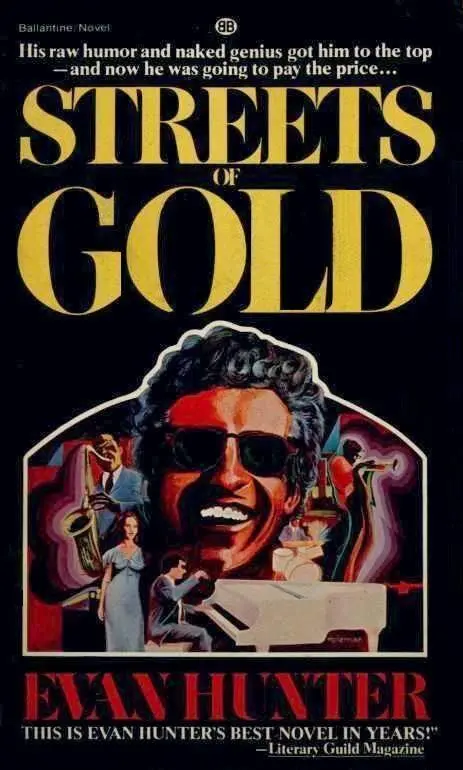
- Название:Streets of Gold
- Автор:
- Издательство:Ballantine Books
- Жанр:
- Год:1975
- Город:New York
- ISBN:978-0-345-24631-8
- Рейтинг книги:4 / 5. Голосов: 1
-
Избранное:Добавить в избранное
- Отзывы:
-
Ваша оценка:
Streets of Gold: краткое содержание, описание и аннотация
Предлагаем к чтению аннотацию, описание, краткое содержание или предисловие (зависит от того, что написал сам автор книги «Streets of Gold»). Если вы не нашли необходимую информацию о книге — напишите в комментариях, мы постараемся отыскать её.
Streets of Gold — читать онлайн бесплатно полную книгу (весь текст) целиком
Ниже представлен текст книги, разбитый по страницам. Система сохранения места последней прочитанной страницы, позволяет с удобством читать онлайн бесплатно книгу «Streets of Gold», без необходимости каждый раз заново искать на чём Вы остановились. Поставьте закладку, и сможете в любой момент перейти на страницу, на которой закончили чтение.
Интервал:
Закладка:
In his broken English, he said, “Go play you jazza. And buona fortuna , Ignazio.”
It was a blessing.
III
Oscar Peterson once said: “First you learn to play piano, then you learn to play jazz” — or words to that effect. I once heard him play eighteen straight choruses of “Sweet Georgia Brown,” and while he was on the sixth chorus, I thought He’ll never top that one, but he topped it in the seventh, and then again in the tenth, and he kept topping himself as he went along, utilizing a personal retrieval system to yank idiomatic ideas out of his mind and push them into his hands, shaping those ideas into an entirely fresh improvisational line, each chorus having no intrinsic relationship to the one preceding it or the one following it, except as part of an original, imaginative, and (to me) inspirational flow. But he had paid his dues, he had the technical knowledge stored in the computer bank of his memory, all of it was under his hands; those years of learning Bach and Chopin from one of the best classical teachers in Canada finally paid off when he came down to New York and promptly knocked off everybody’s hat.
In 1943, I knew how to play piano, but I didn’t know how to play jazz, and if there was anyone teaching it, I couldn’t find him. It’s a different tune today, when jazz has been elevated to the stature of an art form. (I still think it’s only folk music, and I’ve been playing it for thirty-one years now, but I suppose mine is a minority opinion.) Today you can find jazz departments at Indiana U. and the New England Conservatory and several other revered institutions across the length and breadth of this great creative nation. And even those schools without departments per se are offering courses in jazz. It wasn’t that way in 1943. In 1943, there was nobody. I had only my brother’s records.
His collection of piano stylists was fairly comprehensive, I now realize, including such early ragtime players as Scott Joplin and James P. Johnson, and some good representative barrelhouse piano playing by Jelly Roll Morton and Frank Melrose, and stuff by old jazzmen whose names alone seemed to promise strange and exotic keyboard happenings — Pine Top, and Cripple Clarence, and Speckled Red; Cow Cow, Papa Jimmy Yancey, Willie the Lion — and then moving up through men like Meade Lux Lewis, Albert Amnions, and Biff Anderson. Most of the records, though, were by Fats Waller, Earl Hines, Teddy Wilson, and Art Tatum. I liked these best, possibly because there were more of them than any of the others. I’ve since learned that there was a direct line of succession from Waller to Tatum and from Hines to Wilson, but I didn’t know it then. I only knew that I liked the way these men played jazz.
I once sat in with Dizzy Gillespie, and he jokingly (I think) said, “I sure wish you cats would give us back our rhythm,” and I jokingly (I think) replied, “Okay by me, Diz. Just give us back our harmony.” Well, harmony and rhythm were jogging along there simultaneously in the left hand of every piano player I listened to, and it was the left hand that delineated the various styles I learned to identify. But even though I was no stranger to counterpoint (who could be after all those years of Bach?), and even though I had no difficulty recognizing that the chords in any jazz chorus were held for either two beats or four beats, and the rhythm was a steady four/four, and the melody was built on eighth notes, I nonetheless had difficulty understanding how all of these units were put together to get that distinctive... I’m sorry, but “swing” is the only word that describes it. Jazz is by definition a duple musical system. Everything in it is based on equivalents and multiples of two; that’s part of its symmetry. But those three levels of duo-divisible rhythm moving in counterpoint were pressed into a larger rhythmic context that seemed like...
Well, magic.
I’m blind. To me, there’s no such thing as sleight of hand. I figured it was simply a matter of sitting down and learning a new system. There was no one to teach me, and so I had to teach myself. If Tatum had learned it, I could learn it. I now know that Tatum was perhaps the greatest keyboard virtuoso since Franz Liszt. But ignorance is bliss, and I figured if I had once mastered the “Hungarian Rhapsody,” I could now master this thing called jazz.
Back in 1937, Susan Koenig had gently patted my hand and told me my “Moonlight” Sonata was the most beautiful thing she’d heard in her life. In December of 1943, we were both seventeen years old, and I was itching to get into her pants (or anybody’s , for that matter). I had no real idea what she looked like, but I had formed some tactile, olfactory, and auditory impressions — I had touched her a little, smelled her a lot, and hardly listened to her at all.
Every Friday afternoon, Santa Lucia’s held a social for its juniors and seniors, and I had been dogging Susan’s tracks for the better part of a year now, seeking her out in the school gymnasium while the record player oozed Harry James’s “I Had the Craziest Dream,” Dinah Shore’s “You’d Be So Nice to Come Home To,” or Freddy Martin’s “I Look at Heaven,” a popularization of the Grieg Concerto upon which I’d worked so long and hard. I was working equally long and hard on Susan, who — unless my senses were sending absolutely haywire messages to my brain — looked something like this:
1. She was approximately five feet four inches tall. I reckon this by deducting from my own height the distance between the top of my head and the tip of my nose, which, according to my Braille ruler, was six inches. The top of Susan’s head came to just under my nose. Subtracting six inches from my own height, which was five feet ten in 1943, I got a girl who measured five-four.
2. Her eyes were brown. She told me this. She wore shades all the time. So did I.
3. She wore her hair very long, almost to the middle of her back. It would brush the top of my hand as we danced. The style was unusual for 1943, when girls were wearing shoulder-length pageboys, with or without high pompadours. But Susan later told me it was simpler and neater for a blind girl to wear it long and straight.
4. Her brassiere size was 36B. I pressed against her chest a lot and based my estimate on empirical knowledge, having handled many such garments in my Aunt Bianca’s corset shop, and having been intimately involved with Michelle’s bras during the thirteen-month period of her extraordinary growth. Michelle’s bra size, when she moved away in 1941, was a 34C.
5. The top of Susan’s head smelled of Ivory soap. Her ear lobes smelled of Wortt’s Je Reviens . She later identified this brand name for me while my nose was nestled between her naked breasts, where she also dabbed a bit of that intoxicating scent.
6. Her voice, angelic back there in 1937 when she’d praised me for my performance, had lowered in pitch to a G above middle C, somewhat husky, always breathless, even when she wasn’t whispering in my ear as we endlessly circled that gymnasium floor and tried to avoid collisions.
Did you know that blind people can detect the presence of an object by the echoes or warmth it gives off, and even by changes it causes in the air pressure, which are felt on the face? A little-known fact, but scientifically authenticated. I once detected the presence of a short, fat lady standing on the corner of White Plains Avenue and 217th Street, and asked her if the approaching trolley went to Fordham Road. When she did not reply, I asked the question again and discovered I was talking to a mailbox. The mailbox did not answer me. But then again, neither did it answer the Martians when they insisted it take them to its leader. Which reminds me of what Django Reinhardt, the gypsy jazz guitarist said when he first came to America in 1946: “Take me to Dizzy.”
Читать дальшеИнтервал:
Закладка:
Похожие книги на «Streets of Gold»
Представляем Вашему вниманию похожие книги на «Streets of Gold» списком для выбора. Мы отобрали схожую по названию и смыслу литературу в надежде предоставить читателям больше вариантов отыскать новые, интересные, ещё непрочитанные произведения.

Обсуждение, отзывы о книге «Streets of Gold» и просто собственные мнения читателей. Оставьте ваши комментарии, напишите, что Вы думаете о произведении, его смысле или главных героях. Укажите что конкретно понравилось, а что нет, и почему Вы так считаете.