Evan Hunter - Streets of Gold
Здесь есть возможность читать онлайн «Evan Hunter - Streets of Gold» весь текст электронной книги совершенно бесплатно (целиком полную версию без сокращений). В некоторых случаях можно слушать аудио, скачать через торрент в формате fb2 и присутствует краткое содержание. Город: New York, Год выпуска: 1975, ISBN: 1975, Издательство: Ballantine Books, Жанр: Современная проза, на английском языке. Описание произведения, (предисловие) а так же отзывы посетителей доступны на портале библиотеки ЛибКат.
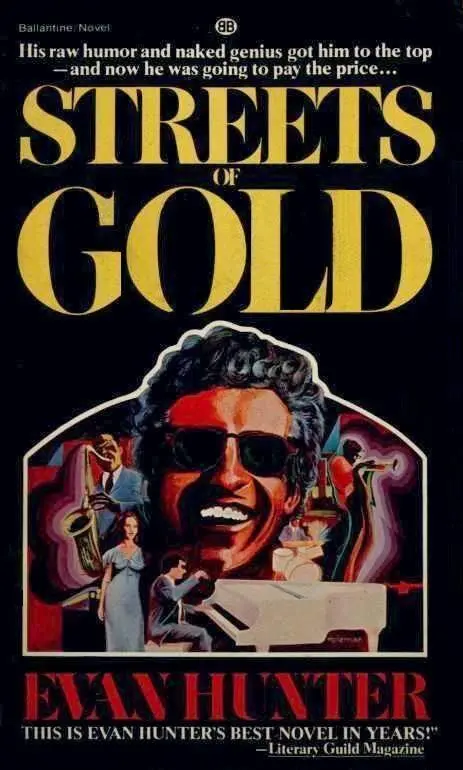
- Название:Streets of Gold
- Автор:
- Издательство:Ballantine Books
- Жанр:
- Год:1975
- Город:New York
- ISBN:978-0-345-24631-8
- Рейтинг книги:4 / 5. Голосов: 1
-
Избранное:Добавить в избранное
- Отзывы:
-
Ваша оценка:
Streets of Gold: краткое содержание, описание и аннотация
Предлагаем к чтению аннотацию, описание, краткое содержание или предисловие (зависит от того, что написал сам автор книги «Streets of Gold»). Если вы не нашли необходимую информацию о книге — напишите в комментариях, мы постараемся отыскать её.
Streets of Gold — читать онлайн бесплатно полную книгу (весь текст) целиком
Ниже представлен текст книги, разбитый по страницам. Система сохранения места последней прочитанной страницы, позволяет с удобством читать онлайн бесплатно книгу «Streets of Gold», без необходимости каждый раз заново искать на чём Вы остановились. Поставьте закладку, и сможете в любой момент перейти на страницу, на которой закончили чтение.
Интервал:
Закладка:
Stultifyingly ignorant — I could read in Braille only the language of classical music, and had no concept of this new language — blissfully naive as to its complexity, desperately hungry to get to the piano and try it, try to play it, waiting for my father’s alarm to go off at a quarter to five, soaringly optimistic, knowing that once I got my hands on the keyboard, the music would leap magically from my fingers, I lay on my brother’s bed and stared sightlessly at the ceiling and contemplated a journey to a land more alien than any I might have imagined in my most fantastic dreams.
As my grandfather had done in 1900, I decided firmly and irrevocably to chance the voyage.
It remained only to discuss the matter with Federico Passaro.
He listened in silence to the records I had brought with me.
He listened while Tatum played “Rosetta” and “St. Louis Blues” and “Moonglow” and part of “Begin the Beguine,” and then he abruptly lifted the needle from the player.
“Yes?” he said. “You wanted me to listen. I listened.”
I took a deep breath. “I want to play like that,” I said.
“Like what?”
“Like what you just heard.”
“What is that?” he said. “Jazz.”
“Ah, yes. Jazz.”
“It’s what I want to play.”
“What do you mean?” he said. “For fun? For amusement?”
“Mr. Passaro...”
“Well, I can see no real harm in it,” he said, surprising me; I had expected a tantrum similar to the one I’d provoked with my request for “You Turned the Tables on Me.” But Passaro actually chuckled, and then said, “In fact, the man has good technique. Has he had classical training?”
“I don’t know anything about him.”
“What is he playing in the bass clef? Tenths? They sound like tenths to me. And not open tenths, either. You may find the stretch difficult. Well, try it, I don’t think it can hurt you.”
“I’ve already tried it,” I said.
“Ah? And can you reach those chords?”
“I have to stretch for them, you’re right.”
“Well, that won’t hurt you. His arpeggios are very clean, too; he must have had classical training. I’m not familiar with all the chords he played in the twelve-bar piece. What were those chords?”
“I don’t know.”
“They seem to utilize many notes outside the mode. Well, no matter. If you want to fool around with this for your own amusement, I have no...”
“ All the time, Mr. Passaro.”
“Eh?”
“I want to play it all the time?”
“What do you mean, all the time?”
“That’s what I want to play.”
The room went silent.
“Let me understand you,” Passaro said.
“I want you to teach me to play the way he plays,” I said. “Art Tattum. That’s his name. That’s how I want to play.”
“Iggie, this is a bad joke,” Passaro said, and chuckled again. “I’m a very patient man, you know that by now, we’ve been together for more than seven years, very patient. But this is a bad joke. Are you finished with it? If so, I’d like to...”
“Mr. Passaro, can you teach me to play what he’s playing?”
“No,” Passaro said, his voice suddenly sharp. “Of course not! What are you saying?”
“I don’t want to play this way anymore.”
“What way?”
“This way,” I said, and my hands moved out to the keyboard, and I ran through the first four bars of a Chopin scherzo, and then abruptly pulled back my hands and quietly said, “That way, Mr. Passaro.”
“ That way,” he said, “is the only way I teach.”
“Well,” I said.
His voice softened again. “What is it?” he asked gently, and sat beside me on the piano bench. “Ah, Iggie, I’ve been stupid. Forgive me. Your recent loss, your brother, I know the grief you must.... forgive me, please. Go home. Please. I’ll see you next Saturday, do the exercises I gave you, get your hands back in shape, have you practiced much, I’m sure you haven’t. Come back next week. Forgive me for being inconsiderate. I get so involved sometimes, I... forgive me.”
“Mr. Passaro,” I said, “I don’t want to come back next week unless you can teach me to play like Tattum.”
I felt Passaro stiffen beside me. He was silent for several moments, and then he rose, and moved away from the bench and the piano, and began pacing the floor.
“No,” he said. “I won’t allow this to happen. No. No, Iggie, I’m sorry. No. You can’t do this. I will not permit it. It’s been too long. No. I’ve given you... I’ve invested... I’ve... no. Enough! You’ll go home, you’ll do your exercises, and next week we’ll pick up again on the Moussorgsky. There’s a lot to be done. They are already holding auditions for many of the prizes. If we...”
“Mr. Passaro, I don’t...”
“Stop it!” he shouted. “Do you want to kill me? Stop it, please , stop saying this... these... please, Iggie.”
“I don’t care about prizes, Mr. Passaro. I don’t want any prizes, I want to play like Tattum.”
“Tattum, Tattum, quello sfaccime, che c’importa Tattum? He’s a piano player; you’re an artist ! I’ve made you an artist ! You came to me with talent, and I took it, and shaped it, and put in your hands what’s in my own hands. You’re destroying me. Do you want to destroy me, Iggie?”
“No, Mr. Passaro, but...”
“I thought you loved music. I thought my own love for music . ..”
“I do love music!”
“Then stop talking about trash!”
“I’m sorry, Mr. Passaro.”
He fell silent. When he spoke again, he had controlled his anger, and his voice was intimately low.
“Iggie,” he said, “how many pupils do you think... how many do I have like you? How many do you think?”
“Mr. Passaro...”
“One. In twenty years, one . I have no others like you. I’ve never had another like you. I may never have another as long as I live. I’ve never lied to you, Iggie. Never. I said you’d win prizes, and you will. I said you’d play in Carnegie Hall...”
“I don’t want to play in Carnegie Hall.”
And then he exploded.
He called me an ingrate, he called me a fool, he called me an immature child, he told me I was truly blind if I was ready to throw away a brilliant career as a concert pianist. He told me he was not mistaken about my future, he would not have lavished such attention on me if for a moment, for a single moment, he had thought he was mistaken. And for what ? Were all those hours of patient instruction to be wasted? Did I think it was a simple matter to teach a blind person? He had given me more time and more energy than he’d given all his other pupils together, and now this . He reviled my decision, he spit upon my decision, he told me I would come to regret it, he promised I would be back on my knees begging him to teach me again, and he told me by then it would be too late, my repertoire would be gone, I would have squandered precious hours on the playing of trash, my opportunity will have vanished, my promise will have corroded, my future will have been flushed down the toilet like shit.
“So go!” he shouted, “Leave me! And good luck to you!”
It was a curse.
In the back room of my grandfather’s tailor shop, I told him of my decision. He listened carefully. He was sixty-three years old, and he had been in this country for forty-two years, and I think he still found many of its ways baffling and incomprehensible.
He was pensively silent for a long time.
Perhaps he was thinking if only he had sent Luke to college, perhaps he was thinking if only he had allowed Tony to join the Air Corps, perhaps he was thinking that here in this America you could not expect the young to follow in the footsteps of their elders, you had to let them go, you had to let them run, you had to set them free.
Читать дальшеИнтервал:
Закладка:
Похожие книги на «Streets of Gold»
Представляем Вашему вниманию похожие книги на «Streets of Gold» списком для выбора. Мы отобрали схожую по названию и смыслу литературу в надежде предоставить читателям больше вариантов отыскать новые, интересные, ещё непрочитанные произведения.
Обсуждение, отзывы о книге «Streets of Gold» и просто собственные мнения читателей. Оставьте ваши комментарии, напишите, что Вы думаете о произведении, его смысле или главных героях. Укажите что конкретно понравилось, а что нет, и почему Вы так считаете.