Christopher Hope - Kruger's Alp
Здесь есть возможность читать онлайн «Christopher Hope - Kruger's Alp» весь текст электронной книги совершенно бесплатно (целиком полную версию без сокращений). В некоторых случаях можно слушать аудио, скачать через торрент в формате fb2 и присутствует краткое содержание. Год выпуска: 2009, Издательство: Atlantic Books, Жанр: Современная проза, на английском языке. Описание произведения, (предисловие) а так же отзывы посетителей доступны на портале библиотеки ЛибКат.
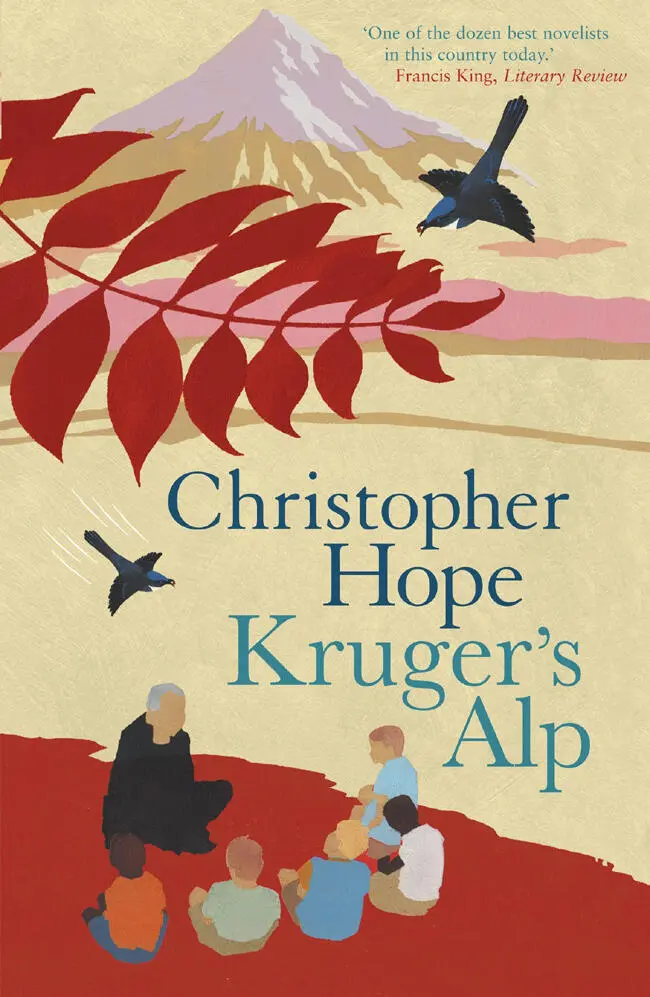
- Название:Kruger's Alp
- Автор:
- Издательство:Atlantic Books
- Жанр:
- Год:2009
- ISBN:нет данных
- Рейтинг книги:3 / 5. Голосов: 1
-
Избранное:Добавить в избранное
- Отзывы:
-
Ваша оценка:
Kruger's Alp: краткое содержание, описание и аннотация
Предлагаем к чтению аннотацию, описание, краткое содержание или предисловие (зависит от того, что написал сам автор книги «Kruger's Alp»). Если вы не нашли необходимую информацию о книге — напишите в комментариях, мы постараемся отыскать её.
Kruger's Alp — читать онлайн бесплатно полную книгу (весь текст) целиком
Ниже представлен текст книги, разбитый по страницам. Система сохранения места последней прочитанной страницы, позволяет с удобством читать онлайн бесплатно книгу «Kruger's Alp», без необходимости каждый раз заново искать на чём Вы остановились. Поставьте закладку, и сможете в любой момент перейти на страницу, на которой закончили чтение.
Интервал:
Закладка:
‘It makes a change,’ said Kipsel.
‘Ferreira believed in figures. He also believed in the integrity of the Regime. Mad it might be, but honest. Negative, but sincere. Narrow, but forthright. The Regime had set its face against blacks, Communists, Jews, Catholics, against compromise, liberalisation, democracy. This might be narrow, foolish even, but it was a question of principles. And he could admire people with principles, who would die for those principles. As for himself, well somebody had to do the sums, as he liked to say. He had kept the faith. Now he found the Regime dealing with the Russians through Popov and Himmelfarber —’
‘And Himmelfarber’s nephew, left in Moscow on deposit,’ Kipsel reminded him gloomily. ‘Blanchie, this gets blacker.’
‘And Himmelfarber was supposed to be an enemy. But gold as we know is more important than principles. The Regime had dealt with Moscow when they moved bullion dealings from London to Zurich. In Switzerland he’d heard rumours that some big man in the Regime had cleaned up on the move. Then he discovered money going to the Israelis! Now the orthodox teaching was that at least half of the Regime was of the unshakable opinion that Hitler got a bad press and was really a sensitive, patriotic house painter at heart who became Chancellor and was looking for nothing more than sweetness and light and that any stories to the contrary were products of commy, pinko Jews, who wished to destroy the white man’s way of life, his religious beliefs, and to sleep with his daughters — and yet here was the Government supporting whole teams of Israelis and concealing them in the countryside. Israelis who wore baseball caps the wrong way round and disturbed the peace of the countryside, cost a fortune to police and protect and then desecrated the Calvinist Sabbath by drinking and whoring in sleepy country towns. Most important of all, he’d been taught that the President was the father of his country and its stay and protection in times of trouble, that he would lead the nation in the flight to the beaches when, and if, by some horrible catastrophe, the savages prevailed and the last white tribe in Africa faced extinction. Then, with his back to the sea, the President would hand round the poison to the kids and begin shooting the women before the enemy troops arrived. That’s what he believed, and then blow me down, he goes out and finds that the old fox has been salting money away for years in a Swiss account against just such a contingency, against that rainy day which might carry him off to Bolivia or Paraguay.’
‘Then he goes back to his books and finds he isn’t looking at figures, he’s reading a horror novel,’ Kipsel broke in. ‘He finds not one financial nightmare but three or four. There are the funds creamed off the various Government departments and sent abroad secretly for Kuiker and Yssel’s Department of Communications to fight its propaganda war. There is the money Bubé has been collecting in his secret accounts against a rainy day.’
‘And there are the funds entering the country which presumably baffle the hell out of him until he interviews the brokers Kranz, Lundquist and Skellum. And his last and most cherished belief collapses. He finds out about the Manus Virginis with their strategic charity, how the Ring collaborates with them in tactical investments in the future of the Regime.’
Kipsel sighed. ‘Poor Tony. Finding that the Church was in it too will have hurt more than anything.’
‘Yes, but not for the reasons you think. What crucified Ferriera when he discovered the links between the Regime, the Ring and the Hand, with the Nuncio Agnelli acting as flyhalf, was that the Church really was powerful after all. Tony had never accepted Lynch’s theories about the structure of power. He rejected the Church as played-out, ineffectual, unimportant. And he was wrong. Everywhere he looked he found a policy of outright deception. There was the Church going around the country issuing statements about embracing its black brethren in Christ. There was Bishop Blashford publicly deploring the shipment of human populations to the transit camps and relegation of entire tribes to desolate “homelands”, and defying the Regime to arrest him. There were the charitable bodies shipping in dried milk and penicillin and designing new churches in the beehive style and attacking the Regime for being in league with the devil and preaching that the programme of separate freedom for ethnic groups was a crime against humanity, an economic nonsense and a sin against the Holy Spirit. While this was going on, here was the Regime whose followers took an oath of loyalty to Calvin before they slept and believed the Pope feasted on baby meat and sucked the marrow from the bones of orphans, meeting with certain Italian Societies, and here were its loyal followers in that most secret of societies, the Ring, those ultra-Calvinists, sitting round a table with a bunch of genuine opera-loving flesh and blood holy Romans, fresh from the Vatican, representing the Manus Virginis and discussing share portfolios. One by one, every belief he held had been destroyed. Lynch had been right. And if Lynch had been right about the deceptions, he was right about all the other things too — including the missing Kruger millions, right about the house on the hill. It was in this despairing state that he phoned me.’
Kipsel was very pale. ‘I didn’t know he phoned you.’
‘Just before he died. I was one of the last people to speak to him.’
‘What did he say?’
‘That I should get out. That he had found the City of God, or Gold. The line was bad. He was slightly hysterical, said he was planning a trip himself. He sent me money. Next thing I knew he was dead.’
‘And here you are?’
‘And here we are.’
Kipsel swore bitterly, then scrambled to his feet and picked up his stick and rucksack. ‘Let’s get on. I don’t want to know any more. Tony “the Pug” Sidelsky! The whole thing’s a horrid cheap little pantomime. Do you think it’s much further?’
‘I hope not, I hope not,’ said Blanchaille fervently. ‘I’ve had about as much as I can take. All my prayers are that God preserve me from any more of my itinerant, wandering, bemused, addle-brained countrymen, from policemen, rugby players, patriots, accountants, priests and presidents.’
‘Amen,’ said Kipsel.
CHAPTER 23
And so I saw in my dream how they hurried on their way, anxious to arrive somewhere, anywhere, elsewhere, the pear and the fish, strange partners.
Fearful imaginings crowded in on Blanchaille and left him weak and uncertain of his true direction, characteristic phobias, indigenous phantoms, familiar demons arose from the catalogues every South African recites before sleep and loves to recall with horror. Black men hunted with huge home-made knives beaten out of oil drums or made from railway steel ripped from the sleepers, flattened by a maniac, hammered, honed to a scalpel’s edge, metal machetes called pangas , slicing the air; he remembered white boys, so huge, so long and lanky they reminded him of giraffes, against whom he had played rugby, boys with strangely dark complexions and moustaches, surely men, and not that white! They raced down the rugby fields towards you with that stiff-legged giraffe gait, their hooves wrenching the turf. These monsters were surely never the babies which loyal white mothers had had for Bubé? No, these boy giants were born with full moustaches — wearing rugby boots. Their call-up papers were delivered to the maternity wing, they leapt from their cradles, kissed their new mothers goodbye and went off to defend their country’s borders against the Total Onslaught. Thus the dreams of misplaced, wandering white Africans, each with his own compendium of horrors, stories of tokoloshes , green and black mambas, murdered nuns. Each has his favourite, but most fearful for Blanchaille was the memory of a crop of graves he had watched growing in the camps. Growing and growing. If there was a symbol that scared him, it was not the gun nor the knife nor the snake — but the spade. In the camps he had learnt to dig. He had stood in the big trench grave and thrown red sand up onto the parapet, mounting higher and higher. He had felt he was digging in for a great war. What he now feared most as he slogged along an obscure Swiss track towards an improbable destination was not ambush or betrayal, but arrival. In the old story, the Regime was regarded by its opponents as utterly evil, by its supporters as divinely good. Everyone dwelt among absolutes and was happy. Now it seemed that the Regime was no better or worse than two dozen other shabby little dictatorships north of the border. He stole a glance at Kipsel, a tousle of curls falling over the shallow brow, the fish lips making their silent, pouting little o ’s. Had it occurred to him that if the hell he had left behind wasn’t as bad as they had believed or hoped — then might not the place to which they travelled be no better than anyone might imagine?
Читать дальшеИнтервал:
Закладка:
Похожие книги на «Kruger's Alp»
Представляем Вашему вниманию похожие книги на «Kruger's Alp» списком для выбора. Мы отобрали схожую по названию и смыслу литературу в надежде предоставить читателям больше вариантов отыскать новые, интересные, ещё непрочитанные произведения.









Обсуждение, отзывы о книге «Kruger's Alp» и просто собственные мнения читателей. Оставьте ваши комментарии, напишите, что Вы думаете о произведении, его смысле или главных героях. Укажите что конкретно понравилось, а что нет, и почему Вы так считаете.