S. Agnon - Shira
Здесь есть возможность читать онлайн «S. Agnon - Shira» весь текст электронной книги совершенно бесплатно (целиком полную версию без сокращений). В некоторых случаях можно слушать аудио, скачать через торрент в формате fb2 и присутствует краткое содержание. Год выпуска: 2014, Издательство: Toby Press, Жанр: Современная проза, на английском языке. Описание произведения, (предисловие) а так же отзывы посетителей доступны на портале библиотеки ЛибКат.
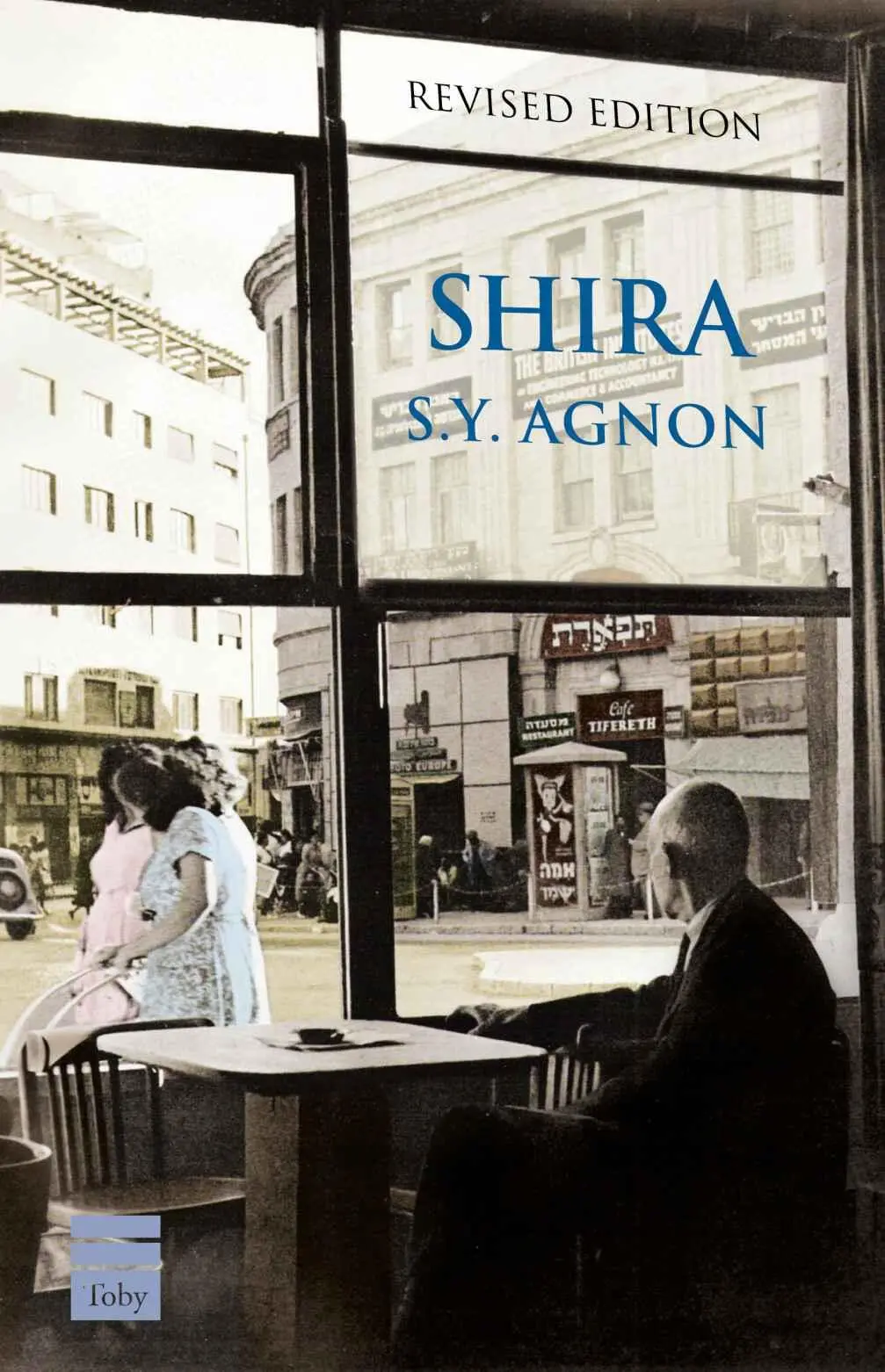
- Название:Shira
- Автор:
- Издательство:Toby Press
- Жанр:
- Год:2014
- ISBN:нет данных
- Рейтинг книги:5 / 5. Голосов: 1
-
Избранное:Добавить в избранное
- Отзывы:
-
Ваша оценка:
Shira: краткое содержание, описание и аннотация
Предлагаем к чтению аннотацию, описание, краткое содержание или предисловие (зависит от того, что написал сам автор книги «Shira»). Если вы не нашли необходимую информацию о книге — напишите в комментариях, мы постараемся отыскать её.
Shira — читать онлайн бесплатно полную книгу (весь текст) целиком
Ниже представлен текст книги, разбитый по страницам. Система сохранения места последней прочитанной страницы, позволяет с удобством читать онлайн бесплатно книгу «Shira», без необходимости каждый раз заново искать на чём Вы остановились. Поставьте закладку, и сможете в любой момент перейти на страницу, на которой закончили чтение.
Интервал:
Закладка:
Chapter six
Iwill omit the Herbsts’ visit with Bachlam, which went well. When they left Bachlam’s house, Herbst said to his wife, “I don’t expect him to praise me lavishly, but I hope he won’t be too critical.” Now let’s get back to Herbst’s other affairs.
M. Herbst’s article was accepted and published. In style and content, it worked out well. When Dr. Manfred Herbst arrived in the Land of Israel, he couldn’t say anything in proper Hebrew, and, were it not for two or three students who corrected him continually, those who came to hear his lectures would be beside themselves with laughter. Gradually he acquired the language, so that it enhanced his lectures and he was able to write in it. Those who see style as more than mere word combinations are moved to exclaim: “This German, who probably arrived with only the rudiments of biblical grammar, writes more elegant prose than many of those learned old-timers who are considered the creators of modern Hebrew style.” How can this be? Some said that a stylist in one language is a stylist in any language he touches. Others said that, having learned Hebrew as an adult, Herbst read only good books and didn’t fill his belly with vulgar prose that doesn’t stick to the ribs.
Until that article appeared, he had produced nothing in Hebrew, so he treated it like a book. He ordered offprints, had them bound, and distributed them to colleagues, including some Jewish scholars abroad. As long as he was busy inscribing these offprints and mailing them out, time was passing but he didn’t notice. When he was finished, he didn’t know what to do.
He did, actually, know what to do. But, because he was discouraged, that was how it seemed. It goes without saying that he has notes to sort out and, even more important, to classify. If he was going to put his book in order, it would be good to have the notes arranged by subject. Right now, a great deal of effort is being wasted. He often copies material that has already been copied once, because the notes are in a mess and it is hard to confirm whether or not a particular item has been copied. Similarly, he often finds something that is worth copying and doesn’t copy it, assuming it has already been copied; later, when he goes through his papers, he discovers this is not so, and, if he still wants to copy it, he has a hard time tracing either the source or the subject.
He would occasionally go back to his box of notes, taking out a note, putting another in, comparing texts, adding marginal notes, et cetera — including them, not because of their content, but because of pedants and polemicists who, should he omit a reference, would argue that, had the author seen what So-and-so wrote in such-and-such a book, he would not have arrived at such a misguided conclusion. Hence those footnotes and citations that add nothing but are inserted to silence critics, a gratuitous display of erudition.
While dealing with these papers, Herbst sometimes formulated fragmentary ideas he didn’t hesitate to write down, in some cases briefly, in others at length. He was sometimes caught up in his writing, as in the days when he wrote his first book, when ideas flowed, along with the ability to express them and the documentation to support his views. When this occurred, he mourned the early days, which were gone, never to return again. Herbst forgot that then, too, there were arid times. Now it seemed that those days had been altogether good.
Herbst was distressed about the work that remained undone; about Shira, who avoided him; about himself — about the fact that he needed to get rid of Shira in order to be free to work. It can’t be, Herbst would say. It can’t be that I’ll spend my days and years thinking about women. Many times Herbst cried inwardly: What does she want from me? Actually, it was not that she wanted anything of him; it was he who wanted her. What do I want from you? I want to see you, that’s all. Better still, not to see you. If you were to go away, or if I were to go somewhere, I would be rid of you. I would be free. Isn’t it enough that I’ve wasted two years because of you? And that verse “Flesh such as yours / Will not soon be forgotten” played itself in his mind.
The Herbst household was in good order. Herbst had his concerns; his wife had hers. Herbst concerned himself with his books, his lectures, his students, and his major work on burial customs of the poor in Byzantium, while Henrietta concerned herself with the needs of the household — cooking, baking, sewing, ironing, shopping, health care, family matters locally and abroad. In addition, she tended the garden and tended her little girl, Sarah, who was no longer a baby in a crib but was not yet ready for nursery school, which is just as well, for there is no nursery school in Baka. The closest one is in Talpiot, and how could anyone find time to take her there and pick her up? Herbst’s salary is barely adequate to pay for household help. The Herbsts really ought to have moved to a Jewish neighborhood. In fact, they should have done so right after the riots of 1929 and all the more so now, when Arab bands are wreaking havoc, and Arabs are like wolves to Jews. But, being so fond of their home and garden, the Herbsts are reluctant to move. Anyone who has toiled over a house and garden will not abandon them easily. And you know what an investment Henrietta has made in her house and garden. She rented a heap of rubble and transformed it into a fine home. Henrietta ignores danger and lives as she did when she first came to Jerusalem, when the high commissioner, who was Jewish, used to go to the Hurva Synagogue on a special Shabbat, read from the Torah, and sit between the two chief rabbis on a throne adorned with the verse “Suffer not a stranger to sit upon His throne.” After the service, he would attend a reception in his honor, where the country’s leaders sang his praises over a full glass of wine. And the German consul, who sent his children to a Jewish nursery, used to ask Dr. Ruppin to intercede on his behalf when he needed a favor from the high commissioner. The German consul’s brother-in-law, who was a frequent guest in Jewish homes, used to praise all the Carmel wines. At night, after Shabbat, Hasidim would dance down from Mea Shearim to the Old City and from the Old City back to Mea Shearim, and young men and women would stroll all night, wherever they wished. If an Arab met a Jew, he would say hello. If they were acquainted, he would say more — and in Hebrew, so that those who presumed to foresee the future predicted that in another generation the Arabs would become assimilated. How? It remained for the future to fulfill their heart’s desire.
And so the Herbst household is in good order. Nothing has changed except for the help. Sarini is gone, and Firadeus has taken her place. Firadeus is alert and agile, dark and attractive. Her eyes are like two sweet raisins, and she never says a sharp word. She is the embodiment of humility, enhanced by modesty and reticence.
Henrietta is pleased with Firadeus’s work, Manfred is pleased with her manner, and Sarah prefers her to all her dolls. Firadeus is only sixteen, and she supports six people: herself, her mother, her mother’s mother, her father’s blind father, and Manawa, the madwoman they found on the road from Persia to Jerusalem, as well as her little brother, Ziyon. He was born the day her father was killed by an Arab rogue when he was on his way to dump Talpiot’s garbage. Ziyon the father, who was Talpiot’s garbage man, is still remembered fondly by the local housewives; if he found something that had fallen into the garbage by mistake, he would return it. He was mentioned by the chairman at the first meeting of the Talpiot Committee, and all the members stood in silence to honor his memory. How can six souls subsist on Firadeus’s meager wages? While most of her friends sit around telling fortunes, fussing with their hair or their jewelry, Firadeus sits with her mother, wrapping pamphlets given to her by a gentleman with a stiff collar who lives near her employer and pays her half a grush for each piece. If he gives her a hundred pamphlets and she doesn’t return them all, he’s not particular. He pays for the whole lot, realizing that neighbors come by, see writing in the holy tongue, take it to read, and don’t return it, and she, being so young, doesn’t dare to speak up to her elders and say, “Don’t take it.” As was already stated, Firadeus is quick, conscientious, and altogether dependable. If she is told to do something a certain way, that is how she does it. Sometimes even before there is time to say anything, it’s done. Firadeus has another fine quality: she sees everything. I’ll give only one example. The Herbsts were in the habit of having their servants eat with them. The first time Firadeus ate with them, Tamara kept tapping her nose to call her parents’ attention to the girl’s repulsive table manners. In a very few days, Firadeus learned to handle a knife and fork more skillfully, perhaps, than Tamara. Herbst and his wife are not ethnographers; they’re not engaged in studying the different communities. But, when they first arrived in the country, they used to go to the Bukharan streets on Shabbat and holidays to watch the people in their colorful garments. Similarly, they used to take tourists to see the Yemenites in their synagogues. Having had their fill, they no longer concern themselves with all the tribes of Israel to be found in Jerusalem and are no longer able to distinguish the ethnic groups from one another. I would not be mistaken were I to say that Herbst is more attuned to the various Germanic peoples in Jerusalem than to the tribes of Israel. Still, when he hears these peoples being maligned, he responds, “You can say what you like about them, all but the Persians.” There is one problem with Firadeus: sometimes she shows up and sometimes she doesn’t, because her employers live among Arabs, in a neighborhood ruled by hoodlums, where every stone is waiting to be flung at a Jewish head. When Firadeus comes, she takes on all the housework, and her mistress sits writing letters to relatives in Germany. If she doesn’t come, all the work falls on Henrietta, since Tamara is inept when it comes to housework.
Читать дальшеИнтервал:
Закладка:
Похожие книги на «Shira»
Представляем Вашему вниманию похожие книги на «Shira» списком для выбора. Мы отобрали схожую по названию и смыслу литературу в надежде предоставить читателям больше вариантов отыскать новые, интересные, ещё непрочитанные произведения.










Обсуждение, отзывы о книге «Shira» и просто собственные мнения читателей. Оставьте ваши комментарии, напишите, что Вы думаете о произведении, его смысле или главных героях. Укажите что конкретно понравилось, а что нет, и почему Вы так считаете.