S. Agnon - Shira
Здесь есть возможность читать онлайн «S. Agnon - Shira» весь текст электронной книги совершенно бесплатно (целиком полную версию без сокращений). В некоторых случаях можно слушать аудио, скачать через торрент в формате fb2 и присутствует краткое содержание. Год выпуска: 2014, Издательство: Toby Press, Жанр: Современная проза, на английском языке. Описание произведения, (предисловие) а так же отзывы посетителей доступны на портале библиотеки ЛибКат.
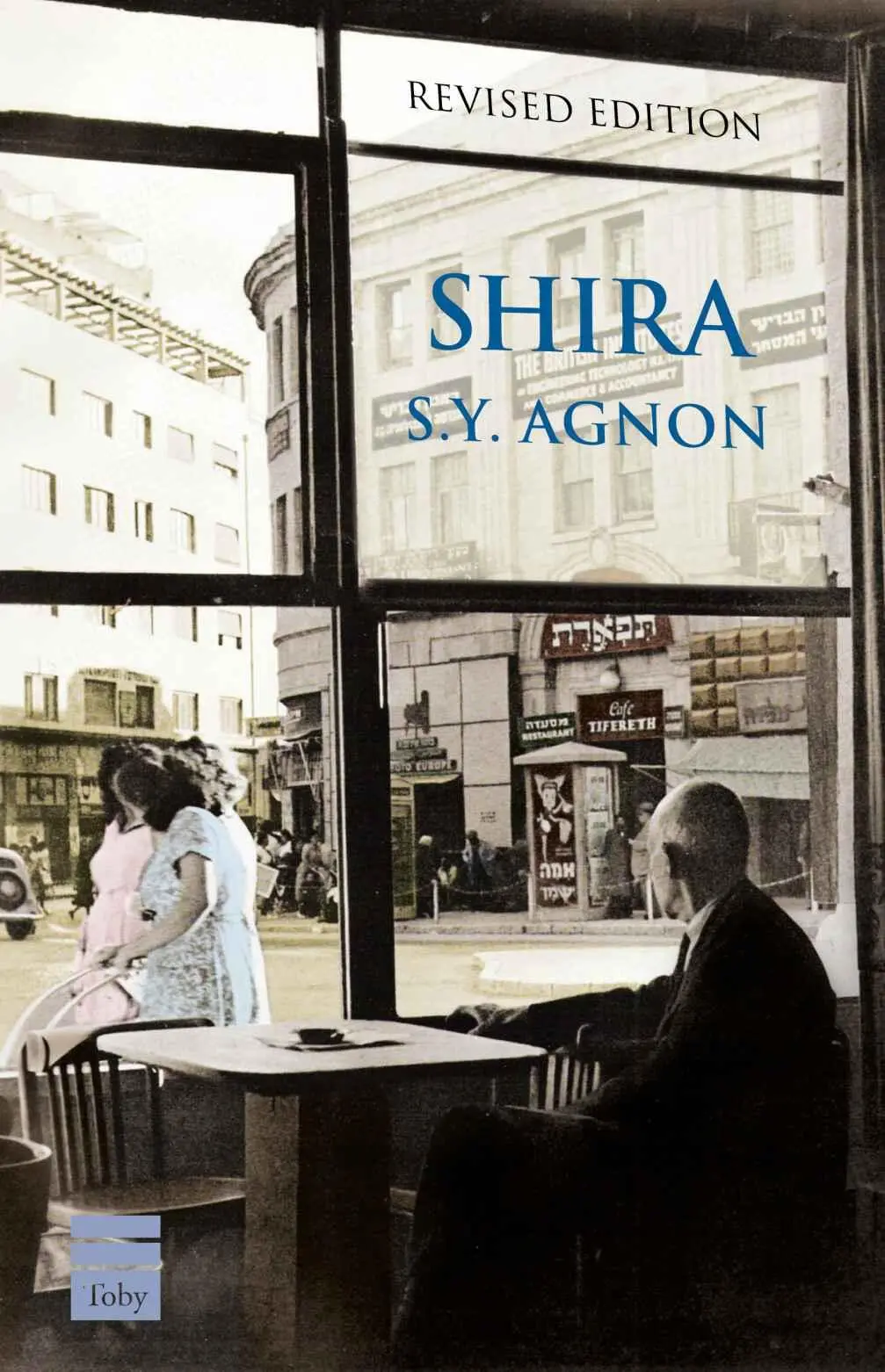
- Название:Shira
- Автор:
- Издательство:Toby Press
- Жанр:
- Год:2014
- ISBN:нет данных
- Рейтинг книги:5 / 5. Голосов: 1
-
Избранное:Добавить в избранное
- Отзывы:
-
Ваша оценка:
Shira: краткое содержание, описание и аннотация
Предлагаем к чтению аннотацию, описание, краткое содержание или предисловие (зависит от того, что написал сам автор книги «Shira»). Если вы не нашли необходимую информацию о книге — напишите в комментариях, мы постараемся отыскать её.
Shira — читать онлайн бесплатно полную книгу (весь текст) целиком
Ниже представлен текст книги, разбитый по страницам. Система сохранения места последней прочитанной страницы, позволяет с удобством читать онлайн бесплатно книгу «Shira», без необходимости каждый раз заново искать на чём Вы остановились. Поставьте закладку, и сможете в любой момент перейти на страницу, на которой закончили чтение.
Интервал:
Закладка:
Meanwhile, he investigated a pile of documents and discovered things no one else had noticed that were relevant to the story of Antonia, the woman of the court, and the nobleman Yohanan. He was thrilled with these discoveries and tested his imagination to see what it would add. But imagination doesn’t always respond, not to everyone and not on demand. Never before had the material refused to comply. Whenever he put his mind to it, a research paper would take shape, seeming to order itself, the pieces falling into place so that there was a beginning, a middle, and an end — all in language suited to the subject, without academic jargon, to which even renowned scholars are not immune.
Herbst went to the window and stared at the trees. They were blooming, as usual, as if of themselves. Actually, one should not forget that Henrietta had a hand in this, and, in fact, so did he; they both tended the trees, hoed, and watered regularly. Neither he nor Henrietta had worked the land in their youth, but the soil was there, so they made a garden. Though no parable is intended, this reflected Herbst’s feelings toward the play. But another feeling, about old age, insinuated itself. Was it old age that drained his energies and disheartened him? So this was why he hadn’t hurried back to Shira after that first night, and, because he hadn’t hurried back, Shira withholds herself from him now.
Turning away from the window and from the trees, he began pacing back and forth. Finally, he stood still, leaned over to press a cigarette into the ashtray, and either took another one or put the one he had just discarded back in his mouth. Then he took out the atlas in order to research the locale of his play. Atlas in hand, he cried out in amazement, “Tamara is in Greece. What does she know about Greece? I doubt she knows as much as the lowest-level student in a German high school. What do they teach here anyway? Who was it who described Apollo arrayed in tefillin? As an ideal, it’s defective; as a joke, it’s equally defective.”
Now, Herbst thought, I’ll try one of the cigarettes Julian Weltfremdt recommended. He leaned over and pressed the remnants of a cigarette into the ashtray, took out a long brown one, and smoked it slowly to assess its flavor. Now, Herbst said to himself, now I’ll look at the map and trace Tamara’s route. He got up, opened the door, and called out, “Henriett, Henriett, do you want to see where your daughter is?”
Henrietta came, parting the clouds of smoke with her hand, went to open the window, and found it open. She laughed in annoyance and said, “Unless your cigarettes induce amnesia, I don’t know why I forget the windows are all open.” Herbst laughed and said, “They don’t induce amnesia, but they do have a trace of mandrake.” Henrietta said, “You were going to show me where Tamara is now. Is there another card from her? I didn’t see the mailman today.” Manfred said, “The mailman wasn’t here, and there are no new cards. We can nonetheless look at the map and see her route.” Henrietta said, “What a good idea.” Manfred said, “But I doubt she is enjoying the trip.” Henrietta said, “Why not?” Manfred said, “Because she wasn’t prepared. She knows less than nothing about Greece. She hasn’t read Homer and doesn’t know Plato. She knows nothing at all about that civilization. Tell me, Henriett, how did Tamara qualify for a teaching certificate?” Henrietta said, “She’s as qualified as her friends.” Manfred said, “I’m not asking only about her; I’m asking about her friends too, and even her teachers. How are they qualified to be teachers?” Henrietta said, “You don’t mean to say they became teachers by pulling strings?” Manfred said, “I wouldn’t say that, but I judge teachers by their pupils.” “What do you learn?” Manfred laughed and said, “I learn, my dear, that they have all learned nothing.” “Nothing?” Manfred said, “Anyway, they didn’t learn what they should have learned. How many poems did you know by heart when you were Tamara’s age? If we were to be exiled somewhere, with no books, I would be content with the poems you remember from your youth. But our Tamara — except for the insipid jingles she sings — probably doesn’t know one entire poem.” Henrietta said, “It’s not her fault.” “If it’s not her fault, whose is it?” Henrietta said, “It may be Hebrew poetry that’s at fault for not lending itself to song.” Manfred said, “You have an excuse for everything, only the excuse is more radical than the problem. Now let’s spread the map and see what places Tamara has graced with the light of her eyes. First let me get a cigarette.” Henrietta said, “And I was going to ask you not to smoke for a while.” Manfred said, “You’re asking the impossible, but is there anything in the world I’m unwilling to give up for you? You’re asking me not to smoke for a while. That’s fine. But first let me have two or three puffs. This is a new brand. Weltfremdt recommended it.” Henrietta said, “Does Weltfremdt smoke?” Manfred said, “If you mean that secret adviser, Professor Ernst Weltfremdt, he doesn’t smoke. No, he doesn’t. But if you mean Dr. Julian Weltfremdt, I can tell you beyond doubt, beyond any doubt, that the gentleman certainly smokes. Yes, indeed, that gentleman certainly does smoke.” Henrietta laughed and said, “If I hadn’t seen your lips moving, I would be sure Professor Weltfremdt himself was talking.” Manfred said, “See, my dear, what close friendship achieves. Sometimes the mere mention of a fine gentleman such as Professor Weltfremdt causes us — indeed, it causes us — to adopt his rhetoric, his very own rhetoric.” Henrietta said, “You admit that you meant to imitate his speech.” Manfred said, “Intentionally or not, either way I succeeded. Isn’t that so, Henriett?” Henrietta said, “Besserman couldn’t do any better. Now let’s sit down and trace Tamara’s route.” After outlining Tamara’s entire route with his finger, Manfred said, “Now I’ll give you the Baedeker, and you can read about all those places.”
Herbst had a collection of Baedekers he was proud of. His pride may have been due to the careless comment of a Scandinavian, one of Strindberg’s last surviving friends, who remarked about Herbst’s collection that not even Strindberg had a better one. He searched but didn’t find the volume, and he remembered it had been borrowed by Sacharson. It was more than a year since Sacharson had borrowed it, and he hadn’t bothered to bring it back. “What a pig,” Herbst said, “to borrow a book and not return it. When I’m done with him, he’ll forget his conversion certificate. But first I have to scold myself. Fool that I am, I should have learned from experience. I once lent someone the Baedeker of Palestine, and it was returned to me without the map of Jerusalem.” Henrietta said, “It’s possible he took the map out for convenience and forgot to put it back.” Manfred said, “If you want to give people the benefit of the doubt, fine. But not when it comes to borrowing books. I’ll have to get Sacharson to return my Baedeker. Now, Henriett, am I released from the ban?” “What ban?” “The ban on smoking.” Henrietta said, “If you must smoke, then smoke. But not the black ones, please.” Manfred laughed and said, “Why is that? Because they have a pinch of mandrake, or because they have no mandrake?” Henrietta said, “What’s so funny about mandrake?” Manfred said, “Have you forgotten the erotic properties of mandrake?” Henrietta said, “To think that the father of a married daughter and of another whose hand is being sought in marriage is making such jokes! But who can blame you — you are young, truly young. If we were Yemenites, I myself would find you another wife.” Manfred said, “You? You would find me another wife?” Henrietta said, “Why not?” Manfred said, “I don’t think a European woman could do that.” “Do what?” “Yield her position to another woman.” Henrietta said, “You’ve forgotten the wife of the teacher from Beit Hakerem.” Manfred said, “To whom are you referring?” Henrietta said, “I think what I said was clear.” Manfred said, “One thing is clear, there is a neighborhood in Jerusalem known as Beit Hakerem. Many teachers live in Beit Hakerem, some of whom are clearly married, and it is also clear that, though what you said is crystal clear, the heart of the matter isn’t clear at all.” Henrietta said, “I know you remember the story, but you want to hear it from me.” Manfred’s eyes twinkled with repressed laughter as he said, “If so, all the more reason why you are required to tell it.” “Required? I don’t like requirements.” Manfred caught her by the chin and said, “Nu, nu, tell me.” Henrietta said, “Don’t you remember? We were walking in Beit Hakerem, and you were thirsty. We went into a house for water and found a young woman with a baby in her arms.” Manfred said, “A sign within a sign. A young woman with a baby in her arms.” Henrietta said, “It seems to me that you know a woman who isn’t so young with a baby in her arms. If you want me to speak, don’t interrupt.” Manfred said, “And then?” Henrietta said, “Why should I repeat things you know as well as I do?” Manfred said, “What do you care? So then the woman said, ‘I can’t go with my husband because the children are small.’“ Henrietta said, “You remember every word, yet you let me wear out my tongue. Do you want to bore us both?” Manfred said, “If I ask you, what’s it to you if you do as I ask? Do you have some special reason not to tell?” Henrietta said, “What reason could there be?” Manfred said, “Then tell me.” Henrietta said, “So the woman continued, ‘On a teacher’s salary, I can’t afford to hire help. What’s the solution? My husband could have two wives. When he is out with one, the other one could look after the child, and then they would switch.’“ Manfred said, “De jure but not de facto.” Henrietta said, “What do you mean, ‘de jure but not de facto’?” Manfred said, “Those are common terms, meaning ‘easier said than done.’ What woman could see her husband in someone else’s arms and be silent? In any case, I wouldn’t subject my wife to such a test.” Henrietta said, “Do you ever have such thoughts?” Manfred said, “Me? What are you saying? Me, God forbid.” Henrietta said, “You stuck another cigarette in your mouth. You still have one, and you’re reaching for more. Another woman, in my place, would see that as symbolic.” Manfred pressed his palms against each other, folded them over his heart, closed his eyes, and crooned a song:
Читать дальшеИнтервал:
Закладка:
Похожие книги на «Shira»
Представляем Вашему вниманию похожие книги на «Shira» списком для выбора. Мы отобрали схожую по названию и смыслу литературу в надежде предоставить читателям больше вариантов отыскать новые, интересные, ещё непрочитанные произведения.





Обсуждение, отзывы о книге «Shira» и просто собственные мнения читателей. Оставьте ваши комментарии, напишите, что Вы думаете о произведении, его смысле или главных героях. Укажите что конкретно понравилось, а что нет, и почему Вы так считаете.