S. Agnon - Shira
Здесь есть возможность читать онлайн «S. Agnon - Shira» весь текст электронной книги совершенно бесплатно (целиком полную версию без сокращений). В некоторых случаях можно слушать аудио, скачать через торрент в формате fb2 и присутствует краткое содержание. Год выпуска: 2014, Издательство: Toby Press, Жанр: Современная проза, на английском языке. Описание произведения, (предисловие) а так же отзывы посетителей доступны на портале библиотеки ЛибКат.
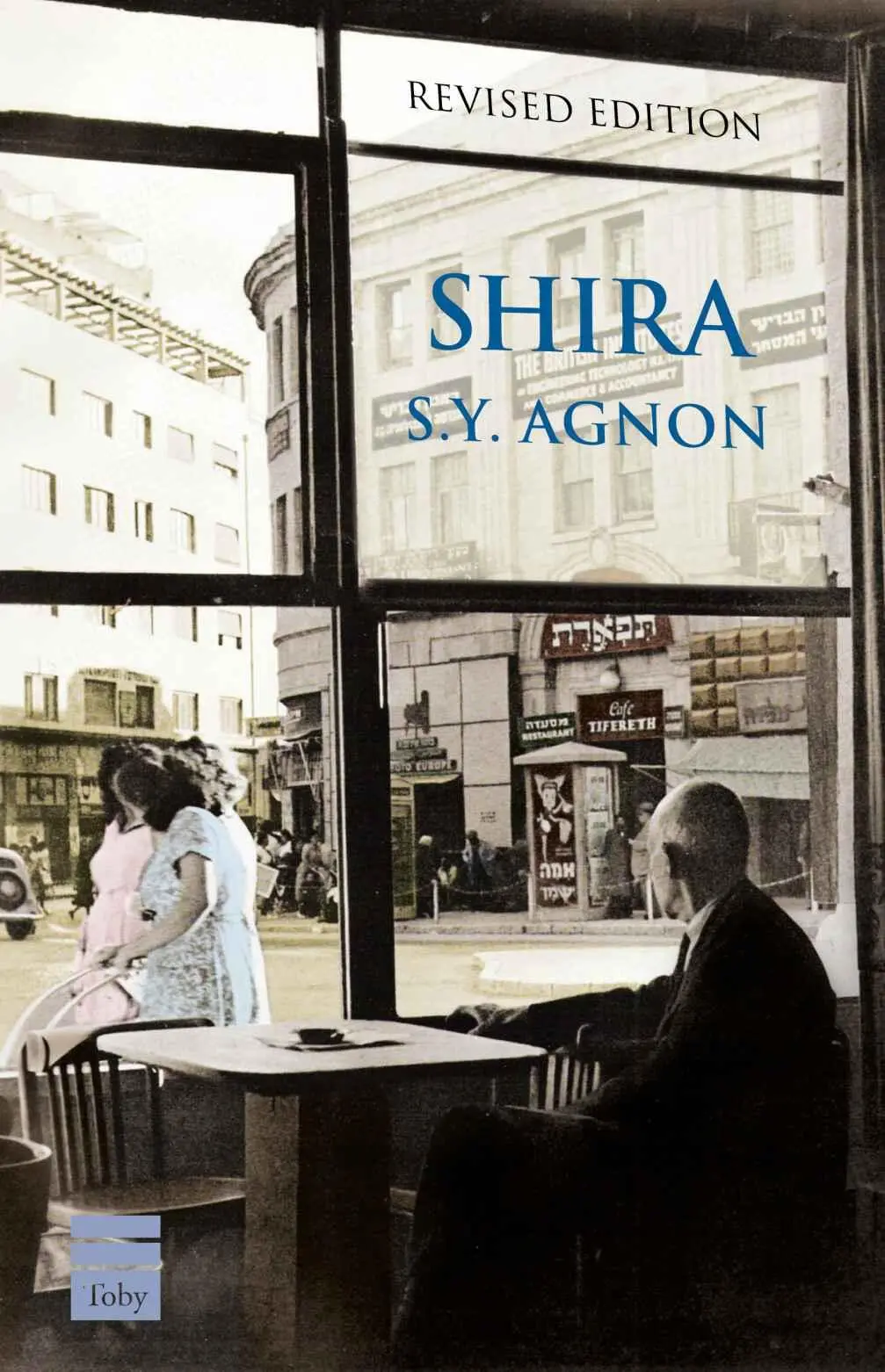
- Название:Shira
- Автор:
- Издательство:Toby Press
- Жанр:
- Год:2014
- ISBN:нет данных
- Рейтинг книги:5 / 5. Голосов: 1
-
Избранное:Добавить в избранное
- Отзывы:
-
Ваша оценка:
Shira: краткое содержание, описание и аннотация
Предлагаем к чтению аннотацию, описание, краткое содержание или предисловие (зависит от того, что написал сам автор книги «Shira»). Если вы не нашли необходимую информацию о книге — напишите в комментариях, мы постараемся отыскать её.
Shira — читать онлайн бесплатно полную книгу (весь текст) целиком
Ниже представлен текст книги, разбитый по страницам. Система сохранения места последней прочитанной страницы, позволяет с удобством читать онлайн бесплатно книгу «Shira», без необходимости каждый раз заново искать на чём Вы остановились. Поставьте закладку, и сможете в любой момент перейти на страницу, на которой закончили чтение.
Интервал:
Закладка:
I am tender, my heart pure,
No trace of sin in it;
Only you forevermore,
My sweet Henriett;
Only you forevermore,
My sweet Henriett.
Chapter seven
The play didn’t develop. Not for lack of imagination alone did it fail to develop, nor because the material was insufficiently dramatic, but something seemingly trivial interfered with the creation of the tragedy. The insipid jingles with which Tamara filled her postcards had an adverse effect on Herbst. On the one hand, he considered them meager and empty; on the other, they led him to look at verses written by poets who weren’t real poets but, inasmuch as they had a command of the language and could rhyme, were regarded as poets. Because he gave these works too much attention, it occurred to him that he could set the story of Antonia and Yohanan in romance or ballad form. Dr. Herbst was mistaken to think that, having written a scholarly paper in Hebrew, he would be able to turn out romances and ballads. What happened in the end was that seven times he dipped his pen in ink without producing a single verse. After several attempts, he gave up on Hebrew and turned his pen to the left, intending to write his romances and ballads in German. An odd thing happened. This scholar — born and educated in Germany, author of a six-hundred-page tome and many essays in German, who spoke German to his wife and most of his friends, who thought in German — when he was about to pour his lyrical musings into German verse, found neither the words nor the form. Herbst was caught between two tongues. When he tried writing in Hebrew, it seemed German would be more responsive; when he tried German, it seemed Hebrew would be more responsive. In fact, neither language responded. The Hebrew wouldn’t come; the German fled. Herbst went to the shelf where things he no longer used were stored, took out his old pipe and cleaned it well, dissected several cigarettes, filled the pipe with tobacco, and sat on his chair smoking away, smoking and thinking: I’ll go back to the beginning and write the tragedy in simple prose, neither rhymed nor metered. He was confident, since the plot, the time, and the place were clear to him, that nothing would prevent him from writing the tragedy. He took out a new notebook and wrote the names of the characters. Then he drew a map of the house and the courtyard, including something he hadn’t thought of originally, which added interest: a drawing of the leper colony in which Antonia’s slave lived out his final years. His drawing of the place was so successful that he feared his dreams would be haunted by what he had pictured when awake. Oddly enough, although he thought a great deal about the leper colony and the faithful slave who spent his final days there, at night Herbst saw neither the slave nor the leper colony.
Now I’ll revert to an orderly account, describing how one thing flowed from another and how everything interlocked, going back to the night after Herbst first wrote the names of the characters associated with the exploits of Antonia, woman of the court, and the nobleman Yohanan. If I omit something that happened to Herbst, I omit it because it’s unimportant, though when it happened it seemed essential. When a man has a toothache, the entire world seems worthless. He goes to a doctor, who fixes the tooth; then he forgets all about it, and everything is normal again.
He had another sleepless night. He saw a thousand things, but not a single drop of sleep. Some of these things appeared because he summoned them, because he said, “Come, come,” whereas others appeared on their own. Their pace was at first steady and regular, then intense and chaotic. The story of Antonia, woman of the court, and the nobleman Yohanan was so intense that his eyes began to hurt, and he had to close them because of the pain. It was, on the face of it, good that he closed his eyes, but this didn’t last, because he had to move to more modest quarters where he could work without being interrupted, having taken it upon himself to write the tragedy of Antonia and Yohanan at the same time that he was assigned by the university to lead a group of young scholars who were touring Greece because Tamara was eager to study the mechanics of poetic meter. It was good that Herbst went with Tamara to Greece. Otherwise, she would have seen him walking with Shira, which was not advisable, because Henrietta was in collusion with the wife of a teacher from Beit Hakerem. They agreed to prohibit their husbands from bringing other women to their studios, declaring, “If they want to draw — let them draw skulls.”
Unrelated to the skull or to poetic meter, the map of Jerusalem appeared, the one that was torn from the Baedeker. Unrelated to the map of Jerusalem, the brown cigarettes, distinguished by neither taste nor aroma, appeared. The fact that their long stems filled the ashtray was their sole distinction. Unrelated to the brown cigarettes, Avraham-and-a-half appeared. Not in person, but in the form of something sweet and good that stretches without limits and endlessly. In the midst of all this, he heard a voice calling, “Adam, Adam.” He pondered a while and concluded: This probably doesn’t refer to Adam Ahlenschlager, whose books I have never even touched. Then to whom does it refer? To Adam Miesckewicz, perhaps, whose poetry was translated into German by two converts, neither of whom was named Sacharson. In the end, everything was covered by a small leather strip, stretching to cover Wechsler and his colleagues, extending over Jerusalem and its inhabitants, and covering Herbst’s eyes, which pained him so much that he closed them, asking the strip of leather, “What is this?” He answered, “It’s that same leather strip, the ptygyl fragment.”
Chapter eight
Having touched on questions of poetry and language, I won’t refrain from relating and clarifying what Dr. Herbst knew about Hebrew literature, what he saw in it, and how he happened to study the language and learn it well enough to write an essay and try his hand at writing a play in Hebrew. Even without the metered verse he had in mind originally, a prose play would be amazing.
As you already know, Manfred Herbst was born and educated in Germany, in German schools, in German scholarship and poetics, like his contemporaries, Jews and non-Jews. I will add some information about Manfred Herbst’s progenitors.
Moritz Herbst, Manfred’s father, was from a small town in Poznan. Like many other Jews who couldn’t make a living there, he went off to Berlin to seek his fortune. He brought no capital to do business with, only the sort of sterling talents that can be converted into silver by their owner: good sense, goodwill, enterprise, and diligence. As a favor to an old man from his town, who, in his youth, had studied Mishnah with Moritz’s father, Moritz was given a job in an office-supply store. This store, one of the first to limit its trade to office supplies, specialized in all sorts of business equipment. Furthermore, anyone who was about to open an office turned to Rosenthal and Co. for advice. When Moritz Herbst began working there, he had only the word of his father’s childhood friend to recommend him. Before long, his actions spoke for him, his talents displayed themselves, and their outcome became more and more apparent. His employer took note and began to linger over the young man from Poznan, to observe how he arranged merchandise, how he dealt with customers, and the like. The employer sometimes expressed himself with an approving nod; he sometimes allowed him to accompany him home, so he could hear his opinion about various customers — who should be allowed to buy on credit and who should be turned down. At first, the employer suspected that he had hired the boy from Poznan only as a favor to that old man and that he would not last long; he soon began to recognize his worth and to befriend him. After a while, he invited him home for afternoon coffee on the weekend. After a further while, he invited him for lunch. From then on, he often invited him to eat in his home. Little by little, Moritz Herbst relinquished the manners he had brought from his village, especially those he realized were inappropriate in Berlin, and made an effort to please the wife of his employer, as well as his handsome and charming daughter, whose manners impressed the young man from Poznan as ultimate perfection. Though this young man seemed somewhat ridiculous to her, she found that there was something different about him. Not knowing how to describe this quality, she called it loyalty. Unless we project this word into the future, it remains abstract, for so far she had had no opportunity to test his loyalty. By and by, the young man from Poznan became a regular guest in this Berlin household, almost a member of the family, welcomed by all. The lady of the house sometimes made him mediate between her and her husband, and her daughter made him mediate between herself and her parents. The employer, seeing that this young man was dependable, turned over some of his own responsibilities to him and, in every case, was pleased with how they were carried out. Three years passed in this fashion. In this period he received three raises, as well as several bonuses. Moritz Herbst advanced from the lowest position to chief clerk, and, when a buyer left to establish his own business, Herbst was promoted and became the buyer. In all those years, Moritz Herbst gave his employer no cause for complaint or envy, although he introduced many innovations and expanded the business more and more. He never made a move without consulting his employer first, phrasing everything as a request, as if he were saying, “I have a favor to ask, sir,” which allowed the employer to believe that everything emanated from him. From the time Moritz Herbst began working in this office-supply store, it never occurred to the owner that he might leave to work elsewhere, nor did Herbst consider leaving. So they grew accustomed to one another, as if they belonged to each other.
Читать дальшеИнтервал:
Закладка:
Похожие книги на «Shira»
Представляем Вашему вниманию похожие книги на «Shira» списком для выбора. Мы отобрали схожую по названию и смыслу литературу в надежде предоставить читателям больше вариантов отыскать новые, интересные, ещё непрочитанные произведения.









Обсуждение, отзывы о книге «Shira» и просто собственные мнения читателей. Оставьте ваши комментарии, напишите, что Вы думаете о произведении, его смысле или главных героях. Укажите что конкретно понравилось, а что нет, и почему Вы так считаете.