S. Agnon - Shira
Здесь есть возможность читать онлайн «S. Agnon - Shira» весь текст электронной книги совершенно бесплатно (целиком полную версию без сокращений). В некоторых случаях можно слушать аудио, скачать через торрент в формате fb2 и присутствует краткое содержание. Год выпуска: 2014, Издательство: Toby Press, Жанр: Современная проза, на английском языке. Описание произведения, (предисловие) а так же отзывы посетителей доступны на портале библиотеки ЛибКат.
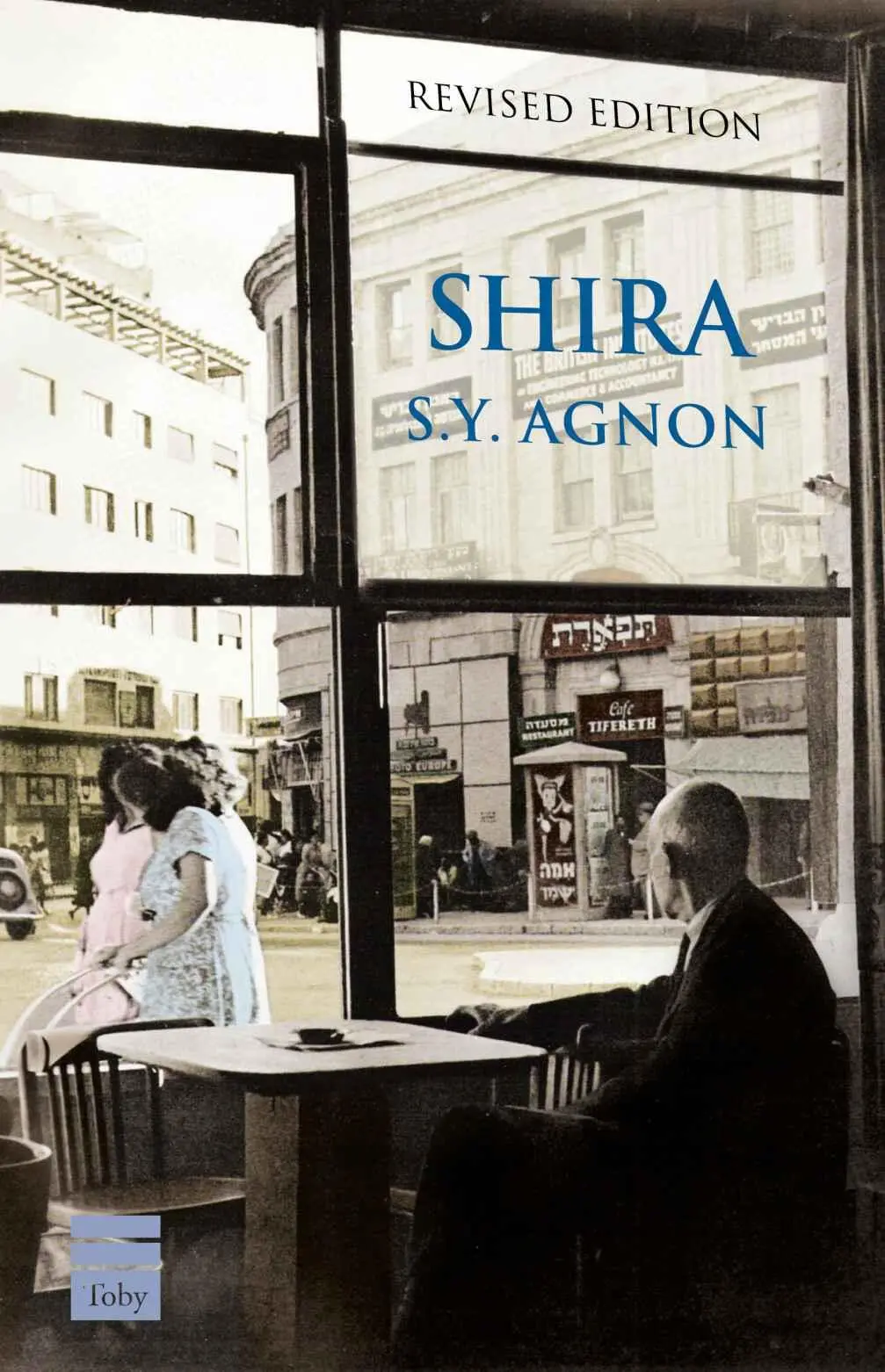
- Название:Shira
- Автор:
- Издательство:Toby Press
- Жанр:
- Год:2014
- ISBN:нет данных
- Рейтинг книги:5 / 5. Голосов: 1
-
Избранное:Добавить в избранное
- Отзывы:
-
Ваша оценка:
Shira: краткое содержание, описание и аннотация
Предлагаем к чтению аннотацию, описание, краткое содержание или предисловие (зависит от того, что написал сам автор книги «Shira»). Если вы не нашли необходимую информацию о книге — напишите в комментариях, мы постараемся отыскать её.
Shira — читать онлайн бесплатно полную книгу (весь текст) целиком
Ниже представлен текст книги, разбитый по страницам. Система сохранения места последней прочитанной страницы, позволяет с удобством читать онлайн бесплатно книгу «Shira», без необходимости каждый раз заново искать на чём Вы остановились. Поставьте закладку, и сможете в любой момент перейти на страницу, на которой закончили чтение.
Интервал:
Закладка:
Herbst lay in bed picturing Theodora in action. This woman, whose early years were spent in a circus, was empress for twenty-one years, assigning tasks to her lieutenants as a director assigns roles to actors. She seated and deposed popes, patriarchs, viziers, and generals; arranged divorces and marriages; had total command of her subjects. She committed scores of murders. Her victims were almost all male. One would suppose that, having been degraded by men in her youth, she was determined to avenge herself when she achieved high position. The most violent ruler of her time, she intended to exercise her power over these men, as they had done when she was the inferior. In any case, late in life she behaved charitably, freeing young girls from the circus masters who owned them and maintaining homes for them.
After reviewing her behavior, he compared it with the behavior of her husband, Emperor Justinian. Justinian enacted laws of chastity, which she overruled. He forbade women to bathe with strange men, to go to circuses at night without an escort, or to spend the night away from home. Theodora, on the other hand, supported adulterous women, and her rulings favored them over their faithful husbands. As someone has rightly said, women should be grateful to Theodora. She secured many rights for them and should be regarded as an early champion of emancipation. If women were historians, they would recognize her as the first patron of women’s rights.
His thoughts about Theodora put other thoughts out of his mind. On the face of it, the author conveyed the essence of the subject, even analyzed it adequately. But, because of that undefined deficiency, Herbst decided to review the book at length, to the extent that space would allow. He didn’t know yet what he would write, but he considered it his duty as a scholar to write about this book. Not because of its significance, but because of similar books that take a historic period, a scholar, a poet, an emperor, or a pope as their subject. One who is not an expert finds in them a mix of history and poetry, but in truth they are neither history nor poetry. As for this particular book, although it provided an adequate picture of the period, it was no different from all the others.
Upon concluding that the author was among those who approach history as if it were polite conversation, Herbst recognized the flaw he couldn’t at first identify. He now realized that the book wasn’t worth reviewing, since it wasn’t a scholarly work. If one were to review it, it would certainly be adequate to write two or three lines indicating that, since it was not a scholarly work, it was not relevant to us.
He reached for his watch, which was on the table beside the bed. As he groped for it, it occurred to him that he could put a nail in the wall and hang the watch on it, so he wouldn’t have to take his hand out from under the blanket to look at it. He was surprised that something so simple had not occurred to him before. He was so involved in the fact that this simple thought had never occurred to him that he forgot to look at the watch and found himself back where he started — with the book he planned to dismiss in two or three lines. For what reason? This was something Herbst preferred to hide from himself. Yet he was already beginning to scheme, and this is roughly what he was thinking: Now that they’re going to promote me, I’ll prove that they’re not wrong.
He considered each professor and which of them was likely to oppose him. First of all, the one who hates me. Why does he hate me? Because I don’t like him. But the real issue is, Why does he have the power to make trouble? Not because he is wise, for wise men are reluctant to take charge, knowing that there are people who are still wiser and that it is they who should rule the world. Meanwhile, fools and villains leap into the breach, take charge of the world, and conduct it willfully and foolishly. This is how it happens that wise men allow idiots and criminals to destroy the world. Since the wise men are wise and growing ever wiser, what they regarded yesterday as ultimate wisdom they realize, a day later, is not wise after all. They seldom maintain a position or remain committed to anything, because wisdom keeps leading them a step further. Not so with fools. Whatever they fix their eyes on, they stick with, never letting go; should they let go, they’d have nothing. Their entire life is a strategy, a way to keep the world in their hands. When Herbst arrived at this insight, he laughed and said to himself: Now that I’ve achieved such wisdom, I’ll act as those fools do and take charge of my world. If I’m unacceptable to someone, I’ll call on him and be friendly. I don’t expect him to fall in love with me; I don’t want him to fall in love with me. What do I expect of him? I expect him to keep his mouth shut, rather than indulge in hostile chatter about me.
Chapter five
Although he didn’t sleep very much that night, he woke up healthy and refreshed. The trip of the previous day and his decision about his job soothed his soul and gave him strength. He put on his robe. In his youth, it had been his favorite garment, and he used to wear it from the moment he woke up until he left home. He had done his favorite work in it, the writing that became the great book for which he was known in the world. Now that the robe is tattered, he wears it only to go from his bed to the bathroom. He glanced at the desk and saw the book he was assigned to review. He opened it and looked it over. Again, he was drawn to read it and yet irritated, not by the things that had irritated him the day before, but by other things. To support his position, the author leans on a certain scholar, without acknowledging that he had changed his mind and wrote, “I was mistaken, I changed my mind.” More disturbing is the fact that the author quoted from a secondary source without verifying it. Even more disturbing is the fact that he contradicts himself. In one chapter, he went along with Ranke, who disputes Procopius and contends that what Procopius wrote about Theodora is sheer nonsense and vicious fabrication; however, in another chapter, the author described Theodora’s actions when she was empress as a consequence of her wanton youth. So the author admits that in her youth she behaved wildly and improperly. In another context, he wrote that religion was remote from her heart, that all her actions were directed toward the welfare of the state, while, in yet another context, he wrote that, being Syrian, she was attracted to the priests, for in Syria everyone adhered to one of the many religious sects. How does the author explain her interest in the Syrian priest Maras? True, she was Syrian and priests were highly respected in Syria; but this was not her reason. It was because she had noticed how vulgar this priest was, in all his ways, and wanted to make him into some sort of priestly court jester. In summary, although the author appears to be an expert in Byzantine history, he has no clear theory and no overview. He included in his book every trivial detail that crossed his path and gave it prominence. Coming upon some further detail, even if it contradicts a previous one, he would add it to the book and highlight it, like a ferret that forages everywhere, making no distinctions. Still and all, Herbst saw a need to review the book — not to display his erudition to the trustees of the university, but because it was written in a vigorous style, engaging the reader and deluding him into thinking of it as a scholarly work, when in fact it was a compilation of details that the author had skillfully molded into a single essay.
Herbst was suddenly enraged. Some years back, he had put together a Byzantine anthology for a foreign publisher. Five or six months later, he happened on an essay by a renowned scholar. He read it and saw that its entire substance was taken from that anthology, except for the conjunctive clauses: “Hence, one can arrive at a conclusion that provides definitive support for this hypothesis…It becomes clear that…Though at first it appears otherwise, one could argue…” This entire essay, which had nothing original in it but its scholarly jargon, was widely acclaimed, although the anthology itself was barely noticed. He recalled a similar incident involving a scholar who wrote an introduction to a book by a friend that was being published posthumously, about codification of the liturgy in the proto-Slavic church. All the material on Byzantium presented in this introduction was lifted from Herbst’s anthology, except for the conjunctive jargon. Neither of these authors bothered to mention the anthology from which they copied their material, typographical errors and all.
Читать дальшеИнтервал:
Закладка:
Похожие книги на «Shira»
Представляем Вашему вниманию похожие книги на «Shira» списком для выбора. Мы отобрали схожую по названию и смыслу литературу в надежде предоставить читателям больше вариантов отыскать новые, интересные, ещё непрочитанные произведения.









Обсуждение, отзывы о книге «Shira» и просто собственные мнения читателей. Оставьте ваши комментарии, напишите, что Вы думаете о произведении, его смысле или главных героях. Укажите что конкретно понравилось, а что нет, и почему Вы так считаете.