S. Agnon - Shira
Здесь есть возможность читать онлайн «S. Agnon - Shira» весь текст электронной книги совершенно бесплатно (целиком полную версию без сокращений). В некоторых случаях можно слушать аудио, скачать через торрент в формате fb2 и присутствует краткое содержание. Год выпуска: 2014, Издательство: Toby Press, Жанр: Современная проза, на английском языке. Описание произведения, (предисловие) а так же отзывы посетителей доступны на портале библиотеки ЛибКат.
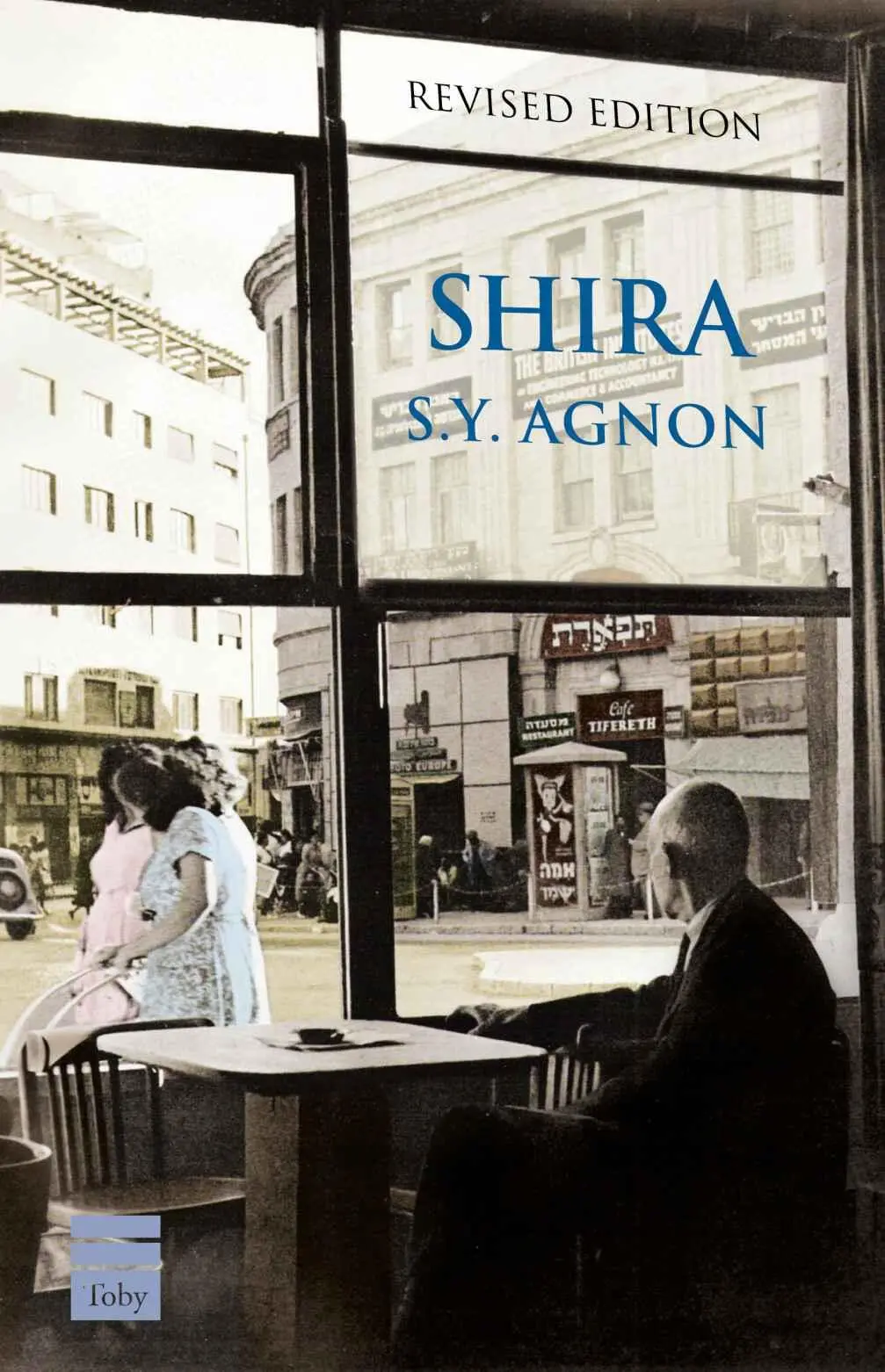
- Название:Shira
- Автор:
- Издательство:Toby Press
- Жанр:
- Год:2014
- ISBN:нет данных
- Рейтинг книги:5 / 5. Голосов: 1
-
Избранное:Добавить в избранное
- Отзывы:
-
Ваша оценка:
Shira: краткое содержание, описание и аннотация
Предлагаем к чтению аннотацию, описание, краткое содержание или предисловие (зависит от того, что написал сам автор книги «Shira»). Если вы не нашли необходимую информацию о книге — напишите в комментариях, мы постараемся отыскать её.
Shira — читать онлайн бесплатно полную книгу (весь текст) целиком
Ниже представлен текст книги, разбитый по страницам. Система сохранения места последней прочитанной страницы, позволяет с удобством читать онлайн бесплатно книгу «Shira», без необходимости каждый раз заново искать на чём Вы остановились. Поставьте закладку, и сможете в любой момент перейти на страницу, на которой закончили чтение.
Интервал:
Закладка:
By now, the many kinds of food and drink that Shira had were arranged on the table. Nothing was missing, not a fork, a knife, a bowl, a glass. By all reason, it was time for her to sit down. What did Nadia do? She went behind the curtain to the sink and washed her hands, singing that same song. Her voice, like the song, was not pleasant, not lovely. When she had dried her hands, she came to Herbst and said, “There’s water, soap, a towel. Wash your hands and we’ll eat.” Herbst answered, “I don’t want to wash my hands.” Shira said, “You don’t want to wash your hands? One should wash before eating.” Herbst said, “I don’t want to eat.” Shira said, “As a nurse, an expert in health, I tell you that a person must eat. If he doesn’t eat, he’ll be hungry; if he’s hungry, he’ll have no strength; and if he has no strength, he’ll end up sick. Hurry up, sweetheart, and wash your hands. I’m hungry, and I want to eat.” As she spoke, she sliced some bread, buttered it, and began to eat. Then she put down her bread and asked, “Why aren’t you eating?” He said, “Because I don’t want to.” She said, “You’re acting like a baby — not a good baby, but an obstinate one. Do you know how we handle obstinate children? We make them eat.” She took the bread, stuffed it into his mouth, and said in a singsong, in baby talk, “A bite for Mommy, a bite for Daddy, and a bite for little Fredchen. Chew it well, my little one, or an ogre will come to put you in his sack and carry you off to a place where they make you eat porridge every day. Be good, my sweet. Eat up, and don’t make Mommy sad. You’re angry, my child. A good boy shouldn’t be angry. Now you’re smiling. Smile, my boy, smile. A smile is good for the heart. Tomorrow, my boy, we’ll take you to the barber and ask him to make a part in your hair. But first, eat well.” She brushed his head with her hand, took a pinch of hair, leaned over his head, and sniffed. As she stood there, he encircled her hips with his arms. She didn’t make a move, nor did she seem to object to his gesture. Suddenly she slipped away and fled. He muttered under his breath, “Damn!” Shira put her hand to her nose and said, “Didn’t they teach you not to swear, my child?” She moved close to him again, brushed her hand over his head, and said, “Eat, my friend. The cocoa will get cold.” Herbst said, “The light is blinding.” Shira said, “Which light?” He pointed to the lamp. “What do you mean, doctor? Should we sit in the dark?” Herbst said, “I didn’t mean the lamp. I meant the light from the neighbors’ houses. Please, Shira, lower the blinds.” Shira said, “The more light, the more joy.” Herbst made a wry face and said, “The light of your eyes is enough for me.” Shira said, “I beg you, don’t talk nonsense. I know my own eyes, and I know they don’t glow. Unless you’re referring to my glasses.” Herbst went to the window and rattled the blind. Shira said, “Easy, easy, you’re breaking it.” Herbst said, “Then you lower it.” She went to the window, singing that same song, stood looking outside, and said, “Enlightened professor, all the houses are dark. You’ve wrecked the pulley, and I can’t lower the blind. What a schlemiel! Everything he touches breaks.” She tugged at it, this way and that, over and over again. Then, turning her head, she said, “It’s hopeless.” Just then, the blind lowered itself. She went to the other window and lowered the blind in one move, turned her head again, and said, “Are you satisfied, my friend?” He nodded and closed his eyes. She said, “Do you have a headache?” He looked at her and said, “Why do you ask?” Shira said, “I saw you squinting, as if you were in pain.” He said, “No, it’s nothing.” She said, “Good.” He said: “Not good.” She said, “Not good?” He said, “Good, good.” She said, “When someone feels good, he doesn’t yell, ‘Good, good.’“He said, “Good, good.” Shira laughed and said, “There you go again. Please tell me, just who is feeling good?”
Herbst opened his arms and said, “Come, Shira, come.” Shira said, “But I’m here.” He said, “Come, sit on my lap.” She said, “He can barely hold himself up, and he wants to hold this heavy load — freckles, eyeglasses, and all. Eat first. It might make you stronger.” Herbst said, “I don’t need food.” “You don’t need food, but you do need this dismal load on your lap. You’re swaying like a windmill. I wonder if you have a fever. Give me your hand; I’ll check your pulse. The pulse is all right, but Fredchen isn’t. Let me listen to your heart.” After she listened to his heart, he said, “Now let me listen to yours.” Shira said, “I, my friend, am normal. I don’t need to be examined.” Meanwhile, he reached out and put his hand on her heart. She shouted at him, “You’re out of your mind! Anyone could peek in and see.” Alarmed, he looked around and then began to shout, “That’s a lie, Shira! A lie! No one is looking.” Shira said, “But someone could look.” Herbst said, “You pulled down the blinds, so no one can see.” Shira said, “But they can guess what you’re doing.” Herbst said, “If they can guess, let them guess.” Shira said, “It doesn’t matter at all to you, my friend, but it matters to me.” Herbst said, “Don’t be — “ Shira said, “What is my Manfredchen asking me not to be?” Herbst said, “I’m not asking anything.” Shira laughed and said, “If you were asking nothing, you’d be doing nothing.” Herbst said, “So what am I doing?” As he spoke, he put his arm around her hips. She loosened his grip. His head drooped, and he was silent.
Shira said, “You’re tired. Lie down for a while, then you can get up and go home.” Herbst stretched out on her bed, closed his eyes, and waited, expecting Shira to come and sit near him. When she didn’t come, he opened his eyes and discovered she was nowhere in sight. He muttered, “The hell with her, where did she go?” He looked around and saw that the table was bare: Damn; she went to do the dishes. She has to do them now, when I feel as if I was flung into a blazing furnace.
And, in truth, the fire had already taken hold. He was like fire within fire, flaming and enflaming; he was overwhelmed by a sweetness that melts the whole body. He no longer existed; nor did any part of him exist, other than that mounting sweetness. When he stirred and realized he was alone, he pricked up his ears but heard nothing. He began to wonder. When some time had passed and she wasn’t back, he began to worry: What if she doesn’t come back? If she didn’t come back and he were found stretched out on her bed, he’d be in trouble. Anyway, she certainly hadn’t gone far. If she had, she wouldn’t have left her purse and her powder. Then he saw his shadow on the wall, and his blood froze. Shira returned.
Shira came back, dressed in light clothes, giving off the good scent of lavender. Herbst reached out to her and whispered, “Come, Shira, come.” She sat beside him, her body quivering. He thought to himself: If I had any sense, I would lie here and let her quiver, let her know what it’s like. But he had no sense, and he didn’t lie calmly. Shira said gently, “You’re in such a frenzy, so stormy and wild. Take off your jacket and cool off.” She got off the bed to make room. As he struggled to get his jacket off, with her standing by, there was an uproar outside and the sound of running. Shira opened a window, stuck her head out, then turned back toward Herbst, saying, “It’s the curfew. They’ve announced another curfew until six in the morning.” Herbst was in a panic. He didn’t know what he would do, but he knew he had to get back immediately, that he couldn’t not go home.
“When does it start?” he asked in alarm. Shira said, “It starts now and is in effect until morning. You want to go? Do you have a pass?” Herbst said, “I don’t have any such thing.” Shira said, “Then how will you go? The police will stop you.” Herbst said, “But I must get home.” Shira said, “You must get home, but how? If you go out, a policeman will stop you immediately and take you to the station. You’ll have to spend the night there.” Herbst said, “I’m sure you understand, Shira, that I have to go. Think of something, Shira. I’m dying, I’m going crazy.” Shira looked at him irately and said, “No need to go crazy. I’ll talk to Axelrod, my neighbor. He may agree to take you home.” Herbst said, “Go on, Shira. Ask Axelrod to take me home. Who’s Axelrod?” Shira said, “Axelrod is Axelrod’s son.” Herbst said, “You’re teasing me.” Shira said, “It’s as I said. This Axelrod is the son of the Axelrod you met at the hospital when you brought Mrs. Herbst to the maternity section. Papa Axelrod is a pest of the first water, but the son is a daring young man who drives a bus for Hamekasher. I’ll see if he’s in.” Herbst looked at her imploringly and said, “Go on, Shira, go. But can you allow yourself to be seen in those clothes?” A few minutes later, he heard the sound of a car. A broad-shouldered young man came in and said, “Hop in, professor. Don’t worry, I’ll take you home.”
Читать дальшеИнтервал:
Закладка:
Похожие книги на «Shira»
Представляем Вашему вниманию похожие книги на «Shira» списком для выбора. Мы отобрали схожую по названию и смыслу литературу в надежде предоставить читателям больше вариантов отыскать новые, интересные, ещё непрочитанные произведения.









Обсуждение, отзывы о книге «Shira» и просто собственные мнения читателей. Оставьте ваши комментарии, напишите, что Вы думаете о произведении, его смысле или главных героях. Укажите что конкретно понравилось, а что нет, и почему Вы так считаете.