Alan Moorehead - Gallipoli
Здесь есть возможность читать онлайн «Alan Moorehead - Gallipoli» весь текст электронной книги совершенно бесплатно (целиком полную версию без сокращений). В некоторых случаях можно слушать аудио, скачать через торрент в формате fb2 и присутствует краткое содержание. Год выпуска: 0101, ISBN: 0101, Издательство: Rockport Publishers, Жанр: prose_military, military_history, на английском языке. Описание произведения, (предисловие) а так же отзывы посетителей доступны на портале библиотеки ЛибКат.
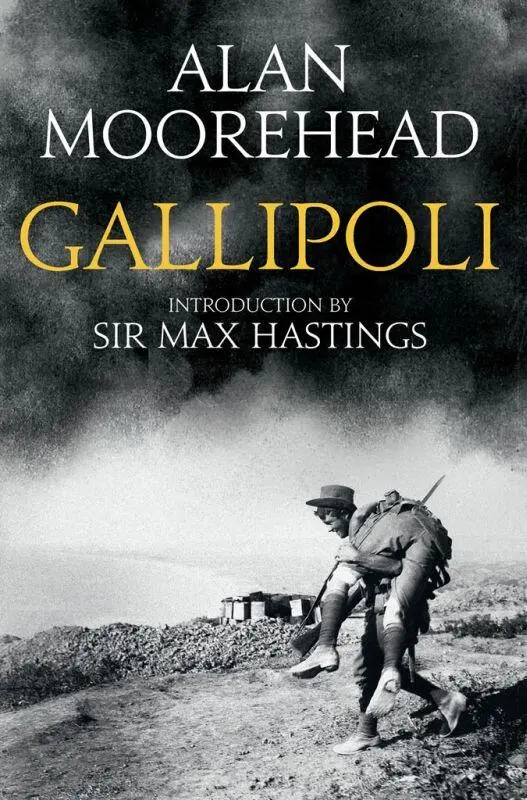
- Название:Gallipoli
- Автор:
- Издательство:Rockport Publishers
- Жанр:
- Год:0101
- ISBN:9781781314852
- Рейтинг книги:5 / 5. Голосов: 1
-
Избранное:Добавить в избранное
- Отзывы:
-
Ваша оценка:
Gallipoli: краткое содержание, описание и аннотация
Предлагаем к чтению аннотацию, описание, краткое содержание или предисловие (зависит от того, что написал сам автор книги «Gallipoli»). Если вы не нашли необходимую информацию о книге — напишите в комментариях, мы постараемся отыскать её.
Gallipoli — читать онлайн бесплатно полную книгу (весь текст) целиком
Ниже представлен текст книги, разбитый по страницам. Система сохранения места последней прочитанной страницы, позволяет с удобством читать онлайн бесплатно книгу «Gallipoli», без необходимости каждый раз заново искать на чём Вы остановились. Поставьте закладку, и сможете в любой момент перейти на страницу, на которой закончили чтение.
Интервал:
Закладка:
Tekke Burnu,
Tekke Tepe,
Telririam, Solomon,
Tenedos,
Thursby, Rear-Admiral,
Triad , S.S.,
Triumph , H.M.S.,
Troy,
Truce, May,
Turquoise , S.S.,
U-boats,
Unwin, Commander, V.C.,
Usedom, Admiral,
Uzun Keupri,
Vassilaki,
Vengeance , H.M.S.,
Venizelos,
Walker, General,
Wangenheim, Baron von, German Ambassador in Constantinople; character and career; negotiates with Enver; offers replace warships; fears fall of Constantinople in March; confident in May; dies,
War Council (Dardanelles Committee, War Committee), meeting to discuss Gallipoli expedition; resolution; members; admirals silent at; renews discussion of Gallipoli; elated by news of naval attack; insists on military support for Navy; withdrawal of Queen Elizabeth ; reconstructed; agrees to send more divisions to Gallipoli; decides to send a senior general there; discusses evacuation; sees Murdoch’s report; dismisses Hamilton; renamed; Churchill removed from,
Wear , H.M.S.,
Weber Pasha, closes Dardanelles,
Wehib Pasha,
Wemyss, Admiral,
White, Lt.-Colonel,
Wigram, Dr.,
Williams, A. B.,
Willmer, Major,
Wilson, Admiral,
Wilson, President,
Wire Gully,
Xeros, Gulf of,
Xerxes,
‘Y’ Beach,
Young Turks, deposed Sultan; struggle for survival; relationship with British Government; personalities; hatred of; described by T. E. Lawrence; plan to destroy Constantinople; security measures; massacre of Armenians; growing strength; overthrown,
Zeebrugge.
Endnotes
1
Published in T. E. Lawrence to his Biographer — Liddell Hart.
2
Sir Gerard Lowther, who preceded Mallet.
3
The poem which Lord Byron wrote when he himself accomplished this feat in 1810 is well known, but he added to it the following footnote which is seldom printed, and which gives a livelier impression of the Narrows than any statistics can provide.
‘On the 3rd of May, 1810, while the Salsette (Captain Bathurst) was lying in the Dardanelles, Lieutenant Ekenhead of that frigate and the writer of these rhymes swam from the European shore to the Asiatic — by-the-by, from Abydos to Sestos would have been more correct. The whole distance from the place whence we started to our landing on the other side, including the length we were carried by the current, was computed by those on board the frigate at upwards of four English miles; though the actual breadth is barely one. The rapidity of the current is such that no boat can row directly across, and it may in some measure be estimated from the circumstance of the whole distance being accomplished by one of the parties in an hour and five, and by the other in an hour and ten, minutes. The water was extremely cold from the melting of the mountain snows. About 3 weeks before in April, we had made an attempt, but having ridden all the way from the Troad the same morning, and the water being of an icy chilliness, we found it necessary to postpone the completion till the frigate anchored below the castles, when we swam the straits, as just stated; entering a considerable way above the European, and landing below the Asiatic fort. Chevalier says that a young Jew swam the same distance for his mistress; and Oliver mentions it having been done by a Neapolitan; but our consul, Tarragona, remembered neither of these circumstances, and tried to dissuade us from the attempt. A number of the Salsette’s crew were known to have accomplished a greater distance; and the only thing that surprised me was that, as doubts had been entertained of the truth of Leander’s story, no traveller had ever endeavoured to ascertain its practicability.’
4
The Turks in fact were so short of mines that they had been collecting those the Russians had been floating down the Bosphorus from the Black Sea in the hope of destroying the Goeben and the Breslau. In Constantinople these mines had been picked up, transhipped to the Dardanelles, and put into the minefields there.
5
It was left to the Navy to supply aircraft for the operation.
6
Actually the first transports had just reached Malta, where that day the officers were being entertained at a special performance of the opera Faust.
7
Enver reversed this opinion after March 18. Some time later, when it was safe to do so, he admitted: ‘If the English had only had the courage to rush more ships through the Dardanelles they could have got to Constantinople.’
8
A phrase of Desmond McCarthy’s in a preface to Ben Kendim by Aubrey Herbert.
9
ANZAC: Australian and New Zealand Army Corps. The word bears an unfortunate resemblance to the Turkish ‘ANSAC’ which means ‘almost’.
10
One of them was subsequently torpedoed by a U-boat near Malta, and must have occasioned some surprise to the Germans. As the ship settled her wooden turrets and her 12-inch guns floated away on the tide.
11
The D.S.O. It was in the following year that Freyberg was awarded the V.C. in France.
12
Not to be confused with the Queen Elizabeth.
13
The following verse written by Jack Churchill, Winston Churchill’s brother, appeared later in an Army broadsheet:
“Y Beach, the Scottish Borderer cried,
While panting up the steep hillside,
Y Beach!
To call this thing a beach is stiff,
It’s nothing but a bloody cliff.
Why beach?’
14
The French actually forced the Turkish garrison at Kum Kale to surrender that night and when they were taken off on the following day they brought 450 Turkish prisoners with them.
15
Chanak.
16
A reference to the Arabian Nights tale in which a series of empty dishes is served to a hungry man.
17
Or ‘Eggs-a-cook’, an expression used by the Egyptian vendors when they sold eggs to the Anzac troops during their stay in Egypt.
18
Gas was never used at Gallipoli.
19
These engagements may be summarized:
June 4: Allied attack in the centre. Gain 250–500 yards on a one-mile front. Allies’ casualties 6,500, Turkish 9,000.
June 21 and following days: French attack on the right. Gain of about 200 yards. French casualties 2,500, Turkish 6,000.
June 28: British attack on the left. Gain of half a mile. British casualties 3,800, Turkish unknown.
July 5: Turkish attack along the whole line. Nothing gained. Casualties, Turks 16,000, Allies negligible.
July 12/13: Allied attack on a one-mile front. Gain of 400 yards. Casualties, Allies 4,000, Turks 10,000.
20
Dysentery was nothing new on the Gallipoli peninsula. Xerxes’ soldiers were infected with it on their return march from Greece to the Hellespont in the fifth century B.C.
21
Perhaps because of its isolation and its strangeness, perhaps because of the lack of other entertainment, the Gallipoli campaign produced an extraordinary number of diaries. Every other man seems to have kept one, and no doubt the notebooks still exist in tens of thousands of homes. It was customary to illustrate them with sketches and photographs, and perhaps some wild flower, a bird’s feather, a souvenir like a captured Turkish badge, pressed between the leaves.
Читать дальшеИнтервал:
Закладка:
Похожие книги на «Gallipoli»
Представляем Вашему вниманию похожие книги на «Gallipoli» списком для выбора. Мы отобрали схожую по названию и смыслу литературу в надежде предоставить читателям больше вариантов отыскать новые, интересные, ещё непрочитанные произведения.








Обсуждение, отзывы о книге «Gallipoli» и просто собственные мнения читателей. Оставьте ваши комментарии, напишите, что Вы думаете о произведении, его смысле или главных героях. Укажите что конкретно понравилось, а что нет, и почему Вы так считаете.