Jan Slauerhoff - The Forbidden Kingdom
Здесь есть возможность читать онлайн «Jan Slauerhoff - The Forbidden Kingdom» весь текст электронной книги совершенно бесплатно (целиком полную версию без сокращений). В некоторых случаях можно слушать аудио, скачать через торрент в формате fb2 и присутствует краткое содержание. Год выпуска: 2013, Издательство: Pushkin Press, Жанр: Классическая проза, на английском языке. Описание произведения, (предисловие) а так же отзывы посетителей доступны на портале библиотеки ЛибКат.
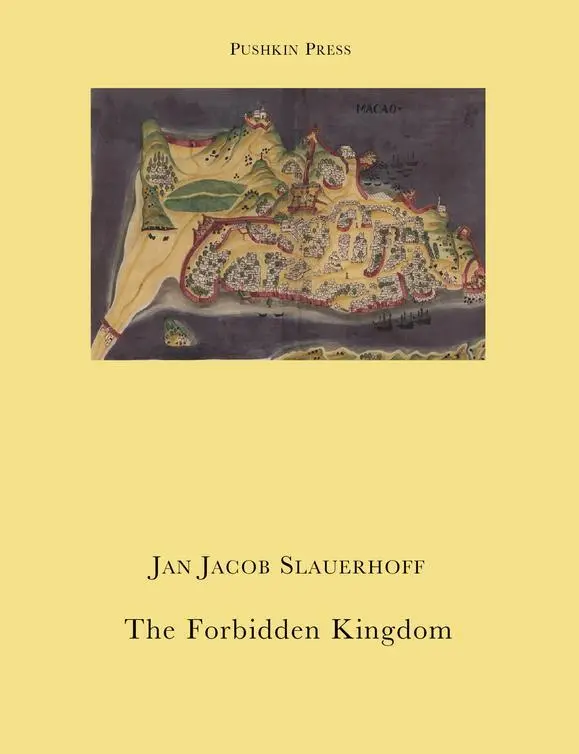
- Название:The Forbidden Kingdom
- Автор:
- Издательство:Pushkin Press
- Жанр:
- Год:2013
- ISBN:нет данных
- Рейтинг книги:5 / 5. Голосов: 1
-
Избранное:Добавить в избранное
- Отзывы:
-
Ваша оценка:
The Forbidden Kingdom: краткое содержание, описание и аннотация
Предлагаем к чтению аннотацию, описание, краткое содержание или предисловие (зависит от того, что написал сам автор книги «The Forbidden Kingdom»). Если вы не нашли необходимую информацию о книге — напишите в комментариях, мы постараемся отыскать её.
brings together the seemingly unrelated lives of a twentieth-century ship's radio operator and the sixteenth-century Portuguese poet-in-exile Luis Camoes.
Jacob Slauerhoff draws his reader into a dazzling world of exoticism, betrayal, and exile, where past and present merge and the possibility of death is never far away.
Born in The Netherlands in 1898, upon graduating from university
signed up as a ship's surgeon with the Dutch East India Company. He was at sea throughout his life, voyaging to the Far East, Latin America, and Africa.
The Forbidden Kingdom — читать онлайн бесплатно полную книгу (весь текст) целиком
Ниже представлен текст книги, разбитый по страницам. Система сохранения места последней прочитанной страницы, позволяет с удобством читать онлайн бесплатно книгу «The Forbidden Kingdom», без необходимости каждый раз заново искать на чём Вы остановились. Поставьте закладку, и сможете в любой момент перейти на страницу, на которой закончили чтение.
Интервал:
Закладка:
One important difference between a story of time-travel and the “journey” the radio operator makes through time is that in The Forbidden Kingdom the past is not seen through the eyes of the present. The twentieth-century character is not imported unchanged into another time in order to view and comment on it; confrontation between past and present is not an explicit theme of the narrative. Rather, the novel performs the impossible communication between past and present by subtle and mysterious means—“clues” as to what will happen build up to a climax. The anticipated, but impossible dissolution of linear time does actually take place. The first clue to the existence of a parallel character to Camões comes in a recurrent dream during Camões’s sea journey to Macao, narrated in Chapter Four:
[…] I am a lowly figure among men and have to work and obey for a paltry wage. Yet I am more powerful than when I laboriously assembled words and ordered them on paper. Now I hurl my words into space; they travel infinite distances, driven by a vibration that I nonchalantly produce with my hand […]
Sometimes he had a tight-fitting hood on his head, sometimes he felt that the ship was no longer made of wood but of blistering iron […]
Now a host of yellow-skinned people forced their way into the cramped cabin […] (pp. 125-26)
If the reader is at first puzzled by the reference to words being hurled into space, the cumulative references to anachronistic elements of the dream, such as wood being replaced by steel in the ship’s construction and the strange close-fitting clothes worn by those on board, soon make it clear that Camões’s dream represents some kind of vision of the future.
The functioning of the “clues” depends on the reader developing a sense of their reliability, which happens at moments of recognition later on in the novel — what is sensed by Camões in one chapter, is realized by the radio operator in another, and vice versa . Slauerhoff achieves this by the repetition of a particular situation, and of certain key words. So, for example, in Chapter Six, narrated by the radio operator, we read: Radio? How long ago was it since I had sat in a narrow cabin with headphones on and my hand on the key? Distinct echoes of Camões’s dream.
At the heart of the novel is a dangerous journey into the interior of the forbidden kingdom of China, which in the sixteenth century had not yet been successfully penetrated by Europeans. When Camões, half dead from exposure to the relentless sun in the desert, finds himself by a large stone to mark the route, he has the sensation that someone else will take his place even though he himself may be lost. In the following chapter, Cameron’s ship is attacked by bandits who abandon the crew in the desert. Cameron finds the stone, clings to it, feels mysteriously revived and survives the ordeal.
The circumstances leading to the temporary integration of the characters, which is also a temporal integration, are laden with symbols. The radio operator enters a tomb in the desert in search of shade and cool. The tomb is a multiple symbol — as an enclosed, protective space it represents a pre-natal state which in turn could indicate a kind of rebirth. The radio operator is protected from the world enclosed in the tomb with its “womb shape”. To the reader, a tomb initially indicates death, but must now be seen as suggesting a beginning as well as an end. Of course, if the character remains in the tomb, he will never be found and will die there, but his instinct for survival expels him into the hostile conditions of the desert again. The tomb is more than a symbol of death and birth — like the stones that mark out the road (to survival), it is itself a survival from the past, a piece of history, a refuge in the present. It too escapes clock-time. But if the dimension of eternal time has been accessed in this way, it is space that plays the crucial part; it is only when the physical place is identical for the two characters that time opens up.
The difference between this magic box and Dr Who’s police box, for example, is that the latter, like Wells’s time machine, actually travels to the new time zone, whereas Slauerhoff’s remains immobile. The travelling has apparently occurred in the characters’ minds, but there is one problem confronting the reader. When the main character returns half crazed and in rags from the desert, he is carrying gold coins from old Macao, wearing ancient clothes, and only understands Portuguese, though he speaks English. The setting may be the twentieth century, but the character is a hybrid — the radio operator has been colonized by Camões. The man finds a hotel, and while his body lies on the bed, his mind travels easily through the centuries. The experience is depicted as akin to passing down a mine shaft with the sedimented past in view, including a brief reference to the opening scene of the novel. This is a prelude to the final coming together of Camões and Cameron. This time the stone edifice to which Cameron is taken back in time is the cathedral of Macao, a ruin in the twentieth century, and the scene of a fierce battle in the fifteenth. The hero of the fight turns out to be Camões, unexpectedly returned from China, but the reader also knows from the hybrid character’s own account that Camões/Cameron was anything but a hero. In fact, he was so traumatized by his extreme experiences that he was hardly aware of what he was doing.
The Forbidden Kingdom is much more than a modernist experiment with time and narrative; it is a novel of adventure, of the pioneer spirit of those early European expeditions to discover new territory and new ways of generating wealth for those who sent them on their journey. It is also a novel about the outcast, whether poet or sailor, a man exiled from the familiar world in which he grew up. He is nomadic, he yearns for happiness, he falls for a beautiful and unattainable woman, who may be drawn to him, but whose circumstances forbid closeness: a modern romantic who experiences intense feeling and suffering. Yet the novel also invites reflection on the colonial enterprise and the violence it involved. While the immediate focus in Slauerhoff’s novel is on the alienation of the individual in a hostile world, its depiction of colonialism and its negative view of established European culture give it a political undertone.
The two main characters find themselves on the other side of the world from where they were born — exiles not just from their country of birth, but also from European civilization. However, while Camões and the ship’s radio operator have a great deal in common as victims, their experiences and above all their attitudes to the forbidden kingdom of China set them apart from one another. In Macao, Camões is a victim of the social norms both of the homeland and of the colony: deprived of his freedom, he is tortured by his fellow countrymen and forced to join the fated embassy to Beijing. Instead of finding refuge among the colonialists, Camões is treated brutally by them. Although he is physically weak, and not an obvious threat, the mentality of the Portuguese in Macao is one of suspicion towards all outsiders. They are afraid that he possesses knowledge which they do not have. This is also why they torture the Dominican friars. During the extreme conditions of the excursion into China with the failed embassy to Beijing, Camões loses all sense of his Portuguese identity. Perhaps there is a residual identity — that of a universal figure, the poet. Slauerhoff’s portrayal of Camões is particularly striking to a twentieth-century reader who knows that Camões has, in the intervening centuries, become Portugal’s national poet, a symbol of Portugal and its culture. In the world of Slauerhoff’s text, the poet is shown as alienated from the Portuguese culture into which he was born, and also from the Portuguese colonial culture to which he is banished — a far cry from the symbolic Camões.
Читать дальшеИнтервал:
Закладка:
Похожие книги на «The Forbidden Kingdom»
Представляем Вашему вниманию похожие книги на «The Forbidden Kingdom» списком для выбора. Мы отобрали схожую по названию и смыслу литературу в надежде предоставить читателям больше вариантов отыскать новые, интересные, ещё непрочитанные произведения.





Обсуждение, отзывы о книге «The Forbidden Kingdom» и просто собственные мнения читателей. Оставьте ваши комментарии, напишите, что Вы думаете о произведении, его смысле или главных героях. Укажите что конкретно понравилось, а что нет, и почему Вы так считаете.