Jan Slauerhoff - The Forbidden Kingdom
Здесь есть возможность читать онлайн «Jan Slauerhoff - The Forbidden Kingdom» весь текст электронной книги совершенно бесплатно (целиком полную версию без сокращений). В некоторых случаях можно слушать аудио, скачать через торрент в формате fb2 и присутствует краткое содержание. Год выпуска: 2013, Издательство: Pushkin Press, Жанр: Классическая проза, на английском языке. Описание произведения, (предисловие) а так же отзывы посетителей доступны на портале библиотеки ЛибКат.
- Название:The Forbidden Kingdom
- Автор:
- Издательство:Pushkin Press
- Жанр:
- Год:2013
- ISBN:нет данных
- Рейтинг книги:5 / 5. Голосов: 1
-
Избранное:Добавить в избранное
- Отзывы:
-
Ваша оценка:
The Forbidden Kingdom: краткое содержание, описание и аннотация
Предлагаем к чтению аннотацию, описание, краткое содержание или предисловие (зависит от того, что написал сам автор книги «The Forbidden Kingdom»). Если вы не нашли необходимую информацию о книге — напишите в комментариях, мы постараемся отыскать её.
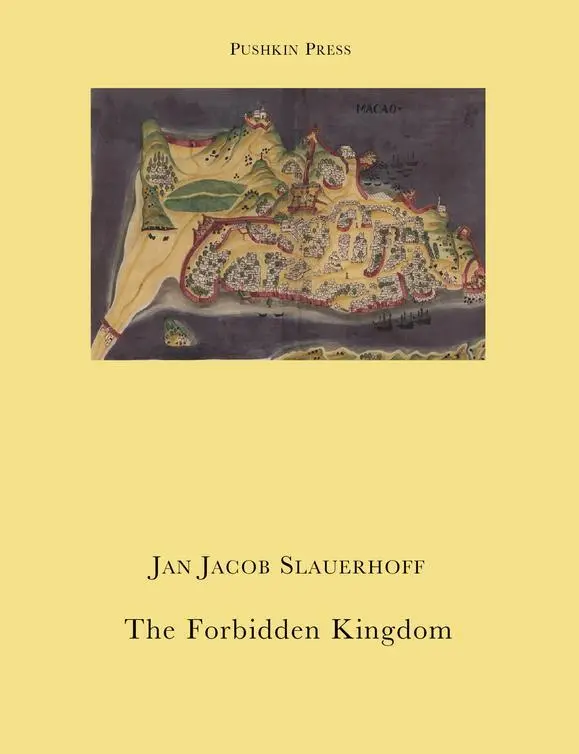
brings together the seemingly unrelated lives of a twentieth-century ship's radio operator and the sixteenth-century Portuguese poet-in-exile Luis Camoes.
Jacob Slauerhoff draws his reader into a dazzling world of exoticism, betrayal, and exile, where past and present merge and the possibility of death is never far away.
Born in The Netherlands in 1898, upon graduating from university
signed up as a ship's surgeon with the Dutch East India Company. He was at sea throughout his life, voyaging to the Far East, Latin America, and Africa.
The Forbidden Kingdom — читать онлайн бесплатно полную книгу (весь текст) целиком
Ниже представлен текст книги, разбитый по страницам. Система сохранения места последней прочитанной страницы, позволяет с удобством читать онлайн бесплатно книгу «The Forbidden Kingdom», без необходимости каждый раз заново искать на чём Вы остановились. Поставьте закладку, и сможете в любой момент перейти на страницу, на которой закончили чтение.
Интервал:
Закладка:
First I would make for the place I had most shunned, since it is so cruel to the penniless and the weak that people are simply allowed to die in the street. First to Shanghai. From there, at right angles away from the coast, across the plains, to where the mountains rise from the distant, hazy rice paddies, with the poppy fields lying among them like red lakes.
If any happiness was to be found anywhere on earth, it must be there. There the oldest wisdom, the most exalted nature and the purest pleasure were to be found. Blissful in the present, armoured by the many scars from the past, I would be able to confront all the ghosts and demons, without merging with them, offering them hospitality, without myself changing one hair, a single cell.
I, who at first was so weak and did not set foot even on its outermost edge, will penetrate this land that has always remained pristine, that does not repel, but tolerates, that allows itself seemingly to be conquered and destroys all barbarians and foreigners in its languid, slowly suffocating grip and under the pressure of its mass.
To be one of the for ever unconscious millions — what joy — or if that is unattainable, someone who knows every thing, for whom everything is behind him and who nevertheless goes on living.
AFTERWORD
The Dutch writer Jan Jacob Slauerhoff (1898–1936) was born in Leeuwarden, the provincial capital of Friesland in the northern part of the Netherlands. He trained as a doctor, though he never followed a conventional career path. Slau, as he was known to his friends, combined medical practice with writing in what was to be a short and intensely nomadic life. He left behind the small world of the Netherlands to travel, first in Europe and later in the Far East, working as a ship’s doctor on the China-Java-Japan route. These wanderings gave rise to one of the most famous lines of Dutch poetry— Alleen in mijn gedichten kan ik wonen (Only in my poems can I dwell) from the poem Woninglooze ( Homeless ). This nomadic sensibility was highly unusual for the time in which Slauerhoff was writing; it both harks back to nineteenth-century Romanticism and anticipates today’s extreme mobility.
In Dutch literary history of the last thirty years, Jan Jacob Slauerhoff tends to feature most strongly as a poet — the Netherlands’ own poète maudit , in fact. This is no facile comparison — it comes from the writer himself whose self-identification with Tristan Corbière is evident from both his critical writings and letters. Slauerhoff’s biographer Wim Hazeu discusses his poetic personality in relation to Verlaine, Rimbaud and Laforgue as well as Corbière. At the same time, Slauerhoff is most frequently described as a Romantic poet because of his themes of loss, longing, doomed love, dreamlike landscapes, and of roaming the seas. Fellow Dutch poet Hendrik Marsman emphasized in his review of the cycle of poems Eldorado in 1928 that though Slauerhoff’s preoccupations were “as Romantic as hell”, his sensibility and his poetic diction were modern.
Slauerhoff was already well established as a poet when he published his first prose works — two collections of short stories, Het lente-eiland en andere verhalen ( The Isle of Spring and Other Stories ) and Schuim en asch ( Foam and Ashes ) — in 1930. The Forbidden Kingdom followed in 1932; it appeared in nine instalments in the literary magazine Forum and immediately afterwards in book form. It is one of the most vividly written and experimental novels in the Dutch language. Set in both the sixteenth and twentieth centuries, rather like Virginia Woolf’s Orlando , its journey through time is accompanied by its central character’s transformation. But whereas Orlando is transformed from man to woman in the course of the centuries, Slauerhoff’s character is a twentieth-century ship’s radio operator who “becomes” the sixteenth-century Portuguese poet Camões. In its disregard for the norms of realist fiction, The Forbidden Kingdom establishes itself as a modernist novel.
The narrative techniques used by Slauerhoff had never been used before in Dutch literature, and some reviewers certainly found them challenging. Slauerhoff does not allow himself to be confined by his readers’ expectations; instead he unsettles them at every turn. Ultimately he fails to deliver the historical writing promised by his prologue to The Forbidden Kingdom , which narrates the founding of the Portuguese colony of Macao in the sixteenth century. Or rather, he interrupts it with other narratives. Take the first chapter, for instance — it is also set in the sixteenth century, though the location is the Portuguese homeland. The narrative switches back and forth between Camões as storyteller and a third-person narrator as it relates the poet’s banishment from Portugal because of his love for the Infant’s betrothed. Readers are never given the opportunity to settle into a comfortable relationship with the text, though the Camões story does eventually merge with the story of the founding of the colony, since Camões’s place of exile turns out to be Macao. But Chapter Six introduces a new story and simultaneously breaks the time frame — it is set in the twentieth century, told in the first person by a new character. The reader is asked to believe — or perhaps to make-believe — that the radio operator somehow “tunes into” Camões, while the sixteenth-century character in turn “colonizes” the twentieth-century character.
Slauerhoff’s experiment with narrated time appears at first to involve two separate unrelated narratives, but in fact moves towards contact across time between the main characters of each narrative. The double time frame, and the way it is given expression through the characters, raises questions both about the perception of time and about the way time is traditionally represented in the realist novel. These preoccupations can be seen as a broader cultural phenomenon which had its origins in Einstein’s theories. Slauerhoff is known to have read and discussed J.W. Dunne’s An Experiment with Time (1927). What is interesting about Dunne’s book is not his theory, which comes across as pseudo-science, but the indication it gives of a popular interest in exploring ideas relating to time and space. In it Dunne develops a theoretical model which “explains” how in dreams one can see the future as well as the past, because the dreamer is “in a field of existence entirely different from that of ordinary waking life” ( An Experiment with Time , p. 164). The two main characters of The Forbidden Kingdom , Camões and the nameless ship’s radio operator, dream each other, and experience visions which are not subject to linear time.
In Slauerhoff’s sequel to The Forbidden Kingdom — Het leven op aarde ( Life on Earth , 1934) — the twentieth-century character who resembles the protagonist of The Forbidden Kingdom not only has a name, but he also carries out the planned journey into China with which our novel ends. This man’s name is Cameron, and after his death Slauerhoff’s papers revealed that he had originally planned three Cameron novels. Although Cameron’s counterpart remains nameless in The Forbidden Kingdom, in what follows I will use this name, especially when talking about the composite or hybrid character Camões/Cameron.
The moments of contact between the two main characters represent a kind of Modernist version of time-travel — one that, in keeping with Dunne’s theory, takes place in the mind. The unnatural or magical quality of the moments of contact emphasizes the time gap which has to be bridged by some special means. A more traditional time-travel novel, such as H.G. Wells’s The Time Machine (1898) to which Dunne also refers, not wishing to violate the sense of a coherent realistic fictional world, resorts to science to invent special machines to make it possible to visit another time. This way the overall time frame is preserved, since the other time is inserted into the dominant frame. Slauerhoff’s character Cameron escapes clock-time altogether and briefly inhabits a dimension where, like Walter Benjamin’s angel of history, he can see through the centuries that have gone before. Camões, on the other hand, is facing in the other direction, toward the future.
Читать дальшеИнтервал:
Закладка:
Похожие книги на «The Forbidden Kingdom»
Представляем Вашему вниманию похожие книги на «The Forbidden Kingdom» списком для выбора. Мы отобрали схожую по названию и смыслу литературу в надежде предоставить читателям больше вариантов отыскать новые, интересные, ещё непрочитанные произведения.





Обсуждение, отзывы о книге «The Forbidden Kingdom» и просто собственные мнения читателей. Оставьте ваши комментарии, напишите, что Вы думаете о произведении, его смысле или главных героях. Укажите что конкретно понравилось, а что нет, и почему Вы так считаете.