Jan Slauerhoff - The Forbidden Kingdom
Здесь есть возможность читать онлайн «Jan Slauerhoff - The Forbidden Kingdom» весь текст электронной книги совершенно бесплатно (целиком полную версию без сокращений). В некоторых случаях можно слушать аудио, скачать через торрент в формате fb2 и присутствует краткое содержание. Год выпуска: 2013, Издательство: Pushkin Press, Жанр: Классическая проза, на английском языке. Описание произведения, (предисловие) а так же отзывы посетителей доступны на портале библиотеки ЛибКат.
- Название:The Forbidden Kingdom
- Автор:
- Издательство:Pushkin Press
- Жанр:
- Год:2013
- ISBN:нет данных
- Рейтинг книги:5 / 5. Голосов: 1
-
Избранное:Добавить в избранное
- Отзывы:
-
Ваша оценка:
The Forbidden Kingdom: краткое содержание, описание и аннотация
Предлагаем к чтению аннотацию, описание, краткое содержание или предисловие (зависит от того, что написал сам автор книги «The Forbidden Kingdom»). Если вы не нашли необходимую информацию о книге — напишите в комментариях, мы постараемся отыскать её.
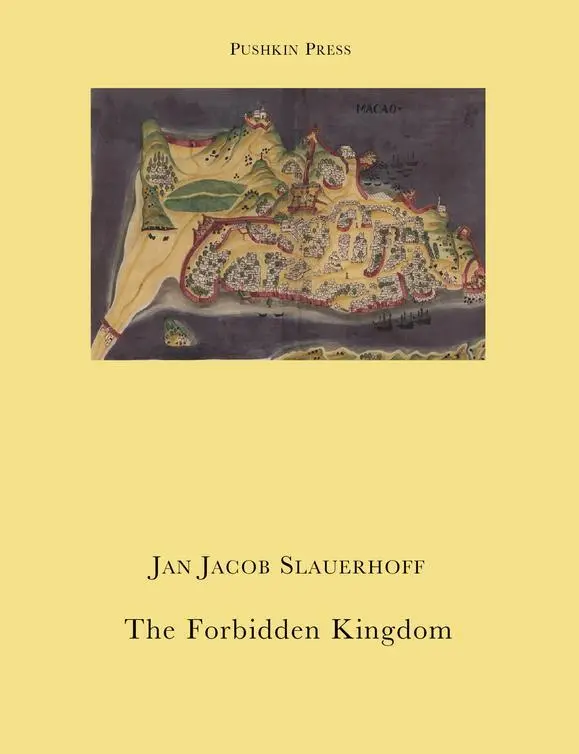
brings together the seemingly unrelated lives of a twentieth-century ship's radio operator and the sixteenth-century Portuguese poet-in-exile Luis Camoes.
Jacob Slauerhoff draws his reader into a dazzling world of exoticism, betrayal, and exile, where past and present merge and the possibility of death is never far away.
Born in The Netherlands in 1898, upon graduating from university
signed up as a ship's surgeon with the Dutch East India Company. He was at sea throughout his life, voyaging to the Far East, Latin America, and Africa.
The Forbidden Kingdom — читать онлайн бесплатно полную книгу (весь текст) целиком
Ниже представлен текст книги, разбитый по страницам. Система сохранения места последней прочитанной страницы, позволяет с удобством читать онлайн бесплатно книгу «The Forbidden Kingdom», без необходимости каждый раз заново искать на чём Вы остановились. Поставьте закладку, и сможете в любой момент перейти на страницу, на которой закончили чтение.
Интервал:
Закладка:
The grave seemed to me a more appropriate resting place. It was so tall and the smooth, dark stones of the entrance were inviting. The world rejected me. I crawled into the grave without revulsion. It was cool inside, and I pushed the dried bones aside. In the darkness I bumped into a funerary urn. Perhaps there was something still in it — indeed there was liquid, but I dared not drink it though my thirst was pressing.
Was this not a safe hiding place from the misadventures that threatened me, such as the great empire itself within its walls and mountain chains, protected against everything, the invasions of barbarians, the present and the disturbances that will dislocate and shatter the whole world in the future, when its forces are unleashed and descend upon the kingdom? The grave was the gateway through which I could leave my own life and enter the past. I raised my head and looked through the opening, my eye lit on a hexagonal stone, the kind I had seen before. I had to leave the grave again, the deep ever-silent past in which I did not yet belong, and I focused on that stone from the recent past in order to escape from my own time.
I took a few determined steps, but the desert was surging like an ocean, and I thought I saw a piece of driftwood floating, or was it a shipwrecked mariner, or was it me? No, I was standing here, but I could see myself walking in the distance, coming towards me, and I tried to run away from myself, but I could not: the two people — which of whom I was I no longer knew — would merge. Then the wind began to roar with swelling volume, the sky let loose a long scream, and I fell and nearby the ghost fell too.
I awoke in a yellow light, not the sun’s: I had never seen the moon so full. I tried to recover the thread of my memories, but everywhere I encountered confusion. Had we not just been by a larger stretch of water than the narrow pond here — had it dried out so much? Surely I could not have slept for more than a few days.
What happened before this journey of the dead through the desert began? I kept coming back to a shipwreck, a storm, an attack by Chinese, but surely it was much longer ago and we had no Chinese on board back then. What came afterwards? Imprisonment. Why? A journey to the north, to Beijing. Why? I didn’t recognize the clothes I had on or the ones lying next to me. Had I been taken prisoner, released again and had these things set down beside me?
I tried to put them on, but they disintegrated like cobwebs; a few coins fell out. I had also had these in the prison, but the guard had refused to accept them. But I didn’t remember any more about a prison.
I looked around in desperation, searching; in the distance was a stone that I recognized, and I went slowly up to it. It was a marker, erected so as to be able to find the way back, but the inscription had almost worn away. With great difficulty I read: Em nome d’El Rei Nosso Senhor D. João III mandou pôr este letreiro em fé da muita lealdade —*
I clung to the stone, I leant against it and after a while it was as if in this squatting position new strength flowed into me, and as the light turned from yellow to pink in the morning, I was able to go on, at first quite quickly, then slower and slower as if my strength were failing again, then faster from fear, and finally I saw, like a beacon at sea, another hexagonal stone in the distance…
* In the name of Our Lord the King, Dom João III, I ordered this inscription to be erected in token of my great loyalty.
CHAPTER 9
I
IN THE MID-NINETEENTH CENTURY, when Macao was increasingly losing its former sense of power, and lay on its peninsula half forgotten by its own country and entirely forgotten by Europe, great mansions were built on the steep slopes of the rocky island of Hong Kong and lush gardens laid out for the rich, who were later to live off the docks and wharves down below on the narrow strip of beach that encircled the island, and off the ships that were to load and unload in the ample, still empty bay. Macao was unconcerned. The occasional large vessel called in, mooring far outside the silted-up harbour. Apart from that, there were only flat-bottomed coasters, the slender lorchas , popular as armed escorts for rich Chinese merchants, and the odd smuggler’s ship.
Macao was quite unperturbed. The merchants were rich and remained so. The other colonists and the Chinese inhabitants were poor and remained so. The city’s independence had been recognized in name by the Emperor, four centuries after its foundation, since it now posed no threat. Despite that freedom the mandarins did not negotiate as they used to, but ordered, and their orders were mostly obeyed. The ruling class became even richer: opium smuggling and slave trafficking to South America brought in more than the laborious honest trade they had once conducted. Macao did not fear Hong Kong; what trade could grow up around a bare rock?
Almost out of the blue, after having languished for five years as a dead city and a failure from the outset, Hong Kong took off, the bay became a busy port of call, rich Chinese merchants from the still turbulent Canton came and settled on the peaceful island. It became a free port. So did Macao, for all the difference it made: it simply meant that the customs revenues were lost.
People continued to sneer at Hong Kong, until there was an exodus of many leading merchants, whose families had been established in Macao for centuries, and of all the artisans and shopkeepers. Life in Macao became almost impossible. There was nothing to buy, nothing could be made, everything had to come from Hong Kong. As a last desperate measure, casinos were introduced in Macao and indeed some people did occasionally come to lose the wealth they had acquired in Hong Kong.
Portugal sent ever-increasing numbers of civil servants to improve the situation, ensuring that it became increasingly hopeless. Eventually a kind of equilibrium asserted itself, giving Macao a last exiguous lease of life. Then in about 1900 a regular steamship service was established between Hong Kong and Macao.
It was as if in this way the city of the future was giving a few crumbs of its progress to the city of the past. The two low steamers were the only ones linking Macao with the outside world. All that was moored in its harbour these days were a few mouldering craft and the odd decommissioned steamer with old-fashioned paddle wheels, or an obsolete coastal patrol vessel. The civil servants whose salaries swallowed up the last income of the unfortunate colony had to travel on English ships from Lisbon to Hong Kong and there change to one of the shuttle steamers.
One afternoon a thin, scruffy-looking man stood on this wooden jetty, from where the ships in question sailed, leaning against one of the fenders. He was constantly being bumped into by coolies lugging packages or hurrying travellers and almost pushed into the water, but he moved no further than a branch that is pushed aside and springs back. When he had stood there for a large part of the afternoon, the harbour-master, a half-caste but largely Chinese, came and asked him what he was doing. In the harbour-master’s own opinion he spoke good English, and in any case had risen infinitely far above pidgin level. But this white man, because he was white beneath the grime, appeared not to understand his English. Then they were joined by the purser of the boat, a corpulent and pock-marked individual from Macao, who made up for the insignificance of the vessel on which he sailed by wearing five rings on his sleeve (one more than a mail-boat captain). His cap too bore a heavy gilt band. Nevertheless he preferred to go about barefoot. The authority figure squared up to the man and asked him in Portuguese what he wanted. This time the loafer answered immediately, but in pure English, which infuriated the harbour-master, who thought he had not been considered worthy of an answer and started to make it clear to the pauper that however white he was, he was still a scrap of dirt compared with the harbour-master, who was also known as shore captain.
Читать дальшеИнтервал:
Закладка:
Похожие книги на «The Forbidden Kingdom»
Представляем Вашему вниманию похожие книги на «The Forbidden Kingdom» списком для выбора. Мы отобрали схожую по названию и смыслу литературу в надежде предоставить читателям больше вариантов отыскать новые, интересные, ещё непрочитанные произведения.





Обсуждение, отзывы о книге «The Forbidden Kingdom» и просто собственные мнения читателей. Оставьте ваши комментарии, напишите, что Вы думаете о произведении, его смысле или главных героях. Укажите что конкретно понравилось, а что нет, и почему Вы так считаете.