Jerome Jerome - Paul Kelver
Здесь есть возможность читать онлайн «Jerome Jerome - Paul Kelver» весь текст электронной книги совершенно бесплатно (целиком полную версию без сокращений). В некоторых случаях можно слушать аудио, скачать через торрент в формате fb2 и присутствует краткое содержание. Город: New York, Год выпуска: 1902, Издательство: Dodd, Mead & Company, Жанр: Классическая проза, на английском языке. Описание произведения, (предисловие) а так же отзывы посетителей доступны на портале библиотеки ЛибКат.
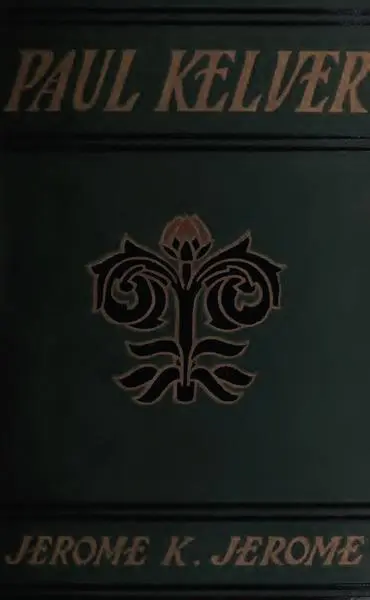
- Название:Paul Kelver
- Автор:
- Издательство:Dodd, Mead & Company
- Жанр:
- Год:1902
- Город:New York
- ISBN:нет данных
- Рейтинг книги:3 / 5. Голосов: 1
-
Избранное:Добавить в избранное
- Отзывы:
-
Ваша оценка:
Paul Kelver: краткое содержание, описание и аннотация
Предлагаем к чтению аннотацию, описание, краткое содержание или предисловие (зависит от того, что написал сам автор книги «Paul Kelver»). Если вы не нашли необходимую информацию о книге — напишите в комментариях, мы постараемся отыскать её.
Paul Kelver — читать онлайн бесплатно полную книгу (весь текст) целиком
Ниже представлен текст книги, разбитый по страницам. Система сохранения места последней прочитанной страницы, позволяет с удобством читать онлайн бесплатно книгу «Paul Kelver», без необходимости каждый раз заново искать на чём Вы остановились. Поставьте закладку, и сможете в любой момент перейти на страницу, на которой закончили чтение.
Интервал:
Закладка:
“'Haven't seen it,' he replied.”
“'About a column?' I suggested.”
“'Three-quarters,' he preferred, and went.”
“The moment he was gone, I slipped downstairs and met a printer's boy coming up.”
“'What's the name of your sub?' I asked him. 'Tall man with a black moustache, looks tired.'”
“'Oh, you mean Penton,' explained the boy.”
“'That's the name,' I answered; 'couldn't think of it.'”
“I walked straight into the editor; he was still irritable. 'What is it? What is it now?' he snapped out.”
“'I only want the ticket for the Royalty Theatre,' I answered. 'Penton says you've got it.'”
“'I don't know where it is,' he growled.”
“I found it after some little search upon his desk.”
“'Who's going?' he asked.”
“'I am,' I said. And I went.”
“They have never discovered to this day that I appointed myself. Penton thinks I am some relation of the proprietress, and in consequence everybody treats me with marked respect. Mrs. Wallace herself, the proprietress, thinks I am the discovery of Penton, in whose judgment she has great faith; and with her I get on admirably. The paper I don't think is doing too well, and the salary is small, but sufficient. Journalism suits my temperament, and I dare say I shall keep to it.”
“You've been somewhat of a rolling stone hitherto,” I commented.
He laughed. “From the stone's point of view,” he answered, “I never could see the advantage of being smothered in moss. I should always prefer remaining the stone, unhidden, able to move and see about me. But now, to speak of other matters, what are your plans for the immediate future? Your opera, thanks to the gentlemen, the gods have dubbed 'Goggles,' will, I fancy, run through the winter. Are you getting any salary?”
“Thirty shillings a week,” I explained to him, “with full salary for matinees.”
“Say two pounds,” he replied. “With my three we could set up an establishment of our own. I have an idea that is original. Shall we work it out together?”
I assured him with fervour that nothing would please me better.
“There are four delightful rooms in Queen's Square,” he continued. “They are charmingly furnished: a fine sitting-room in the front, with two bedrooms and a kitchen behind. Their last tenant was a Polish Revolutionary, who, three months ago, poor fellow, was foolish enough to venture back to Russia, and who is now living rent free. The landlord of the house is an original old fellow, Deleglise the engraver. He occupies the rest of the house himself. He has told me I can have the rooms for anything I like to offer, and I should suggest thirty shillings a week, though under ordinary circumstances they would be worth three or four pounds. But he will only let us have them on the understanding that we 'do for' ourselves. He is quite an oddity. He hates petticoats, especially elderly petticoats. He has one servant, an old Frenchwoman, who, I believe, was housekeeper to his mother, and he and she do the housework together, most of their time quarrelling over it. Nothing else of the genus domestic female will he allow inside the door; not even an occasional charwoman would be permitted to us. On the other hand, it is a beautiful old Georgian house, with Adams mantelpieces, a stone staircase, and oak-panelled rooms; and our portion would be the entire second floor: no pianos and no landlady. He is a widower with one child, a girl of about fourteen or maybe a little older. Now, what do you say? I am a very fair cook; will you be house-and-parlour-maid?”
I needed no pressing. A week later we were installed there, and for nearly two years we lived there. At the risk of offending an adorable but somewhat touchy sex, convinced that man, left to himself, is capable of little more than putting himself to bed, and that only in a rough-and-ready fashion, truth compels me to record the fact that without female assistance or supervision of any kind we passed through those two years, and yet exist to tell the tale. Dan had not idly boasted. Better plain cooking I never want to taste; so good a cup of coffee, omelette, or devilled kidney I rarely have tasted. Had he always confined his efforts within the boundaries of his abilities, there would be little to record beyond continuous and monotonous success. But stirred into dangerous ambition at the call of an occasional tea or supper party, lured out of his depths by the example of old Deleglise, our landlord—a man who for twenty years had made cooking his hobby—Dan would at intervals venture upon experiment. Pastry, it became evident, was a thing he should never have touched: his hand was heavy and his temperament too serious. There was a thing called lemon sponge, necessitating much beating of eggs. In the cookery-book—a remarkably fat volume, luscious with illustrations of highly-coloured food—it appeared an airy and graceful structure of dazzling whiteness. Served as Dan sent it to table, it suggested rather in form and colour a miniature earthquake. Spongy it undoubtedly was. One forced it apart with the assistance of one's spoon and fork; it yielded with a gentle tearing sound. Another favourite dainty of his was manna-cake. Concerning it I would merely remark that if it in any way resembled anything the Children of Israel were compelled to eat, then there is explanation for that fretfulness and discontent for which they have been, perhaps, unjustly blamed—some excuse even for their backward-flung desires in the direction of the Egyptian fleshpots. Moses himself may have been blessed with exceptional digestion. It was substantial, one must say that for it. One slice of it—solid, firm, crusty on the outside, towards the centre marshy—satisfied most people to a sense of repletion. For supper parties Dan would essay trifles—by no means open to the criticism of being light as air—souffle's that guests, in spite of my admonishing kicks, would persist in alluding to as pudding; and in winter-time, pancakes. Later, as regards these latter, he acquired some skill; but at first the difficulty was the tossing. I think myself a safer plan would have been to turn them by the aid of a knife and fork; it is less showy, but more sure. At least, you avoid all danger of catching the half-baked thing upon your head instead of in the pan, of dropping it into the fire, or among the cinders. But “Thorough” was always Dan's motto; and after all, small particles of coal or a few hairs can always be detected by the careful feeder, and removed.
A more even-tempered man than Dan for twenty-three hours out of every twenty-four surely never breathed. It was a revelation to me to discover that for the other he could be uncertain, irritable, even ungrateful. At first, in a spirit of pure good nature, I would offer him counsel and advice; explain to him why, as it seemed to me, the custard was pimply, the mayonnaise sauce suggestive of hair oil. What was my return? Sneers, insult and abuse, followed, if I did not clear out quickly, by spoilt tomatoes, cold coffee grounds—anything that happened to be handy. Pained, saddened, I would withdraw, he would kick the door to after me. His greatest enemy appeared to be the oven. The oven it was that set itself to thwart his best wrought schemes. Always it was the oven's fault that the snowy bun appeared to have been made of red sandstone, the macaroni cheese of Cambrian clay. One might have sympathised with him more had his language been more restrained. As it was, the virulence of his reproaches almost inclined one to take the part of the oven.
Concerning our house-maid, I can speak in terms of unqualified praise. There are, alas, fussy house-maids—who has not known and suffered them?—who overdo the thing, have no repose, no instinct telling them when to ease up and let the place alone. I have always held the perpetual stirring up of dust a scientific error; left to itself, it is harmless, may even be regarded as a delicate domestic bloom, bestowing a touch of homeliness upon objects that without it gleam cold and unsympathetic. Let sleeping dogs lie. Why be continually waking up the stuff, filling the air with all manner of unhealthy germs? Nature in her infinite wisdom has ordained that upon table, floor, or picture frame it shall sink and settle. There it remains, quiet and inoffensive; there it will continue to remain so long as nobody interferes with it: why worry it? So also with crumbs, odd bits of string, particles of egg-shell, stumps of matches, ends of cigarettes: what fitter place for such than under the nearest mat? To sweep them up is tiresome work. They cling to the carpet, you get cross with them, curse them for their obstinacy, and feel ashamed of yourself for your childishness. For every one you do persuade into the dust-pan, two jump out again. You lose your temper, feel bitter towards the man that dropped them. Your whole character becomes deteriorated. Under the mat they are always willing to go. Compromise is true statesmanship. There will come a day when you will be glad of an excuse for not doing something else that you ought to be doing. Then you can take up the mats and feel quite industrious, contemplating the amount of work that really must be done—some time or another.
Читать дальшеИнтервал:
Закладка:
Похожие книги на «Paul Kelver»
Представляем Вашему вниманию похожие книги на «Paul Kelver» списком для выбора. Мы отобрали схожую по названию и смыслу литературу в надежде предоставить читателям больше вариантов отыскать новые, интересные, ещё непрочитанные произведения.











Обсуждение, отзывы о книге «Paul Kelver» и просто собственные мнения читателей. Оставьте ваши комментарии, напишите, что Вы думаете о произведении, его смысле или главных героях. Укажите что конкретно понравилось, а что нет, и почему Вы так считаете.