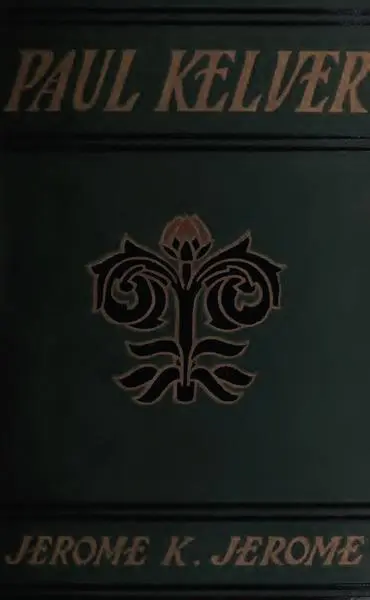
Jerome Jerome - Paul Kelver
Здесь есть возможность читать онлайн «Jerome Jerome - Paul Kelver» весь текст электронной книги совершенно бесплатно (целиком полную версию без сокращений). В некоторых случаях можно слушать аудио, скачать через торрент в формате fb2 и присутствует краткое содержание. Город: New York, Год выпуска: 1902, Издательство: Dodd, Mead & Company, Жанр: Классическая проза, на английском языке. Описание произведения, (предисловие) а так же отзывы посетителей доступны на портале библиотеки ЛибКат.
- Название:Paul Kelver
- Автор:
- Издательство:Dodd, Mead & Company
- Жанр:
- Год:1902
- Город:New York
- ISBN:нет данных
- Рейтинг книги:3 / 5. Голосов: 1
-
Избранное:Добавить в избранное
- Отзывы:
-
Ваша оценка:
Paul Kelver: краткое содержание, описание и аннотация
Предлагаем к чтению аннотацию, описание, краткое содержание или предисловие (зависит от того, что написал сам автор книги «Paul Kelver»). Если вы не нашли необходимую информацию о книге — напишите в комментариях, мы постараемся отыскать её.
Paul Kelver — читать онлайн бесплатно полную книгу (весь текст) целиком
Ниже представлен текст книги, разбитый по страницам. Система сохранения места последней прочитанной страницы, позволяет с удобством читать онлайн бесплатно книгу «Paul Kelver», без необходимости каждый раз заново искать на чём Вы остановились. Поставьте закладку, и сможете в любой момент перейти на страницу, на которой закончили чтение.
Интервал:
Закладка:
At the final fall of the curtain the house appeared divided as regarded the merits of the opera; but for “Goggles” there was a unanimous and enthusiastic call, and the while we were dressing a message came for “Goggles” that Mr. Hodgson wished to see him in his private room.
“He can make a funny face, no doubt about it,” commented one gentleman, as “Goggles” left the room.
“I defy him to make a funnier one than God Almighty's made for him,” responded the massive gentleman.
“There's a deal in luck,” observed, with a sigh, another, a tall, handsome young gentleman possessed of a rich bass voice.
Leaving the stage door, I encountered a group of gentlemen waiting upon the pavement outside. Not interested in them myself, I was hurrying past, when one laid a hand upon my shoulder. I turned. He was a big, broad-shouldered fellow, with a dark Vandyke beard and soft, dreamy eyes.
“Dan!” I cried.
“I thought it was you, young 'un, in the first act,” he answered. “In the second, when you came on without a moustache, I knew it. Are you in a hurry?”
“Not at all,” I answered. “Are you?”
“No,” he replied; “we don't go to press till Thursday, so I can write my notice to-morrow. Come and have supper with me at the Albion and we will talk. You look tired, young 'un.”
“No,” I assured him, “only excited—partly at meeting you.”
He laughed, and drew my arm through his.
Chapter V.
How on a Sweet Grey Morning the Future came to Paul.
Over our supper Dan and I exchanged histories. They revealed points of similarity. Leaving school some considerable time earlier than myself, Dan had gone to Cambridge; but two years later, in consequence of the death of his father, of a wound contracted in the Indian Mutiny and never cured, had been compelled to bring his college career to an untimely termination.
“You might not have expected that to grieve me,” said Dan, with a smile, “but, as a matter of fact, it was a severe blow to me. At Cambridge I discovered that I was by temperament a scholar. The reason why at school I took no interest in learning was because learning was, of set purpose, made as uninteresting as possible. Like a Cook's tourist party through a picture gallery, we were rushed through education; the object being not that we should see and understand, but that we should be able to say that we had done it. At college I chose my own subjects, studied them in my own way. I fed on knowledge, was not stuffed with it like a Strassburg goose.”
Returning to London, he had taken a situation in a bank, the chairman of which had been an old friend of his father. The advantage was that while earning a small income he had time to continue his studies; but the deadly monotony of the work had appalled him, and upon the death of his mother he had shaken the cloying dust of the City from his brain and joined a small “fit-up” theatrical company. On the stage he had remained for another eighteen months; had played all roles, from “Romeo” to “Paul Pry,” had helped to paint the scenery, had assisted in the bill-posting. The latter, so he told me, he had found one of the most difficult of accomplishments, the paste-laden poster having an innate tendency to recoil upon the amateur's own head, and to stick there. Wearying of the stage proper, he had joined a circus company, had been “Signor Ricardo, the daring bare-back rider,” also one of the “Brothers Roscius in their marvellous trapeze act;” inclining again towards respectability, had been a waiter for three months at Ostend; from that, a footman.
“One never knows,” remarked Dan. “I may come to be a society novelist; if so, inside knowledge of the aristocracy will give me decided advantage over the majority of my competitors.”
Other callings he had sampled: had tramped through Ireland with a fiddle; through Scotland with a lecture on Palestine, assisted by dissolving views; had been a billiard-marker; next a schoolmaster. For the last three months he had been a journalist, dramatic and musical critic to a Sunday newspaper. Often had I dreamt of such a position for myself.
“How did you obtain it?” I asked.
“The idea occurred to me,” replied Dan, “late one afternoon, sauntering down the Strand, wondering what I should do next. I was on my beam ends, with only a few shillings in my pocket; but luck has always been with me. I entered the first newspaper office I came to, walked upstairs to the first floor, and opening the first door without knocking, passed through a small, empty room into a larger one, littered with books and papers. It was growing dark. A gentleman of extremely youthful figure was running round and round, cursing to himself because of three things: he had upset the ink, could not find the matches, and had broken the bell-pull. In the gloom, assuming him to be the office boy, I thought it would be fun to mistake him for the editor. As a matter of fact, he turned out to be the editor. I lit the gas for him, and found him another ink-pot. He was a slim young man with the voice and manner of a schoolboy. I don't suppose he is any more than five or six-and-twenty. He owes his position to the fact of his aunt's being the proprietress. He asked me if he knew me. Before I could tell him that he didn't, he went on talking. He appeared to be labouring under a general sense of injury.”
“'People come into this office,' he said; 'they seem to look upon it as a shelter from the rain—people I don't know from Adam. And that damned fool downstairs lets them march straight up—anybody, men with articles on safety valves, people who have merely come to kick up a row about something or another. Half my work I have to do on the stairs.”
“I recommended to him that he should insist upon strangers writing their business upon a slip of paper. He thought it a good idea.”
“'For the last three-quarters of an hour,' he said, 'have I been trying to finish this one column, and four times have I been interrupted.'”
“At that precise moment there came another knock at the door.”
“'I won't see him!' he cried. 'I don't care who he is; I won't see him. Send him away! Send everybody away!'”
“I went to the door. He was an elderly gentleman. He made to sweep by me; but I barred his way, and closed the editorial door behind me. He seemed surprised; but I told him it was impossible for him to see the editor that afternoon, and suggested his writing his business on a sheet of paper, which I handed to him for the purpose. I remained in that ante-room for half an hour, and during that time I suppose I must have sent away about ten or a dozen people. I don't think their business could have been important, or I should have heard about it afterwards. The last to come was a tired-looking gentleman, smoking a cigarette. I asked him his name.”
“He looked at me in surprise, and then answered, 'Idiot!'”
“I remained firm, however, and refused to let him pass.”
“'It's a bit awkward,' he retorted. 'Don't you think you could make an exception in favour of the sub-editor on press night?'”
“I replied that such would be contrary to my instructions.”
“'Oh, all right,' he answered. 'I'd like to know who's going to the Royalty to-night, that's all. It's seven o'clock already.'”
“An idea occurred to me. If the sub-editor of a paper doesn't know whom to send to a theatre, it must mean that the post of dramatic critic on that paper is for some reason or another vacant.”
“'Oh, that's all right,' I told him. 'I shall be in time enough.'”
“He appeared neither pleased nor displeased. 'Have you arranged with the Guv'nor?' he asked me.”
“'I'm just waiting to see him again for a few minutes,' I returned. 'It'll be all right. Have you got the ticket?'”
Читать дальшеИнтервал:
Закладка:
Похожие книги на «Paul Kelver»
Представляем Вашему вниманию похожие книги на «Paul Kelver» списком для выбора. Мы отобрали схожую по названию и смыслу литературу в надежде предоставить читателям больше вариантов отыскать новые, интересные, ещё непрочитанные произведения.






Обсуждение, отзывы о книге «Paul Kelver» и просто собственные мнения читателей. Оставьте ваши комментарии, напишите, что Вы думаете о произведении, его смысле или главных героях. Укажите что конкретно понравилось, а что нет, и почему Вы так считаете.