Jerome Jerome - Paul Kelver
Здесь есть возможность читать онлайн «Jerome Jerome - Paul Kelver» весь текст электронной книги совершенно бесплатно (целиком полную версию без сокращений). В некоторых случаях можно слушать аудио, скачать через торрент в формате fb2 и присутствует краткое содержание. Город: New York, Год выпуска: 1902, Издательство: Dodd, Mead & Company, Жанр: Классическая проза, на английском языке. Описание произведения, (предисловие) а так же отзывы посетителей доступны на портале библиотеки ЛибКат.
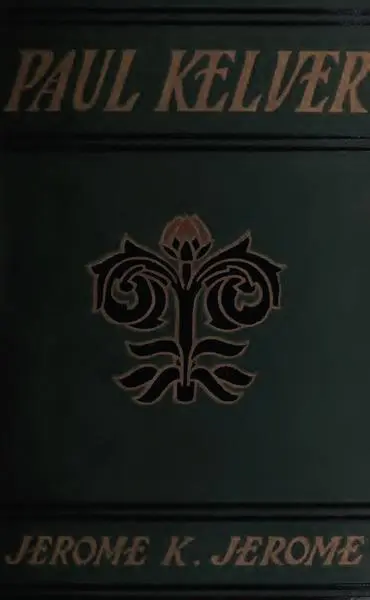
- Название:Paul Kelver
- Автор:
- Издательство:Dodd, Mead & Company
- Жанр:
- Год:1902
- Город:New York
- ISBN:нет данных
- Рейтинг книги:3 / 5. Голосов: 1
-
Избранное:Добавить в избранное
- Отзывы:
-
Ваша оценка:
Paul Kelver: краткое содержание, описание и аннотация
Предлагаем к чтению аннотацию, описание, краткое содержание или предисловие (зависит от того, что написал сам автор книги «Paul Kelver»). Если вы не нашли необходимую информацию о книге — напишите в комментариях, мы постараемся отыскать её.
Paul Kelver — читать онлайн бесплатно полную книгу (весь текст) целиком
Ниже представлен текст книги, разбитый по страницам. Система сохранения места последней прочитанной страницы, позволяет с удобством читать онлайн бесплатно книгу «Paul Kelver», без необходимости каждый раз заново искать на чём Вы остановились. Поставьте закладку, и сможете в любой момент перейти на страницу, на которой закончили чтение.
Интервал:
Закладка:
The gust was dispersed by the practical remark of brother George to the effect that the last tram for Walworth left the Oval at eleven-thirty; to which he further added the suggestion that the Clapham Road was wide and well adapted to a row.
“There ain't going to be no rows,” replied Uncle Gutton, returning to amiability as suddenly as he had departed from it. “We understand each other, don't we, my girl?”
“That's all right, uncle. I know what you mean,” returned Miss Sellars, with equal handsomeness.
“Bring him round again when he's feeling better,” added Uncle Gutton, “and we'll have another look at him.”
“What you want,” advised the watery-eyed young man on shaking hands with me, “is complete rest and a tombstone.”
I wished at the time I could have followed his prescription.
The maternal Sellars waddled after us into the passage, which she completely blocked. She told me she was delight-ted to have met me, and that she was always at home on Sundays.
I said I would remember it, and thanked her warmly for a pleasant evening, at Miss Sellars' request calling her Ma.
Outside, Miss Sellars agreed that my presentiment had proved correct—that I had not shone to advantage. Our journey home on a tramcar was a somewhat silent proceeding. At the door of her room she forgave me, and kissed me good night. Had I been frank with her, I should have thanked her for that evening's experience. It had made my course plain to me.
The next day, which was Thursday, I wandered about the streets till two o'clock in the morning, when I slipped in quietly, passing Miss Sellars' door with my boots in my hand.
After Mr. Lott's departure on Friday, which, fortunately, was pay-day, I set my desk in order and confided to Minikin written instructions concerning all matters unfinished.
“I shall not be here to-morrow,” I told him. “Going to follow your advice.”
“Found anything to do?” he asked.
“Not yet,” I answered.
“Suppose you can't get anything?”
“If the worst comes to the worst,” I replied, “I can hang myself.”
“Well, you know the girl. Maybe you are right,” he agreed.
“Hope it won't throw much extra work on you,” I said.
“Well, I shan't be catching it if it does,” was his answer. “That's all right.”
He walked with me to the “Angel,” and there we parted.
“If you do get on to the stage,” he said, “and it's anything worth seeing, and you send me an order, and I can find the time, maybe I'll come and see you.”
I thanked him for his promised support and jumped upon the tram.
The O'Kelly's address was in Belsize Square. I was about to ring and knock, as requested by a highly-polished brass plate, when I became aware of pieces of small coal falling about me on the doorstep. Looking up, I perceived the O'Kelly leaning out of an attic window. From signs I gathered I was to retire from the doorstep and wait. In a few minutes the door opened and his hand beckoned me to enter.
“Walk quietly,” he whispered; and on tip-toe we climbed up to the attic from where had fallen the coal. “I've been waiting for ye,” explained the O'Kelly, speaking low. “Me wife—a good woman, Paul; sure, a better woman never lived; ye'll like her when ye know her, later on—she might not care about ye're calling. She'd want to know where I met ye, and—ye understand? Besides,” added the O'Kelly, “we can smoke up here;” and seating himself where he could keep an eye upon the door, near to a small cupboard out of which he produced a pipe still alight, the O'Kelly prepared himself to listen.
I told him briefly the reason of my visit.
“It was my fault, Paul,” he was good enough to say; “my fault entirely. Between ourselves, it was a damned silly idea, that party, the whole thing altogether. Don't ye think so?”
I replied that I was naturally prejudiced against it myself.
“Most unfortunate for me,” continued the O'Kelly; “I know that. Me cabman took me to Hammersmith instead of Hampstead; said I told him Hammersmith. Didn't get home here till three o'clock in the morning. Most unfortunate—under the circumstances.”
I could quite imagine it.
“But I'm glad ye've come,” said the O'Kelly. “I had a notion ye did something foolish that evening, but I couldn't remember precisely what. It's been worrying me.”
“It's been worrying me also, I can assure you,” I told him; and I gave him an account of my Wednesday evening's experience.
“I'll go round to-morrow morning,” he said, “and see one or two people. It's not a bad idea, that of Jarman's. I think I may be able to arrange something for ye.”
He fixed a time for me to call again upon him the next day, when Mrs. O'Kelly would be away from home. He instructed me to walk quietly up and down on the opposite side of the road with my eye on the attic window, and not to come across unless he waved a handkerchief.
Rising to go, I thanked him for his kindness. “Don't put it that way, me dear Paul,” he answered. “If I don't get ye out of this scrape I shall never forgive meself. If we damned silly fools don't help one another,” he added, with his pleasant laugh, “who is to help us?”
We crept downstairs as we had crept up. As we reached the first floor, the drawing-room door suddenly opened.
“William!” cried a sharp voice.
“Me dear,” answered the O'Kelly, snatching his pipe from his mouth and thrusting it, still alight, into his trousers pocket. I made the rest of the descent by myself, and slipping out, closed the door behind me as noiselessly as possible.
Again I did not return to Nelson Square until the early hours, and the next morning did not venture out until I had heard Miss Sellars, who appeared to be in a bad temper, leave the house. Then running to the top of the kitchen stairs, I called for Mrs. Peedles. I told her I was going to leave her, and, judging the truth to be the simplest explanation, I told her the reason why.
“My dear,” said Mrs. Peedles, “I am only too glad to hear it. It wasn't for me to interfere, but I couldn't help seeing you were making a fool of yourself. I only hope you'll get clear off, and you may depend upon me to do all I can to help you.”
“You don't think I'm acting dishonourably, do you, Mrs. Peedles?” I asked.
“My dear,” replied Mrs. Peedles, “it's a difficult world to live in—leastways, that's been my experience of it.”
I had just completed my packing—it had not taken me long—when I heard upon the stairs the heavy panting that always announced to me the up-coming of Mrs. Peedles. She entered with a bundle of old manuscripts under her arm, torn and tumbled booklets of various shapes and sizes. These she plumped down upon the rickety table, and herself upon the nearest chair.
“Put them in your box, my dear,” said Mrs. Peedles. “They'll come in useful to you later on.”
I glanced at the bundle. I saw it was a collection of old plays in manuscript-prompt copies, scored, cut and interlined. The top one I noticed was “The Bloodspot: Or the Maiden, the Miser and the Murderer;” the second, “The Female Highwayman.”
“Everybody's forgotten 'em,” explained Mrs. Peedles, “but there's some good stuff in all of them.”
“But what am I to do with them?” I enquired.
“Just whatever you like, my dear,” explained Mrs. Peedles. “It's quite safe. They're all of 'em dead, the authors of 'em. I've picked 'em out most carefully. You just take a scene from one and a scene from the other. With judgment and your talent you'll make a dozen good plays out of that little lot when your time comes.”
“But they wouldn't be my plays, Mrs. Peedles,” I suggested.
“They will if I give them to you,” answered Mrs. Peedles. “You put 'em in your box. And never mind the bit of rent,” added Mrs. Peedles; “you can pay me that later on.”
Читать дальшеИнтервал:
Закладка:
Похожие книги на «Paul Kelver»
Представляем Вашему вниманию похожие книги на «Paul Kelver» списком для выбора. Мы отобрали схожую по названию и смыслу литературу в надежде предоставить читателям больше вариантов отыскать новые, интересные, ещё непрочитанные произведения.








Обсуждение, отзывы о книге «Paul Kelver» и просто собственные мнения читателей. Оставьте ваши комментарии, напишите, что Вы думаете о произведении, его смысле или главных героях. Укажите что конкретно понравилось, а что нет, и почему Вы так считаете.