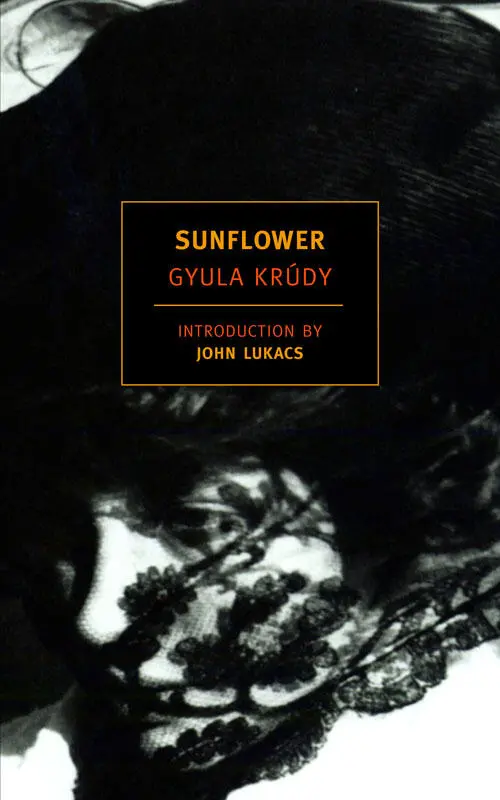
Gyula Krudy - Sunflower
Здесь есть возможность читать онлайн «Gyula Krudy - Sunflower» весь текст электронной книги совершенно бесплатно (целиком полную версию без сокращений). В некоторых случаях можно слушать аудио, скачать через торрент в формате fb2 и присутствует краткое содержание. Город: New York, Год выпуска: 2007, Издательство: New York Review Books, Жанр: Классическая проза, на английском языке. Описание произведения, (предисловие) а так же отзывы посетителей доступны на портале библиотеки ЛибКат.
- Название:Sunflower
- Автор:
- Издательство:New York Review Books
- Жанр:
- Год:2007
- Город:New York
- ISBN:нет данных
- Рейтинг книги:4 / 5. Голосов: 1
-
Избранное:Добавить в избранное
- Отзывы:
-
Ваша оценка:
Sunflower: краткое содержание, описание и аннотация
Предлагаем к чтению аннотацию, описание, краткое содержание или предисловие (зависит от того, что написал сам автор книги «Sunflower»). Если вы не нашли необходимую информацию о книге — напишите в комментариях, мы постараемся отыскать её.
In
young Eveline leaves the city and returns to her country estate to escape the memory of her desperate love for the unscrupulous charmer Kálmán. There she encounters the melancholy Álmos-Dreamer, who is languishing for love of her, and is visited by the bizarre and beautiful Miss Maszkerádi, a woman who is a force of nature. The plot twists and turns; elemental myth mingles with sheer farce: Krúdy brilliantly illuminates the shifting contours and acid colors of the landscape of desire.
John Bátki’s outstanding translation of
is the perfect introduction to the world of Gyula Krúdy, a genius as singular as Robert Walser, Bruno Schulz, or Joseph Roth.
Sunflower — читать онлайн бесплатно полную книгу (весь текст) целиком
Ниже представлен текст книги, разбитый по страницам. Система сохранения места последней прочитанной страницы, позволяет с удобством читать онлайн бесплатно книгу «Sunflower», без необходимости каждый раз заново искать на чём Вы остановились. Поставьте закладку, и сможете в любой момент перейти на страницу, на которой закончили чтение.
Интервал:
Закладка:
Queen of my heart, one who secretly loved you the most sends his farewell, his greetings toward your window, and reminds you that there is only one decent man in the whole county, and his name is Andor Álmos-Dreamer.
Please accept all that a dying man can give: his blessing.
Your humble servant,
Pistoli
Pistoli, having looked around in vain to find a suitable personage to notarize his documents, went up to the county seat at Nagykálló, where he used to run loose as often as he could, back in his days as a madman.
He found his three deranged wives together in the asylum garden, for they always kept each other’s company and never fought; Mishlik was digging a pit and the other two watched attentively.
For a while Pistoli observed his mad wives from the cover of the garden shrubbery, nodding repeatedly.
“Ah, so the poor things are already digging my grave. Alas, they will not be able to come to my funeral.”
The poor creatures were not the least bit surprised to see Pistoli suddenly in their midst. Since they usually talked mostly about him, the appearance of the man they so often mentioned seemed natural. The two older women merely nodded in greeting, but Mishlik, who had not yet abandoned all hope, vehemently grasped Pistoli’s arm:
“Ah, good to see you here, marquis. Perhaps you could intercede on our behalf. They won’t let us bury our petticoats here. But what use could we still have for a chemise, don’t you agree?”
“I’ll make sure to talk to the director,” said Pistoli, glad to comply.
“Why, only those women need petticoats who still have a husband or lover,” continued Mishlik, producing a lively variety of facial expressions. “But our lord and husband has vanished like smoke…like smoke…Is it possible to bury smoke? When it’s gone, it’s gone…”
Alarmed, they stared at Pistoli, but he kept his calm. He caressed their faces one after the other.
“Still, you had it pretty good, for each of you received one third of your husband’s affections. Other women get only a quarter share. For a man’s love is like moonlight: it has four quarters. The woman who gets the last quarter is happiest, for that’s the longest lasting. But Pistoli’s moon was divided into only three parts. One-two-three. There was no fourth. And there never will be one. So why should you bury your petticoats?”
After this, Pistoli soon had to make his escape from the garden, for the three women crowded about very close to him. Their careworn, grieving, cemetery-flower faces surrounded the moribund man. The first carried her worries like cobwebs from a cellar. The second one displayed images of woe seen on antique funeral monuments…The third one presented a frost-bitten autumnal pallor, acrid as sumac blossoms. In the autumn of life the eyes withdraw into their orbits like a shepherd into his hut when the nights are getting cooler. Above the thinning crop of hair the moon passes on, as over a field, where once upon a time it was impossible not to linger among the lush, wild growth of young curls. The fields grow rusty red, and so does the aging woman’s hair, like outdated furs.
“Alas, no matter how smart I am, I won’t have the good fortune of dying in the lap of a fifteen-year-old girl,” thought Pistoli, ambling in the direction of a roadside tavern to review his adventures for the final time.
It was as if he were sobering up after a twenty-year drunk. He sat high up on the ramparts of a fort, with a long-distance view over life’s meandering gray and empty highways. He had danced with wild mercenaries and pink-flashing girls of easy virtue till daybreak, hitting the very rafters, trampling on top of the coffin and the cradle. But at sunrise he sobered. Now he could see how futile all that sweaty running, tramping, and hastening toward distant, beckoning towers had been. He saw only life’s monotonous span, here and there a hump of land that rose for no particular reason; and valleys where only the solitary frog croaked. Along the empty highways he saw the capsized carts that would never reach their unknown destination. The wind whistled over the horizon like an invisible player’s fingers over a silent piano. Yes, Mr. Pistoli was sober at last — having believed for a quarter century that drunkenness lay always in wine and women, and not in his freakish head. How much imbecility he had witnessed while loitering around life’s fairgrounds, nosing about barbecue stands and white-footed females! Where were they now, those ebony and russet female pelts he had once been ready to die for? Where were they now, women thirsting for revenge, the savor of kisses, the fragrance of their bodies, soft touch of their palms, flash of their eyes, carillon of their voices, their honeyed whispers, the stupefying fume of their sighs, their high-strung legs, the thrill of their groans and precious moans, virgins’ frenzied, abandoned oaths, and the wine-tasting apples of untouched maidens? The roads are empty everywhere, no matter how wide his eyes scan, shaded by his palm; all is laid to rest, like a bird fallen on dry leaves; the arrow no longer quivers in the deep wound it had struck; the inflated balloon pops under the clown’s tailcoat, and life, daubed with pancake makeup, stands gaping at the source of the sound. No, it had not been all that wonderful…Nor very surprising…Not even all that interesting. It was merely like a dog panting under a hawthorn bush. At times the flag flew from life’s pinnacle. Then the rain drenched the flag and the parade was over…Only the insane and the imbecilic imagine that life has not raced past them.
At this moment Mr. Pistoli had the strangest vision, as he sat in that roadside tavern by his glass of red wine, contemplating his boots, rummaging among his thoughts.
Up on one mountaintop in the far distance sat Eveline. Her benevolent face was distorted, her curls hung in grizzled knots, her dear eyes were veiled by cataracts, night had descended over her lips, like a madwoman’s…And this hag had been her, once: the kind, noble, lamblike, dove-hearted one…This ancient, deranged crone had once been Eveline Nyirjes…Pistoli covered his eyes and sobbed. But even through his tears he could see the other mountaintop on the horizon, where Miss Maszkerádi bobbed like a crazed belly dancer. Her tresses undone, her voice screeching, her talons curving, her eyes spitting flames and knives, her legs like a wolf’s, her neck ringed like a serpent’s.
“Ah, what kind of wine is this?” cried Pistoli, and shivering, pulled the cape about himself, as he departed from the road-side inn.
It was around midnight when he got home.
The moon, like a peacock feather’s eye, stood waking over the lifeless world.
Pistoli, to find some solace amidst his gloomy thoughts, consoled himself by recalling that, after all, nothing base had ever really happened to him, and so he had no cause to complain, when a dark shadow like a bandit’s glided past his porch. It had to be a man, for it wore pants. Pistoli howled out:
“Is that you, Death?”
His alien, hoarse roar gave him courage. Like a wild boar he charged the shadowy figure and his heavy fists pummeled the intruder. The shadow did not respond to the blows. It did not defend itself, nor did it strike back, but merely emitted a sound, something like a horrendous scream behind gritted teeth. At last Pistoli knocked off the nocturnal visitor’s hat, and his hands felt soft, warm, fragrantly feminine hair. His arm froze as if in a spasm; the midnight fisticuffs came to a halt. He fumbled for a matchstick in his waistband, and while the uncertain bluish flame flickered up, Pistoli’s whole being was pierced to the core by a tremulous thought, like a fit of ague.
When the match flared up, Pistoli’s mouth gaped wide, although he could not be said to be disappointed in what he saw. On his porch he found the one he had been waiting for. At arm’s length stood Miss Maszkerádi, her nose bloodied. She wore a strange getup, formal evening wear: tailcoat and trousers, and a blazing white starched shirt. It gave her the mannish and eccentric look of a circus artiste.
Читать дальшеИнтервал:
Закладка:
Похожие книги на «Sunflower»
Представляем Вашему вниманию похожие книги на «Sunflower» списком для выбора. Мы отобрали схожую по названию и смыслу литературу в надежде предоставить читателям больше вариантов отыскать новые, интересные, ещё непрочитанные произведения.












Обсуждение, отзывы о книге «Sunflower» и просто собственные мнения читателей. Оставьте ваши комментарии, напишите, что Вы думаете о произведении, его смысле или главных героях. Укажите что конкретно понравилось, а что нет, и почему Вы так считаете.