Gyula Krudy - Sunflower
Здесь есть возможность читать онлайн «Gyula Krudy - Sunflower» весь текст электронной книги совершенно бесплатно (целиком полную версию без сокращений). В некоторых случаях можно слушать аудио, скачать через торрент в формате fb2 и присутствует краткое содержание. Город: New York, Год выпуска: 2007, Издательство: New York Review Books, Жанр: Классическая проза, на английском языке. Описание произведения, (предисловие) а так же отзывы посетителей доступны на портале библиотеки ЛибКат.
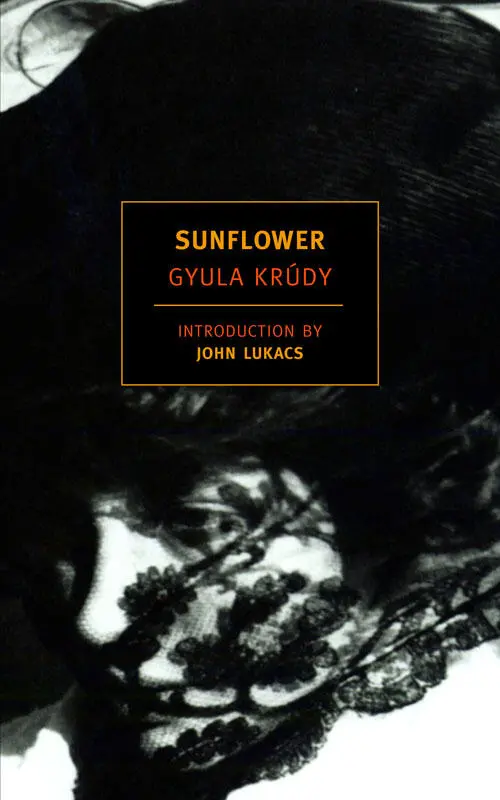
- Название:Sunflower
- Автор:
- Издательство:New York Review Books
- Жанр:
- Год:2007
- Город:New York
- ISBN:нет данных
- Рейтинг книги:4 / 5. Голосов: 1
-
Избранное:Добавить в избранное
- Отзывы:
-
Ваша оценка:
Sunflower: краткое содержание, описание и аннотация
Предлагаем к чтению аннотацию, описание, краткое содержание или предисловие (зависит от того, что написал сам автор книги «Sunflower»). Если вы не нашли необходимую информацию о книге — напишите в комментариях, мы постараемся отыскать её.
In
young Eveline leaves the city and returns to her country estate to escape the memory of her desperate love for the unscrupulous charmer Kálmán. There she encounters the melancholy Álmos-Dreamer, who is languishing for love of her, and is visited by the bizarre and beautiful Miss Maszkerádi, a woman who is a force of nature. The plot twists and turns; elemental myth mingles with sheer farce: Krúdy brilliantly illuminates the shifting contours and acid colors of the landscape of desire.
John Bátki’s outstanding translation of
is the perfect introduction to the world of Gyula Krúdy, a genius as singular as Robert Walser, Bruno Schulz, or Joseph Roth.
Sunflower — читать онлайн бесплатно полную книгу (весь текст) целиком
Ниже представлен текст книги, разбитый по страницам. Система сохранения места последней прочитанной страницы, позволяет с удобством читать онлайн бесплатно книгу «Sunflower», без необходимости каждый раз заново искать на чём Вы остановились. Поставьте закладку, и сможете в любой момент перейти на страницу, на которой закончили чтение.
Интервал:
Закладка:
Such were Mr. Pistoli’s thoughts in his solitude and, since he was as vain as an aging actress, he resolved to avoid the meeting. There are in any human life a number of such inexplicable things, mysterious phenomena that have no apparent meaning, and yet deep down a solution certainly exists. Perhaps the noble Pistoli was merely acting out the offended, humiliated male rearing up to take his revenge on Miss M. for the beating she had given him. Whereas, had he been more of an ordinary soul, he would have elected the jolly path of reconciliation. But he was still smarting from that whiplash…And Pistoli was accustomed to women kissing his hands whenever he was kind, condescending, emotional and passionate toward them. Village women are not spoiled by an overabundance of amorous proposals. As a rule they will be astonished to hear any man’s declaration of love. The most worn-out compliment is a novelty for their ears. They cast their eyes down when they hear their hands or feet praised. And when they are alone again, they will stare at length into the mirror at the tresses some babbling man had praised with such strange extravagance. In this part of the country women are still naive, gullible, and well-meaning. The village primadonna never drives her beaux to suicide. Take Risoulette: she had gone out of her way to be nice to many a man who was barely better looking than the devil himself! (They say even the most pockmarked, puny man will find a lover.) Therefore Pistoli’s huffiness in holding out against the society miss’s summons is quite understandable. In fact, he remembered he still had to say good-bye to his deranged wives.
He had already donned his cape, and pulled the broad-brimmed hat over his eyes, the hat that had made him unrecognizable at Nagykálló (where he had perpetrated so many pranks) — when something suddenly occurred to him. — What if the young lady who wanted to visit him in fact had not ingested chalk? What if this visit was merely a cunning stunt on Miss M.’s part, to oblige Mr. Pistoli never to betray her secret to Eveline, to hold his peace forever about matters glimpsed around the garden cottage during Kálmán Ossuary’s sojourn there? Girlfriends will grow sentimental at times, and will not shrink from the greatest sacrifice just to maintain their intimate bonds. Perhaps Miss M. had merely wanted to prevent his betraying those potentially painful and damaging escapades of hers, amorous escapades which would certainly stab Eveline to the core of her heart if she heard about them? “So, you would shove me underground, while you go on fornicating?” Pistoli muttered, gritting his teeth. “I’m going to queer this deal for you.”
He worked himself into a coarse, cruel, malevolent mood, as he sat down with a sheet of Diósgyo´´r foolscap to write down all about Miss Maszkerádi and Ossuary: everything he knew, and things he did not know…For the moment he did not consider that his treachery would also be a fatal blow for his beloved Eveline, whose consecrated love for Ossuary he had witnessed with his own eyes. He persisted in scraping away with his goose quill, as if he were a liverish judge writing out a death sentence. When he was finished with his business, he sealed the letter and placed it in a double envelope. On the inner one he wrote: “To be opened after my death.” The outer one he addressed to Her Ladyship, Miss Eveline Nyírjes. Pocketing the letter, he cheerfully set out for Kálló, to visit the madwomen.
The letter hiding in Mr. Pistoli’s cape went as follows:
Pistoli Residence, May 18 —
My Queen!
When for the final time I confess to you all those tender respects, my heart’s wild roses, floating moods, my bygone life’s aerial smoke rings, song-filled reveries, the butterflies hovering around my head; bellowing woes, deathwatch beetle — like, gnawing torments and ethereal fluttery humors that rose and fell during my days like two lovers on a swing — I wish to report to you something that may very well be a matter of indifference to you: that I take your memory with me to the other world as a hunter takes the cherished edelweiss in his hatband. You were the Fairy Queen in the apple tree of my life, singing invisibly, seated in a blossom’s calyx. You were my sunrise — the virginal veil over my world; and you were the sunset as well, an old man’s singsong humming prompted by memories of bygone happy loves. For your love I would have turned comedian or gendarme, a Hail-Mary friar or night watchman in your village, although you, alas, never desired that I assume any role in your life.
The tiny grains of sand are inescapably tumbling in my hourglass. A futile, blind and molelike lifetime’s ashes are heaping up on the bottom of the glass. Perhaps I could have been master of ceremonies at your May-time picnics, or else your estate’s undertaker, sheriff, or overseer; but the hell with it, I had no ambition to become anything. If you honor my memory by listening to my glee club’s songs at my graveside, I shall have accomplished all that I aimed for in life.
Staff in hand, I am ready to depart, and so I must not make the otherworldy carriage wait, nor can I let my sinful eyes caress one last time your figure’s lilylike lines, your chignon, that solace of my lifetime, your heartening visage, your precious glance. My eyes have seen much that was never seen by other men. Love, separated from murder by the narrowest of margins, I have always beheld as a miracle. I was always astonished when love appeared on my life’s way. I know love backwards and forwards, as I do my local road master; I recognize love’s footfall in the night, under my window, and do not mistake it for anyone else, such as the watchman. Yes, I have seen love seated up in a tree, carefree, swinging her legs. And I have met her in the roadside ditch, in back of gardens, along the fence, where pictures cut out of old magazines decorated the planks.
I have always known more than others, for women and men told me everything, as to a father confessor. I have heard of the loves of serving girls and the passion of brother for sister, fathers’ infatuation with their daughters…Secrets, voices from the cellars of the soul, in the unsteady light of the confessional’s guttering oil lamp. I was a wise man, for I always listened and never told tales, no matter what women had confided to me at a weak moment, in an unguarded mood. I shall never forget seeing men in their solemn Sunday best, coming and going like earnest churchwardens, when only a little while earlier their wives had testified to me about their hidden passions, the strange histories of bedtime. In the same way, men had trusted me with everything about their wives over a cup of wine, disciplining the soul, absorbed in conversation that delved into the most labyrinthine tunnels of life. Oh, these gingerbread hussars! — But I heard them out, and only when I got home, alone with my glass of wine, did I smile to myself, for I have always despised tattletales, backstabbers, malicious gossips. Pistoli had always been a chivalrous gentleman; in fact, an honorable man. I shall have it inscribed on my tombstone: Here lies an honest man who had exposed only one woman, to another one whom he loved as he loved life itself in his youth, when life was worth living.
And so, the woman I am about to expose, my Queen, happens to be your bosom friend Miss Maszkerádi. You two still face the long vista of your young lives; mine has declined like a wilting rosebush. Why should you be bitterly, irremediably disappointed in your best friend, the one who knows all your secrets? This lady has abused your confidence by carrying on a clandestine affair with your fiancé, who was my guest. Leave it to old Pistoli, he knows what went on. There is no possibility of a mistake here, nor any uncertainty. They have had an affair, and will continue — those two were made for each other. You, my Queen, are an innocent lamb next to this pair of bloodthirsty wolves. They are audacious and ready for anything; you are not — probably not even ready to give credence to everything in this final letter of mine. But I am confident that I will rest in peace under the poplar that I have designated for this purpose.
Читать дальшеИнтервал:
Закладка:
Похожие книги на «Sunflower»
Представляем Вашему вниманию похожие книги на «Sunflower» списком для выбора. Мы отобрали схожую по названию и смыслу литературу в надежде предоставить читателям больше вариантов отыскать новые, интересные, ещё непрочитанные произведения.












Обсуждение, отзывы о книге «Sunflower» и просто собственные мнения читателей. Оставьте ваши комментарии, напишите, что Вы думаете о произведении, его смысле или главных героях. Укажите что конкретно понравилось, а что нет, и почему Вы так считаете.