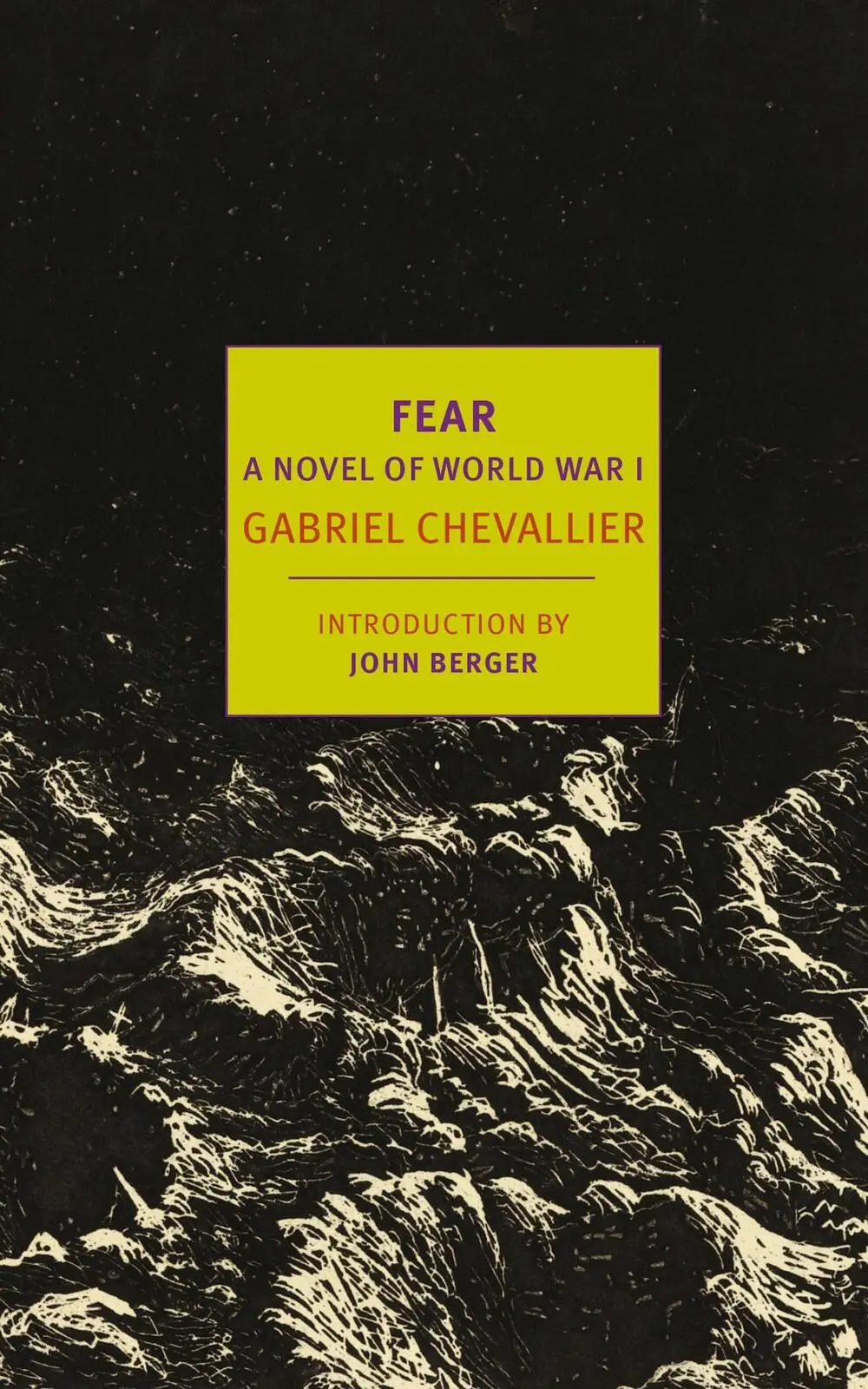
Gabriel Chevallier - Fear
Здесь есть возможность читать онлайн «Gabriel Chevallier - Fear» весь текст электронной книги совершенно бесплатно (целиком полную версию без сокращений). В некоторых случаях можно слушать аудио, скачать через торрент в формате fb2 и присутствует краткое содержание. Город: New York, Год выпуска: 2014, Издательство: New York Review Books, Жанр: Классическая проза, на английском языке. Описание произведения, (предисловие) а так же отзывы посетителей доступны на портале библиотеки ЛибКат.
- Название:Fear
- Автор:
- Издательство:New York Review Books
- Жанр:
- Год:2014
- Город:New York
- ISBN:нет данных
- Рейтинг книги:3 / 5. Голосов: 1
-
Избранное:Добавить в избранное
- Отзывы:
-
Ваша оценка:
Fear: краткое содержание, описание и аннотация
Предлагаем к чтению аннотацию, описание, краткое содержание или предисловие (зависит от того, что написал сам автор книги «Fear»). Если вы не нашли необходимую информацию о книге — напишите в комментариях, мы постараемся отыскать её.
1915: Jean Dartemont heads off to the Great War, an eager conscript. The only thing he fears is missing the action. Soon, however, the vaunted “war to end all wars” seems like a war that will never end: whether mired in the trenches or going over the top, Jean finds himself caught in the midst of an unimaginable, unceasing slaughter. After he is wounded, he returns from the front to discover a world where no one knows or wants to know any of this. Both the public and the authorities go on talking about heroes — and sending more men to their graves. But Jean refuses to keep silent. He will speak the forbidden word. He will tell them about fear.
John Berger has called
“a book of the utmost urgency and relevance.” A literary masterpiece, it is also an essential and unforgettable reckoning with the terrible war that gave birth to a century of war.
Fear — читать онлайн бесплатно полную книгу (весь текст) целиком
Ниже представлен текст книги, разбитый по страницам. Система сохранения места последней прочитанной страницы, позволяет с удобством читать онлайн бесплатно книгу «Fear», без необходимости каждый раз заново искать на чём Вы остановились. Поставьте закладку, и сможете в любой момент перейти на страницу, на которой закончили чтение.
Интервал:
Закладка:
And now I am alone, lying on a stretcher, between the trenches. Night is falling. The armies are leaving and abandoning me. I hear a bugle call, orders being shouted and down on the road I can see troops presenting arms. A colonel climbs out of a car with a flag on the bonnet. Despite the distance, I recognise him: he’s the one who made me go through the test on the parade ground at training camp… He squats down, strikes a match and lights something close to the ground. Then he gets back in his car and drives off quickly. Once again soldiers present arms, once again there are bugle calls. The troops form up in lines of four and march off without looking back. I want to call out but something is blocking my throat. I’m alone again and cold. I think of all the rats swarming over the plain that might attack me. How could I protect myself? I’ve no strength and I’m strapped to the stretcher. I look for help in this bleak, freezing expanse… I can see a little speck of light that at first I take for a glow worm. But it is coming in my direction, wiggling along the ground. I thought it was miles away but it is only the fact that it is tiny that gives the impression of distance. Actually it is close and still advancing. What can it be? Suddenly, all is clear! My hair stands on end, I break into a terrified sweat. Yes, that colonel became my enemy after I had saluted him with my left hand by mistake. The light is the flame at the end of a fuse that he has lit, a fuse which runs from the road to me, which runs round my throat and stops me shouting. And my chest, my stomach, are stuffed with explosives, I am sure of it…
The hospital train has been travelling for an hour, taking us away from the front. In the cattle truck fitted with bunks there are a dozen of us, wounded and feverish, exhausted from having already had to wait for some days on stretchers, moving from one first-aid post to another. Some have serious injuries and are in great pain.
Struck by a sudden revelation, a man with a shrapnel wound in his hip forgot his pain for a moment, and announced the dawning of a new era:
‘Hey, you lot, listen! We can’t hear the guns any more!’
‘For us,’ someone answered, ‘the war is over!’
That was a good month ago. I believed it too. Now I’m not nearly so sure.
6. THE HOSPITAL
‘He [Jesus Christ] has revealed to the world this truth, that one’s country is not everything, and that the man is before, and higher than, the citizen.’
Ernest Renan, La Vie de JésusI AM LYING IN A HOSPITAL BED and covered in dressings. A sheet is attached to the head of the bed on which is sketched a human body, front and back. A dozen marks in red ink indicate the wounds on this body: my body. On the left wrist, the throat, the legs, the right foot. ‘Nothing in the chest or guts, jolly good!’ the little doctor had told me down in the cellar at La Targette where I’d had to wait after the assault from the parapet. Next to the sketch is a temperature chart, at the foot of which can be read: ‘Admitted: 7 October 1915. Operated: 20 October. Discharged…’ I am hoping that this bit stays blank for as long as possible.
On my bedside table there are books, cigarettes, lozenges, writing materials; in the drawer, my wallet, some letters, my knife, my pen, my identity tag which is now useless, and my little aluminium mug which I found in a haversack that had stayed with me. Jolly good, indeed! I’m all right. I’ve escaped the winter offensive, and the war will surely finish. I’m happy. I’ve saved my skin…
The grenade had peppered me with shrapnel. Fortunately it was a tin grenade, blasted into such tiny pieces by the explosion that the shrapnel didn’t hit me with much force. Almost all the wounds were skin deep and even now, after a few weeks, if I press hard on the spots that appear in the middle of my body, I squeeze out very sharp bits of metal. There must be quite a few left since when I change position I can feel sudden pricks like you get if you sit on a drawing-pin. For some time I was afraid that these little bits of shrapnel might cause abscesses. But the embarrassment of showing my buttocks to the nurses always stopped me mentioning it. (For me, buttocks are linked to the image of women and seem contrary to virility. And also, perhaps, there is some remnant of military prejudice, absurd today: a soldier should not be wounded in the back.) I carry out my own examination, groping under the bedclothes. When I’ve found a little hard spot, I twist myself around to investigate it with my mirror. Then I try to clean it out with the aid of my nail or a pin. This keeps me busy during moments when I’m tired of reading or smoking, and my neighbours find it entirely natural, as they busy themselves with similar activities. In any case, we have nothing to hide about our bodies, or their functions, and we look away from those who have to uncover themselves so as not to embarrass them. The only way we discomfort each other is with smell, however hard we try to be discreet.
I have pulled a lot of shrapnel out of my legs, along the tibias, using the point of my knife. I reckon I’ve found about forty pieces. However my body only has eleven serious wounds, none of them grave. The annoying thing is that the injuries are spread all over the place so that I have had to be almost entirely swathed in bandages. As the pus sticks to the gauze the bandages adhere to the wounds so that with the least movement I feel them tearing away. And because there is a little delay in transmission from one to the other my wincing is multiplied by a series of painful twinges. So I keep as still as I can. But because of lying permanently on my back, I get bed sores and so every day I have to spend a few hours on my side. Occasionally I manage to sit up. This is a movement that I prepare carefully so as to avoid any pain sharp enough to make me fall back down rapidly. Anyway, I have plenty of time. I even manage to get up briefly, while they are making my bed.
I ‘went under the knife’ and it wasn’t so bad. The doctor in an ambulance at the front had probed my wounds and without any anaesthetic — or my consent — had pulled out the biggest pieces of shrapnel. One remained in my right foot and one in my left wrist which had lodged — without penetrating them — between the tendons which controlled the two middle fingers of my hand. To extract them they decided to put me to sleep. I was only afraid of being awake, of getting the same treatment as I had received at the front. After a day without food I was taken to the operating theatre around six o’clock, a stark, white room harshly lit by an arc lamp which gave a sharp blue shine to all the steel. I was laid out, naked, in the centre of this white space, offering myself up soft and shivering to all the instruments, as if in a torture chamber, and the nurses in their smocks seemed like the executioners of some grim inquisition. As they bent over me with the wad of cotton wool, the doctor said: ‘Don’t be afraid. Open your mouth wide and breathe deeply.’ Which I did willingly, having no wish to witness the tortures they were going to inflict on my body.
The anaesthetic gave me the distinct impression of dying and since then I’ve thought that death, the crossing over, cannot be such a difficult moment as people believe, so long as it is not accompanied by the agonies that come with illness. One must overcome anxiety, resolve to vanish into nothingness. Under chloroform you quickly lose all sensation of your body; it stops existing. All life flows back into the humming brain. Mine, up to the moment when it vanished in its turn, did not lose its lucidity. Freed of the burden of the flesh, I was nothing more than a mind, and I had the fleeting idea of being pure spirit, an angel, a little dancing flame of joy. I told myself: ‘You are dying!’ and ‘You are not really dying’, and yet: ‘All the same…’ I offered no resistance to this advancing extinction. And then my thoughts, like a distant beacon, threw nothing but a dim light within me flickering over the chiaroscuro of my being and I slipped down into the darkness, into death, without being aware of it.
Читать дальшеИнтервал:
Закладка:
Похожие книги на «Fear»
Представляем Вашему вниманию похожие книги на «Fear» списком для выбора. Мы отобрали схожую по названию и смыслу литературу в надежде предоставить читателям больше вариантов отыскать новые, интересные, ещё непрочитанные произведения.





Обсуждение, отзывы о книге «Fear» и просто собственные мнения читателей. Оставьте ваши комментарии, напишите, что Вы думаете о произведении, его смысле или главных героях. Укажите что конкретно понравилось, а что нет, и почему Вы так считаете.