Nescio - Amsterdam Stories
Здесь есть возможность читать онлайн «Nescio - Amsterdam Stories» весь текст электронной книги совершенно бесплатно (целиком полную версию без сокращений). В некоторых случаях можно слушать аудио, скачать через торрент в формате fb2 и присутствует краткое содержание. Год выпуска: 2012, Издательство: NYRB Classics, Жанр: Классическая проза, на английском языке. Описание произведения, (предисловие) а так же отзывы посетителей доступны на портале библиотеки ЛибКат.
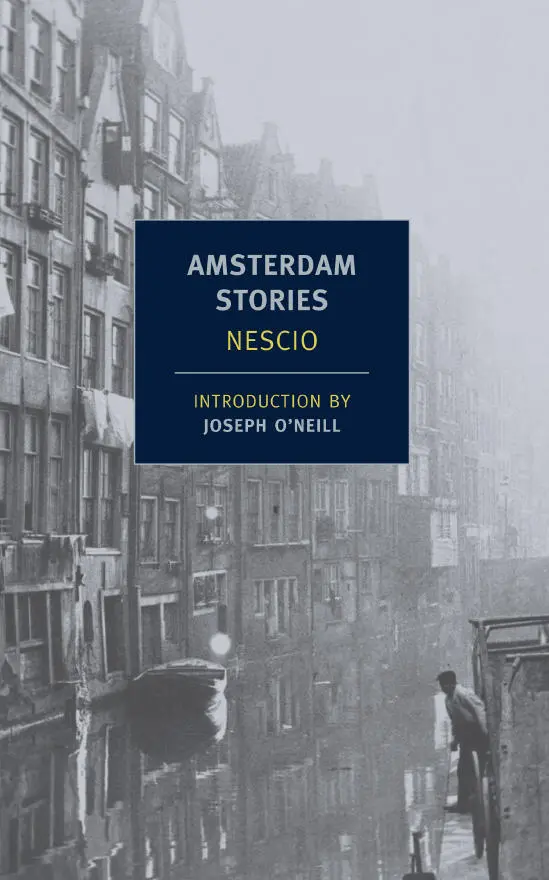
- Название:Amsterdam Stories
- Автор:
- Издательство:NYRB Classics
- Жанр:
- Год:2012
- ISBN:нет данных
- Рейтинг книги:5 / 5. Голосов: 1
-
Избранное:Добавить в избранное
- Отзывы:
-
Ваша оценка:
Amsterdam Stories: краткое содержание, описание и аннотация
Предлагаем к чтению аннотацию, описание, краткое содержание или предисловие (зависит от того, что написал сам автор книги «Amsterdam Stories»). Если вы не нашли необходимую информацию о книге — напишите в комментариях, мы постараемся отыскать её.
Who was Nescio? Nescio — Latin for “I don’t know”—was the pen name of J.H.F. Grönloh, the highly successful director of the Holland — Bombay Trading Company and a father of four — someone who knew more than enough about respectable maturity. Only in his spare time and under the cover of a pseudonym, as if commemorating a lost self, did he let himself go, producing over the course of his lifetime a handful of utterly original stories that contain some of the most luminous pages in modern literature.
This is the first English translation of Nescio’s stories.
Amsterdam Stories — читать онлайн бесплатно полную книгу (весь текст) целиком
Ниже представлен текст книги, разбитый по страницам. Система сохранения места последней прочитанной страницы, позволяет с удобством читать онлайн бесплатно книгу «Amsterdam Stories», без необходимости каждый раз заново искать на чём Вы остановились. Поставьте закладку, и сможете в любой момент перейти на страницу, на которой закончили чтение.
Интервал:
Закладка:
The present volume contains all of Nescio’s major work and a representative selection of his other fiction, both published and unpublished during his lifetime. The stories appear in chronological order of their writing, not their publication. “The Writing on the Wall” and “Out Along the IJ” are from Mene Tekel ; “The Valley of Obligations” and “Insula Dei” are from Above the Valley . For “From an Unfinished Novel” and “The End,” see the notes below.
THE FREELOADER
Dutch title: “ De uitvreter ,” sometimes translated as “The Mooch” or “The Sponger,” literally someone who eats up everything you’ve got. The narrator’s name, “Koekebakker,” literally “cookie baker,” means an inept or silly bungler; Grönloh wanted to use Koekebakker as his pseudonym, but De Gids (the magazine where “The Freeloader” was first published) may have objected — in any case he decided on Nescio. “Koekebakker” is pronounced roughly “Coo-cuh-bocker”; “Japi” is pronounced “Yoppy.”
YOUNG TITANS
Dutch title: “ Titaantjes ,” literally “Little Titans,” sometimes translated as “Little Giants” or “Young Turks.” The diminutive “ -tje ” is very widely used in Dutch (including in the title “Little Poet”) and thus has a wide range of connotations besides size: affection, condescension, camaraderie, nostalgia, sarcasm, and so on.
“ J’ai attendu le Seigneur avec une grande patience, enfin il s’est abaissé jusqu’ à moi ”: “I waited patiently for the Lord, and he inclined unto me [and heard my cry],” the beginning of Psalm 40, quoted in French from Frederik van Eeden’s 1900 novel Van de koele meeren des doods (I thank Sam de Groot for the reference).
“ Per me si va nella città dolente ” and “ Per me si va tra la perduta gente ”: “Through me you enter the city of woe … Through me you enter to join the lost.” Lines inscribed on the Gates of Hell in Dante’s Inferno , Canto III, lines 1 and 3.
THE WRITING ON THE WALL
Dutch title: “ Mene Tekel. ” “Mene, Mene, Tekel, Uparshin” are the words that appear on Belshazzar’s palace wall in the Book of Daniel (5:1–30): Daniel interprets “Mene” to mean “God has numbered the days of your kingdom and brought it to an end,” and “Tekel” to mean “You have been weighed on the scales and found wanting.” This episode is the origin of the phrase “the writing on the wall” in English.
OUT ALONG THE IJ
Dutch title: “ Buiten-IJ ,” the geographical feature (literally “Outer IJ”) at the center of the story. The IJ, the river which widens into the harbor in Amsterdam — like “ij” any time it appears in Dutch — is pronounced roughly like “eye.”
LITTLE POET
Dutch title: “ Dichtertje. ” The story was written remarkably quickly for Nescio — in this case, the date he gave at the end, “June — July 1917,” was his entire period of composition.
“ Bellum transit, amor manet ”: Latin: “War passes, love remains” (cf. “Tempus fugit, amor manet”).
“ Der Tüchtigkeit ist die Welt ”: German: “Competence is everything.”
“ Mon âme prend son élan vers l’infini ”: French: “My soul takes flight toward infinity.”
“ C’est là, c’est là qu’il faut être. Là? ”: French: “There, it has to be there. There?” A slightly altered quotation from the aria based on Goethe’s “Mignon’s Song” in the opera Mignon : “ C’est là! c’est là que je voudrais vivre ” [“There, there is where I want to live”].
“ Ins grosse Vaterland ”: German: “[Leading] into the great fatherland.”
“ Consummatum est ”: “It is finished.” Christ’s words as he was dying on the cross, in the Latin Vulgate.
FROM AN UNFINISHED NOVEL
After “Little Poet” (1917), Nescio wrote little that satisfied him until “Insula Dei” (1942). The selection here consists of some of the surviving drafts of what he apparently intended as a longer piece but abandoned — it should thus not be seen as an actual work by Nescio, and is included in this volume to give a sense of the style and content of his efforts during this long period. (The title is not Nescio’s.)
The only part of the selection here that Nescio published was paragraphs six and seven (“We sat outside …” through “… reflections in the IJ”), which he extracted in 1942 and included among the fragments that would eventually be published in Above the Valley in 1961. There it is prefaced with the following note:
And I include this piece, since it would please me greatly to think that you too can’t get enough of Amsterdam. It is from 1918. Untitled.
The first section of “From an Unfinished Novel,” until the break, is Nescio’s first draft. The minor corrections Nescio made in 1942 to paragraphs six and seven are incorporated. The last five paragraphs contain new material from his final known revision (before the 1942 reclamation), which Nescio dated October 13, 1918, and titled “De Profundis” (Latin for “From the depths,” from Psalm 130: “Out of the depths have I cried unto thee, O Lord”).
THE VALLEY OF OBLIGATIONS
Dutch title: “ Het dal der plichten. ” This is the first story from the 1961 collection Above the Valley , used as a quasi — title story and preface (it is followed by Nescio’s “Introduction” to the volume).
All the manuscript copies up to a certain stage have an additional sentence in the first paragraph, after “Some of them look up every once in a while and then they scream”: “Those are the lucky ones.” It is not clear whether Nescio omitted the sentence intentionally or accidentally; the Dutch edition gives it in a note, not in the text itself.
THE END
Dutch title: “ Het Einde. ” A fragment unpublished in Nescio’s lifetime, written December 14, 1937 (he retired at the end of December, 1937). He wrote a somewhat separate Part II of “The End,” dated almost two weeks later (December 27, 1937), which is not translated here.
The editor of the Dutch Collected Works , Lieneke Frerichs, argues that Nescio’s rereading of “The End,” to decide whether to include it in his 1942 manuscript, inspired both the content and structure of “Insula Dei”: the opening conversation between two men; the “five things worth bothering about” as underlying the five sections of the later story (with the continuation section possibly added to include more of the erotic element, the one least emphasized in the story); several passages included directly in the later story.
INSULA DEI
The only long work Nescio completed after his first three major stories. Clearly the writing of the story was an unexpected, greatly welcome side effect of compiling the 1942 manuscript that eventually served as the basis for Above the Valley : the “Introduction” to Above the Valley , dated “January 29–February 1, 1942,” ends with Nescio saying that “he has hereby put his papers in order, as though he were in fact already dead”—but is then followed by a short Part II dated February 12, 1942, beginning: “And then just like that here is another story. It turned out rather different than I’d thought.” The story itself is dated precisely to the six days February 7–12, 1942 (continuation on February 13).
“Insula Dei” is Latin for “Island of God” and a term sometimes used to refer to monasteries or abbeys.
“The eye is not satisfied with seeing, nor the ear filled with hearing”: Ecclesiastes 1:8.
Примечания
Интервал:
Закладка:
Похожие книги на «Amsterdam Stories»
Представляем Вашему вниманию похожие книги на «Amsterdam Stories» списком для выбора. Мы отобрали схожую по названию и смыслу литературу в надежде предоставить читателям больше вариантов отыскать новые, интересные, ещё непрочитанные произведения.

![Олеся Проглядова - Nomen nescio. Имя неизвестно [litres]](/books/391740/olesya-proglyadova-nomen-nescio-imya-neizvestno-lit-thumb.webp)




Обсуждение, отзывы о книге «Amsterdam Stories» и просто собственные мнения читателей. Оставьте ваши комментарии, напишите, что Вы думаете о произведении, его смысле или главных героях. Укажите что конкретно понравилось, а что нет, и почему Вы так считаете.