Nescio - Amsterdam Stories
Здесь есть возможность читать онлайн «Nescio - Amsterdam Stories» весь текст электронной книги совершенно бесплатно (целиком полную версию без сокращений). В некоторых случаях можно слушать аудио, скачать через торрент в формате fb2 и присутствует краткое содержание. Год выпуска: 2012, Издательство: NYRB Classics, Жанр: Классическая проза, на английском языке. Описание произведения, (предисловие) а так же отзывы посетителей доступны на портале библиотеки ЛибКат.
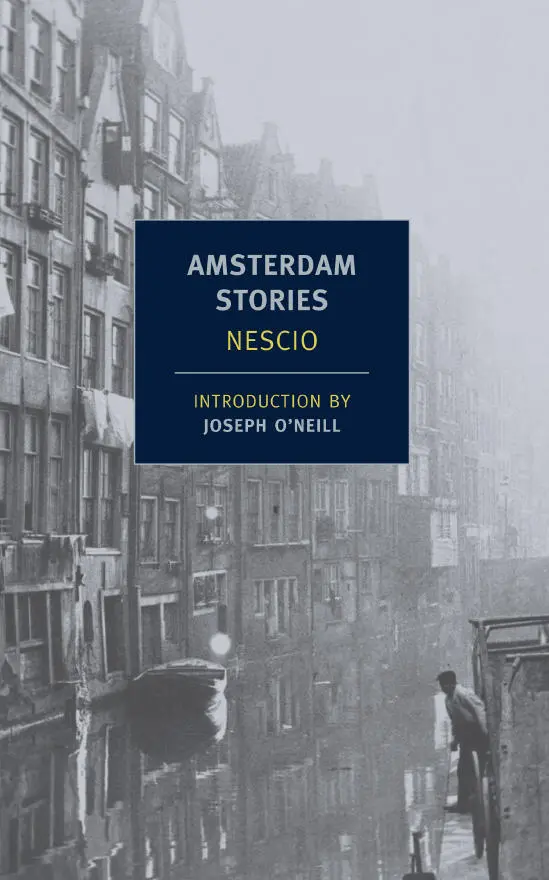
- Название:Amsterdam Stories
- Автор:
- Издательство:NYRB Classics
- Жанр:
- Год:2012
- ISBN:нет данных
- Рейтинг книги:5 / 5. Голосов: 1
-
Избранное:Добавить в избранное
- Отзывы:
-
Ваша оценка:
Amsterdam Stories: краткое содержание, описание и аннотация
Предлагаем к чтению аннотацию, описание, краткое содержание или предисловие (зависит от того, что написал сам автор книги «Amsterdam Stories»). Если вы не нашли необходимую информацию о книге — напишите в комментариях, мы постараемся отыскать её.
Who was Nescio? Nescio — Latin for “I don’t know”—was the pen name of J.H.F. Grönloh, the highly successful director of the Holland — Bombay Trading Company and a father of four — someone who knew more than enough about respectable maturity. Only in his spare time and under the cover of a pseudonym, as if commemorating a lost self, did he let himself go, producing over the course of his lifetime a handful of utterly original stories that contain some of the most luminous pages in modern literature.
This is the first English translation of Nescio’s stories.
Amsterdam Stories — читать онлайн бесплатно полную книгу (весь текст) целиком
Ниже представлен текст книги, разбитый по страницам. Система сохранения места последней прочитанной страницы, позволяет с удобством читать онлайн бесплатно книгу «Amsterdam Stories», без необходимости каждый раз заново искать на чём Вы остановились. Поставьте закладку, и сможете в любой момент перейти на страницу, на которой закончили чтение.
Интервал:
Закладка:
But the Lord is in the great silence and emptiness and in this wondrous end to a monumental day. The day has become mine once more and mine the enchanted world. The sun stands still, there will be no night. Time stands still; pitiless eternity takes pity. God has taken transience from me and from this blossoming world. The heavens arch still and blue over the benevolent green, the grain stands perfectly still and there is a golden radiance above it and the land lies there like someone you love. This world will always be, nothing more can come after it.
When my bicycle starts whirring again I suddenly hear a cuckoo. And all around, before and behind me and on either side, I hear its incomprehensible call. From where? Thirteen times this voice of God calls from beyond the bounds of understanding.
I am very grateful. “Hallelujah, praise he who is without beginning.” I have wrested a beautiful day from eternity. The sun has almost set. We’ll see what tomorrow brings.
And so I walk home through the snow in the last light and the island of God is all around me. There’s another light frost.
Wilted is the word. It’s still thawing, the snow has wilted into a filthy sludge, the neighborhood is wilted, the house is wilted. There is a tin nameplate on the door with letters the same color: B. den Oever. On the upstairs neighbor’s door a patch is bare where the bad kids kick if the door isn’t opened fast enough. And there’s not much paint either on the doors and window frames.
A tall, thin woman in black opens the door. She has jutting cheekbones and sunken cheeks and stands very straight. As small and narrow as she is, she fills the whole cramped hallway. “Is Mr. Philip den Oever home?” Having looked at me, she turns around and opens a door with her left hand: “Flip, someone here for you.” Then, without saying another word, she walks off down the hall to what I guess is the kitchen. She leaves the door to the room open a crack and I stand there indecisively for a moment, then the door opens wider and Flip is standing in front of me. “Welllll, Dikschei, come in, come in.” He is wearing a very respectable old suit, blue serge, a little threadbare, and a very respectable shirt, dark blue stripes, with a matching collar, workingman’s quality though, cheap cotton.
That room. Small, dark, two windows looking out at the railroad embankment with a big sign on it, MUIDERPOORT, and some snow still there, no longer white, and a tall rusty fence with pointed posts running along its base. Dull brown curtains make the room very dark, at least there are no screens. Someone is shuffling right past the windows outside, there are little bits of trash on the street. A large cylindrical heater fills the room but the room is chilly anyway. The little space left is taken up by a table and six chairs. A dull brown tablecloth makes the room even darker. The six chairs look like kitchen chairs that somehow managed to get ahead in the world at one point but have since fallen behind again. The wide wooden frames holding the wicker, with knobs on top, try in vain to recall their once-high position but all they do is remind you of the cheap furniture store in the Dapperplein area, filled to bursting, where they were bought.
The chairs, the chill, the years without work, on welfare. The cramped space and the half dark and the railroad running past.
This is not even the valley of obligations. This is a pit. I look up from below at the back of God’s head. If I stayed here long it would seem like I’d never seen anything of God except the back of his head.
We sit at the table. Flip in his threadbare suit, with Ideas by Multatuli and an open composition book in front of him. Otherwise the table is empty. The whole room is grimly straightened up. There is a big framed photograph on the wall, under glass: Flip himself, his hairstyle, his eyebrows, the same features, the mustache, but a shirt with an old-fashioned wing collar and a thin black bowtie. And it’s not Flip after all — it’s someone ten years younger at least, with something in his nature that I can’t quite put my finger on: someone who knows what’s what. Flip sees me looking and turns partly around in his chair. “My father.” “Oh, yes, of course.” He reads my thoughts immediately and laughs: “You thought it was me? 1905. By now I’m probably old enough to be his father.” His smile gets broader, wider than I’ve seen it recently. “My father had a good business, lead- and tinsmith. Nowadays they’d call it an ‘enterprise,’ like the Germans do, it sounds more distinguished to the hoi polloi. You never met him? No, you never came over to our house back then. I’ll show you my mother.”
He disappears into the back of the house. The connecting door stays open a crack behind him and I can see into a dark alcove where a low bed is barely visible. When he comes back he leaves the door open a crack. There is a bit more light in the alcove, there must be another door open a crack on the other side.
A photograph, “cabinet format,” only slightly faded. A young woman from the 1880s, en face , her whole neck encased in a stiff collar with three little buttons in front and a narrow lace border sticking out of the top, a ruche that frames her face from below. High, noble forehead; big, lovely eyes. A miraculous rebirth of life in this pit of hopelessness. Nothing in Flip is like her except his eyes, his nearsighted eyes like a faithful dog’s. I can’t stop looking at the picture. Why isn’t this woman here the way I see her before me? Why did she change, and then die, so long ago?
That forehead, those eyes: Insula Dei. There it is. While I’m looking Flip starts reading again with his forehead resting on his hands. Ideas by Multatuli, a cousin of the wing collar. But she is alive. Beneath that hairstyle and behind that pince-nez she lives on, in the peculiar external shape of a cocky lead- and tinsmith.
I wait until Flip looks up. “What’s that notebook, are you writing again?” He blushes. By God, the sixty-year-old cocky lead- and tin-smith blushes. “I’m doing something totally crazy.” He hesitates and I don’t press him. “I got the idea after we met.” I wait. He studies my face, I think he wants to know if I’m really the kind of person he thinks I am. “I’m making a list of all the cafés we went to in those twenty years, and all the hotels where we stayed.” And sure enough, he blushes again. “It’s a great thing to do, everything comes back to you. The whole geography of the Netherlands, Belgium, northern France, the German Lower Rhine.
I hold out my hand but he shakes his head. “Not yet. I’ll show you something else.”
He has brought out another photograph. “Liza.” His wife. A child’s eyes, a lively, delicate nose, a sweet mouth. And another: two small children, between two and three years old maybe, standing next to a chair, each with a little hand on the seat, in truth I see only their foreheads and surprised eyes. They have their grandmother’s forehead and eyes. Insula Dei.
I wait. “Dead,” he says, “all dead. TB. She died in ’35. Even in ’34 I didn’t realize how bad it was. A person can really be stupid, when God decides that he shouldn’t be worried about something. I thought she was over it for good. She was complaining about tiredness again, and sometimes the smallest thing made her burst into tears, but I had no idea that anything would go wrong, much less for good. We had a wonderful time together that year in Saint-Georges.”
“Saint-Georges?”
“Saint-Georges-les-Bains, Département de l’Ardèche, le Vivarais, right by the Rhône, right bank, about ten miles from Valence. Population three hundred, a ‘spa’ in a tiny little river. Almost no one there. No real hotels, just three bars, with climbing vines, nice places to have a drink but you can’t stay there. Everything a bit dirty, except for the ‘Château.’ The Salvation Army had set up a children’s summer camp there and they let a few guests stay there in the off-season, by special arrangement. At least they did then . My wife had a friend who worked for the Salvation Army in Paris, that’s how we ended up there. Cheap, decent, not the most private. We lived like kings, high up, a few miles from the Rhône, with a magnificent view over the broad valley with mountains rising up again in the distance. A large house, a spacious regal ‘perron’ with a stone balustrade, old-style French columns, and two stone staircases, a large terrace in front with trees and benches and a balustrade of its own, a semicircle at the edge of the cliff. Almost regal steps zigzag down the mountain from the Château to the gardens. It’s like the view from the Westerbouwing but everything is bigger, and instead of Nijmegen with its little hills you have the start of the Alps, far away, mostly hazy. And the Rhône in the landscape, and lots of trees, lots of pointed poplars, fields in many different shades of green, and little houses, grand but at the same time flowery and charming, now and then a train in the distance. Reminiscent of Montferland sometimes, of the view from the hotel there, the Cleve towers could have been on the mountains opposite. The river was the life in it. A landscape without water is a blind landscape; water is like an eye.”
Читать дальшеИнтервал:
Закладка:
Похожие книги на «Amsterdam Stories»
Представляем Вашему вниманию похожие книги на «Amsterdam Stories» списком для выбора. Мы отобрали схожую по названию и смыслу литературу в надежде предоставить читателям больше вариантов отыскать новые, интересные, ещё непрочитанные произведения.

![Олеся Проглядова - Nomen nescio. Имя неизвестно [litres]](/books/391740/olesya-proglyadova-nomen-nescio-imya-neizvestno-lit-thumb.webp)






Обсуждение, отзывы о книге «Amsterdam Stories» и просто собственные мнения читателей. Оставьте ваши комментарии, напишите, что Вы думаете о произведении, его смысле или главных героях. Укажите что конкретно понравилось, а что нет, и почему Вы так считаете.