Nescio - Amsterdam Stories
Здесь есть возможность читать онлайн «Nescio - Amsterdam Stories» весь текст электронной книги совершенно бесплатно (целиком полную версию без сокращений). В некоторых случаях можно слушать аудио, скачать через торрент в формате fb2 и присутствует краткое содержание. Год выпуска: 2012, Издательство: NYRB Classics, Жанр: Классическая проза, на английском языке. Описание произведения, (предисловие) а так же отзывы посетителей доступны на портале библиотеки ЛибКат.
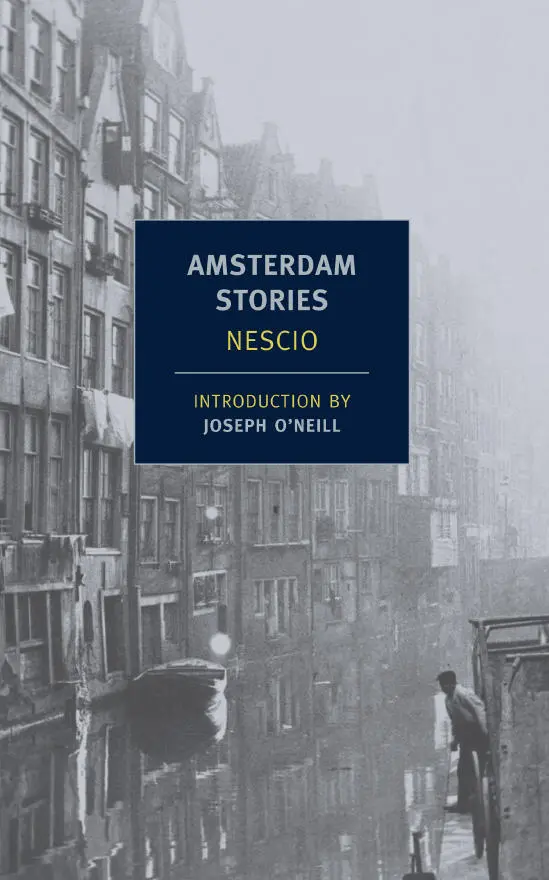
- Название:Amsterdam Stories
- Автор:
- Издательство:NYRB Classics
- Жанр:
- Год:2012
- ISBN:нет данных
- Рейтинг книги:5 / 5. Голосов: 1
-
Избранное:Добавить в избранное
- Отзывы:
-
Ваша оценка:
Amsterdam Stories: краткое содержание, описание и аннотация
Предлагаем к чтению аннотацию, описание, краткое содержание или предисловие (зависит от того, что написал сам автор книги «Amsterdam Stories»). Если вы не нашли необходимую информацию о книге — напишите в комментариях, мы постараемся отыскать её.
Who was Nescio? Nescio — Latin for “I don’t know”—was the pen name of J.H.F. Grönloh, the highly successful director of the Holland — Bombay Trading Company and a father of four — someone who knew more than enough about respectable maturity. Only in his spare time and under the cover of a pseudonym, as if commemorating a lost self, did he let himself go, producing over the course of his lifetime a handful of utterly original stories that contain some of the most luminous pages in modern literature.
This is the first English translation of Nescio’s stories.
Amsterdam Stories — читать онлайн бесплатно полную книгу (весь текст) целиком
Ниже представлен текст книги, разбитый по страницам. Система сохранения места последней прочитанной страницы, позволяет с удобством читать онлайн бесплатно книгу «Amsterdam Stories», без необходимости каждый раз заново искать на чём Вы остановились. Поставьте закладку, и сможете в любой момент перейти на страницу, на которой закончили чтение.
Интервал:
Закладка:
While he is talking he has put his elbows back on the table and rested his forehead in his hands and he looks at the table. And so, in that godforsaken pit, he keeps talking, in a monotone, talking to himself. And the sun is shining on a vast, warm landscape and God’s warm smile lies over everything.
The voice keeps talking.
“She came back to life. Every day I could see her reviving. We took walks if it wasn’t too hot, it was in June, but mostly she just liked to look, she got to know the fields, the trees, the houses, the mountain-tops in the distance. It was warm, on June 18 they started mowing the hay. The real South starts sixty miles farther, where there are olive trees, but there were figs there already, on the trees, and not just trees in fenced-in orchards but out in the fields, just here and there.
“And flowers. Camellias, honeysuckle, jasmine. Linden blossom. Everything saturated with fantastic smells. And crickets, and frogs. Little lizards everywhere. And there was a cuckoo there too, one cuckoo, our cuckoo. There was so much. The river wound downhill in the valley, between trees and shrubs. More of a creek, actually. The Turzon. From above you could only see the trees and shrubs.
“She recovered completely. The journey there was exhausting but she recovered completely. Her cheeks were rosy like a child’s again. And she was so grateful, and loved the countryside so much. The fields, the trees, the flowers, the houses, the Rhône, our cuckoo— they were her friends. She said good morning to them every day and good night every evening.
“Where else have I ever stayed in a place like that? Other than in Veere, 1908 and 1910, at De Campveerse Toren. On one side, the Château borders nothing, it’s surrounded in back by the woods, a little path connects it to the road so there’s no traffic, and even the road isn’t busy. So high up that you’re closer to our dear Lord. In a place with no noise, no billboards, no attractions, no radio. Just think about all the miserable guesthouses and furnished vacation rentals in the world and the abject horror of needing to leave such places and then return to them, with all the miserable human stuff there that makes you ashamed before our dear Lord.”
Typical Flip. He thinks about his wife and sees a landscape. It really is absurd that he never wrote anything after that one book, which in truth was nothing exceptional; it wasn’t personal enough, him enough, it was too much in the style of the time. After so many years he sits mumbling in his pit with his slightly disgusting hair-style and he gushes like a fountain, a whole landscape shoots up into the air and a whole countryside is conjured up in front of you.
He is sitting half turned toward me again, a little slumped to the left on the arm of his chair, toward the table.
“When we came home she was dead tired again and six weeks later we knew that something was really wrong. I’ve often thought that I shouldn’t have let her take that trip. But that’s how it always was: I got it into my head that I wanted to get away, I had to try somewhere else. Two weeks before her second child was due I was in Veere. Always the same. I couldn’t be any other way. Now I know that I was always looking for that damned island. God knows what I’ve selfishly trampled on all these years, always searching, always looking up at the clouds.
“And she never held me back. She herself sent me away when she couldn’t come along: ‘Go see how it is there, then come tell me.’ And the letters she wrote me. I still know a couple of them by heart.
“‘You’re having a great time there, hmm? I’m glad. If only I could have some fun here too, it’s so dreary, I want so badly for it to just be over, it gets so boring, the same aches and pains every day. I’m sure you’ll have so much to tell me when you get back. Liesje is so sweet, she’s getting a lot of fresh air.’
“‘I expected you to be back home all this week, actually, especially on Friday. At midnight I was still awake, wishing the whole time that you’d still come, but I was wrong. No, Liza, Papa’s having too much fun. Write me something? a postcard or two at least?’
“She died the same year we went to Saint-Georges. It was beyond my understanding. I still can’t talk about it. When I try to think about it, even now , I still just see a big black chasm I have no words for.”
Silence. God’s island floats solitary and abandoned. Now all there is is the pit and the tracks across the street.
“There are so many things I did wrong,” he says. “Who hasn’t?” I ask.
He props his elbows on his knees, props his head on his hands again, and looks at me like that. Then he shakes his head: “No, not just some things. I did everything wrong. And treated people badly. And why? For nothing, for a figment of the imagination.”
“A figment of the imagination?” I say. “Is there anything else in life?”
But he looks at the floor. The black chasm holds him fast.
He seems old now, ravaged and bedraggled. God’s incomprehensibility is too much for him. I think about myself. Will it really all turn out to have been a mistake?
He stares at the floor and I stand next to him and look down at the shiny, threadbare back of his jacket. “In a month the crocuses will be in bloom,” I say. He looks up at me. Then, suddenly, he’s standing up and sticking his head out into the hall. “Mie, you’re burning the milk again.”
When I’m back outside I see, across the street, next to the fence, here in this slum, in the grimy slush, two German naval officers.
February 7–12, 1942
(CONTINUED)
There is yet another section of “Insula Dei” that tells how Dikschei made love with Helena den Oever, Flip’s niece and the spitting image of her grandmother.
But that section is absolutely not appropriate for publication. In any case, you can imagine it perfectly well for yourself without much difficulty if you care to remember how you yourself have made love. And if you’re a couple who still get along well, you will look at each other and she’ll lower her eyes and you won’t find your thoughts unpleasant or dishonorable in the least.
You might well have also found it pleasant to read that section. But even so, I’d rather leave it out. I know these cultured, fine, up-standing men and women who would never let themselves go as far as bestial behavior, the ones who like to call themselves and each other Society. I know them. I can already hear what they’d say, already read the little articles they’d publish, if this lovemaking — the wild and tender human passion that drives us all, more than we even realize — went on sale one day in the bookstore, just like that.
I thank you. So as not to think about the impervious entity called the State. Or a group of friends among themselves. Or the way my friend Bonnema would sputter and make faces if he read it.
I will just have to wait until our civilization finally develops a noble frankness and candor once again.
Which I say so that you’ll think I imagine I’ll live forever.
February 13, 1942
NOTES
NESCIO published three books in his lifetime, barely. The stories generally recognized as his major works—“The Freeloader,” “Young Titans,” and “Little Poet”—were first published in book form, after a relatively long hunt for a publisher, in 1918 (“The Freeloader” and “Young Titans” had previously appeared in magazines). The book was not a commercial success, with a first printing of five hundred copies and a second edition coming only in 1933, from a different publisher, and a third in 1947. In 1942, Nescio assembled a manuscript of unpublished pieces dating back as far as 1913; five of those stories, plus a very short sixth piece from 1943, were published as his second book, Mene Tekel , in 1946 (later combined with the fourth edition of “The Freeloader,” “Young Titans,” and “Little Poet” in 1956). Finally, the book Boven het dal [ Above the Valley ] appeared in May 1961: an unusual compilation consisting of the 1942 manuscript, including the stories previously published in Mene Tekel , plus seven additional unpublished stories selected by an editorial committee. Nescio had little direct involvement in putting together the volume and died very soon after its publication, on July 25, 1961. Nescio’s Collected Works appeared in two substantial volumes in 1996, with the second volume containing the Nature Diary he kept of his frequent excursions in Holland from 1946 to 1955. The Nature Diary was a revelation to Dutch readers and the edition was a great success.
Читать дальшеИнтервал:
Закладка:
Похожие книги на «Amsterdam Stories»
Представляем Вашему вниманию похожие книги на «Amsterdam Stories» списком для выбора. Мы отобрали схожую по названию и смыслу литературу в надежде предоставить читателям больше вариантов отыскать новые, интересные, ещё непрочитанные произведения.

![Олеся Проглядова - Nomen nescio. Имя неизвестно [litres]](/books/391740/olesya-proglyadova-nomen-nescio-imya-neizvestno-lit-thumb.webp)





Обсуждение, отзывы о книге «Amsterdam Stories» и просто собственные мнения читателей. Оставьте ваши комментарии, напишите, что Вы думаете о произведении, его смысле или главных героях. Укажите что конкретно понравилось, а что нет, и почему Вы так считаете.