Nescio - Amsterdam Stories
Здесь есть возможность читать онлайн «Nescio - Amsterdam Stories» весь текст электронной книги совершенно бесплатно (целиком полную версию без сокращений). В некоторых случаях можно слушать аудио, скачать через торрент в формате fb2 и присутствует краткое содержание. Год выпуска: 2012, Издательство: NYRB Classics, Жанр: Классическая проза, на английском языке. Описание произведения, (предисловие) а так же отзывы посетителей доступны на портале библиотеки ЛибКат.
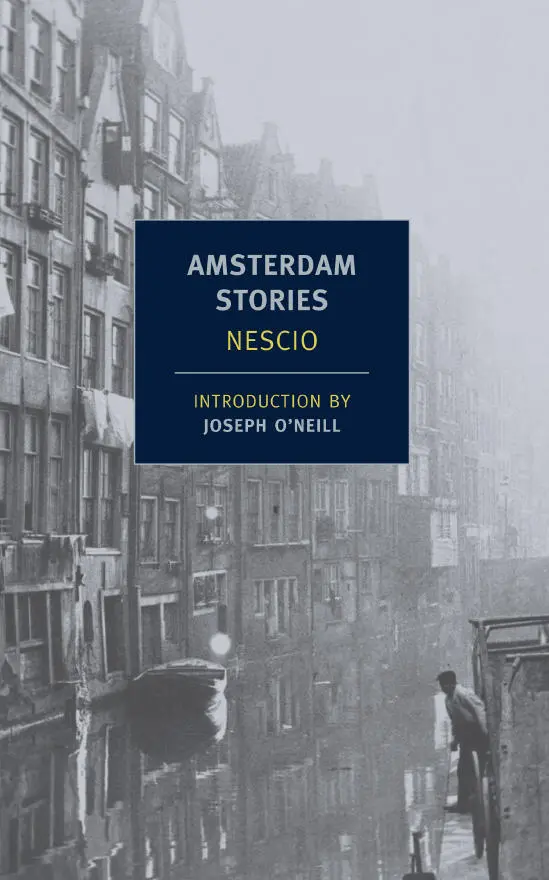
- Название:Amsterdam Stories
- Автор:
- Издательство:NYRB Classics
- Жанр:
- Год:2012
- ISBN:нет данных
- Рейтинг книги:5 / 5. Голосов: 1
-
Избранное:Добавить в избранное
- Отзывы:
-
Ваша оценка:
Amsterdam Stories: краткое содержание, описание и аннотация
Предлагаем к чтению аннотацию, описание, краткое содержание или предисловие (зависит от того, что написал сам автор книги «Amsterdam Stories»). Если вы не нашли необходимую информацию о книге — напишите в комментариях, мы постараемся отыскать её.
Who was Nescio? Nescio — Latin for “I don’t know”—was the pen name of J.H.F. Grönloh, the highly successful director of the Holland — Bombay Trading Company and a father of four — someone who knew more than enough about respectable maturity. Only in his spare time and under the cover of a pseudonym, as if commemorating a lost self, did he let himself go, producing over the course of his lifetime a handful of utterly original stories that contain some of the most luminous pages in modern literature.
This is the first English translation of Nescio’s stories.
Amsterdam Stories — читать онлайн бесплатно полную книгу (весь текст) целиком
Ниже представлен текст книги, разбитый по страницам. Система сохранения места последней прочитанной страницы, позволяет с удобством читать онлайн бесплатно книгу «Amsterdam Stories», без необходимости каждый раз заново искать на чём Вы остановились. Поставьте закладку, и сможете в любой момент перейти на страницу, на которой закончили чтение.
Интервал:
Закладка:
How often in summer I have looked at those same trees, full of leaves, looked at the light on the trees and the shadow, and the darkness under the crowns. Every day I went by and looked. There were shadows from the leaves on the grass; in between, the light was intensely golden. Then it was as if the trees had always been there, exactly the same, and always would be. Who, when he sees a friend, thinks that he will never see him again? Now the ground between the trees is brown and dingy, it’s the leaves from back then, and not even all the leaves. I looked at them so many times and it didn’t help them a bit, they fell anyway.
Insula Dei. I force my thoughts back to that.
Yes. And no. I think about these eventful times. You want to do something, make a difference. But these aren’t the first eventful times I have lived through and if I’m granted even more years then with God’s help I will most likely get to my third war. The silent course of things takes its silent, implacable course, the little man who is a hero today will tomorrow, when peace comes, be scolded in his stupid little job or maybe won’t have a job at all and will turn back into the useless piece of clockwork he used to be. And if he has a little more to him, maybe he will read the first chapter of Ecclesiastes: “All things are full of labour; man cannot utter it.”
Eventful times. What remains from Italy’s eventful times in the thirteenth century except Dante’s Inferno ?
Do. As if I haven’t had enough pointless doing. Oh they have nothing else, they only are when they do. I want to be, and for me to do is: not to be.
It slips away from me again. I see the spring. Like the highest branches of the trees I see the spring from far away. God help me, what a winter we’ve had. Cold. And snow and everything jumbled together. A train has pulled into Amsterdam-Muiderpoort Station from Utrecht, going to Centraal Station, and the stationmaster is about to give the signal to proceed when he quickly asks the conductor hurrying onto the train, “Tell me, what train are you again?”
But now it’s thawing, thank God. I think back to last year’s crocuses in the parks in Groningen, in the gardens of the villas on the way to Haren, and farther. Spring was late last year. The crocuses were in full bloom in mid-April. Yellow, purple, and white, the vanguard of spring. And the Paterswolde lake lay there in the distance, you are standing a little higher in the landscape but you barely see the meadows sloping down, there are low dikes with willow trees on them, the alder catkins are hanging down, here and there a farm-stead is surrounded by tall trees, there are even a few cows in a scrawny pasture. Over there too. I count seven. The lake is all dark blue beneath the April sky, in front of the Eelder woods that are the outer edge of the world, small from a distance but also large. And black. And at the same time blond. However I want to see them. In the middle is a large tree I recognize. And the next day the lake is pale blue and the day after that it’s a delicate gray with a sail on it. A magnificent view, magnificent enough for me, my heart swells and the landscape swells with it, the sky is so high, it is as though I could live there like that, without friends, without the baker and milkman and butcher and grocer, without garbage cans and clothes and even without cigars if necessary and without a pipe, and that’s saying a lot. Ach, I will have to live without tobacco and cigars all too soon anyway, but not on the side of the road to Haren and not beneath the trees in the Frankendael. But I’ll never be rid of the baker and the rest of them. Although God knows, maybe them too. But then the side of the road to Haren will be a very different roadside, like the one you sometimes read about in the paper, where a dead body is found in the winter sometimes. And as for clothes, I can’t do without them, unfortunately, and the police go after nudists whenever they occasionally do turn up. “The beauty of the human body” is written in respectable books but we ordinary folks have to go to museums for it, if we ever get to see any of it at all.
It’s clear I’m not up to it. It wouldn’t be enough for me. “The eye is not satisfied with seeing, nor the ear filled with hearing.”* Do I want to be satisfied? Yes. And no. There is no answer.
And suddenly I am at peace with it. There is no answer. That’s good too. In a month the crocuses will be in bloom again. It’s barely started thawing and already the women are looking around. There is still something to hold on to in this time of war: the thought of peace and the feeling for “that which is not of this earth.” That doesn’t sound bad, it even sounds a bit sublime.
So then: Insula Dei?
I give up and go eat a couple of slices of bread and butter. At the table I awaken in a clear, tangible world. It still feels strange for a moment. A plate, a knife, a fork, some leftover sauerkraut from the day before, it’s clear exactly what you have here: not quite enough.
In the twilight that evening I walk past Frankendael again. The snow is still lying on the gardens in front of the manor house and it’s still light out. But the tall trees are there, to either side. They are silent, life cannot be more silent.
I look slowly up past the trees. Down below the trunks rise up darkly out of the snow, it is a secretive, three-quarters-dark world where Dikscheis led astray by our dear Lord can frolic with nymphs like the ones you see in museums. But up above, the crowns of the trees against the last light of a pale sky look out into the distance. There is no sound, no wind. The trunks wait, they wait for an answer from the crowns. Are the herons returning? Is spring on its way?
And then God does what he always does, thank God, time and time again, every day. In the end that’s why I could never make anything of myself in society. He shows me something that is not there: the blue lake next to the endless field with yellow daffodils, water and daffodils both waving in the breeze. Wordsworth’s “Daffodils.”
Wednesday, July 9, 1941, 9:30 p.m. German daylight time. The sun is low in the sky. Near the end of an unbearably hot day. A narrow bike path between young birch trees. Behind me is Waalre, behind me too is the magic alley of birch trees in Waalre that leads to the train station. At this late hour it is full of shadows, all the shadows of this whole blazing hot day have gathered under these trees. But here and there the sun still golds its way in, a heavy wagon jolts slowly ahead under a heavy vault of branches and leaves, the sun glides along the wagon’s back, the driver walks alongside it, the low sun sparkles on a bicycle too, the eye doesn’t reach all the way to the end of this alley, the vault ends in deep shadow, this road must lead somewhere good and peaceful where a stately man and a willowy woman with elegant faces are waiting for me in a white house with a large front lawn and beeches and lindens all around and with the tea waiting on the tea light. The road leads to the Aalst-Waalre station and service along that line has been canceled.
But the road is behind me, I have turned off to the left onto the bike path and am on my way to Eindhoven and I think about it only in passing.
For me the day has not been unbearably hot. Temperatures like this are fine with me, and almost no clothes — shirt, pants, and shoes; jacket draped over the handlebars. As Zus Zwaardecroon, the neighbor girl, would say: “Like a fairy.”
When I’m almost to Eindhoven, the countryside is wide open on both sides. Rye fields. The sun still burning, low and red. A stately row of Canadian poplars, a copse here and there. A striking emptiness and silence. The fields end somewhere but you can’t see where, lost in the distance against trees or bushes. And then there’s a fantastic golden cloud above the grain fields, climbing up out of the grain fields, shining and spreading up and to the right. The Judgment. I get off my bike, I await the Lord. The cloud drifts, drifts to the right and comes closer. And then something looms up out of the golden matter, at first it’s not clear what, but it’s not the Lord. And a moment later it’s a wagon piled high with hay, or rather, it’s hay that is slowly, listlessly, and almost inaudibly moving closer between the rows of grain, with a man sitting in front and a horse’s head enveloped in a drifting cloud of solid sunshine.
Читать дальшеИнтервал:
Закладка:
Похожие книги на «Amsterdam Stories»
Представляем Вашему вниманию похожие книги на «Amsterdam Stories» списком для выбора. Мы отобрали схожую по названию и смыслу литературу в надежде предоставить читателям больше вариантов отыскать новые, интересные, ещё непрочитанные произведения.

![Олеся Проглядова - Nomen nescio. Имя неизвестно [litres]](/books/391740/olesya-proglyadova-nomen-nescio-imya-neizvestno-lit-thumb.webp)




Обсуждение, отзывы о книге «Amsterdam Stories» и просто собственные мнения читателей. Оставьте ваши комментарии, напишите, что Вы думаете о произведении, его смысле или главных героях. Укажите что конкретно понравилось, а что нет, и почему Вы так считаете.