Louis Couperus - Inevitable
Здесь есть возможность читать онлайн «Louis Couperus - Inevitable» весь текст электронной книги совершенно бесплатно (целиком полную версию без сокращений). В некоторых случаях можно слушать аудио, скачать через торрент в формате fb2 и присутствует краткое содержание. Год выпуска: 2013, ISBN: 2013, Издательство: Pushkin Press, Жанр: Классическая проза, на английском языке. Описание произведения, (предисловие) а так же отзывы посетителей доступны на портале библиотеки ЛибКат.
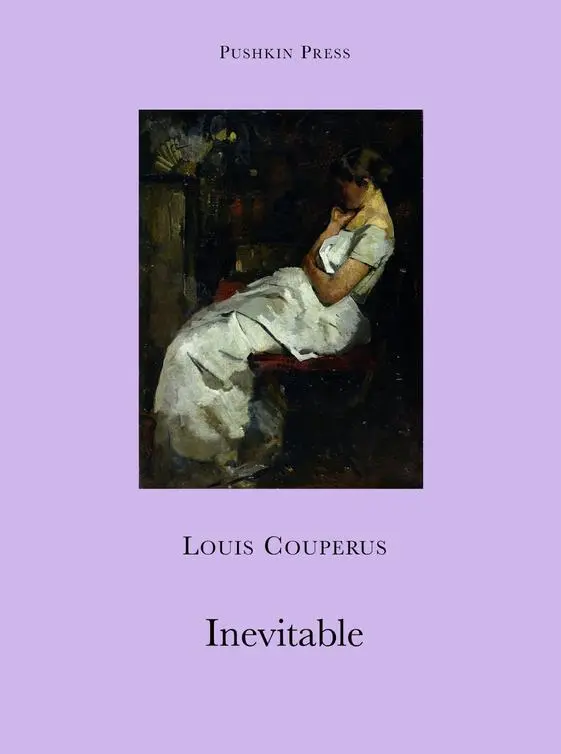
- Название:Inevitable
- Автор:
- Издательство:Pushkin Press
- Жанр:
- Год:2013
- ISBN:9781908968562
- Рейтинг книги:4 / 5. Голосов: 1
-
Избранное:Добавить в избранное
- Отзывы:
-
Ваша оценка:
Inevitable: краткое содержание, описание и аннотация
Предлагаем к чтению аннотацию, описание, краткое содержание или предисловие (зависит от того, что написал сам автор книги «Inevitable»). Если вы не нашли необходимую информацию о книге — напишите в комментариях, мы постараемся отыскать её.
Inevitable — читать онлайн бесплатно полную книгу (весь текст) целиком
Ниже представлен текст книги, разбитый по страницам. Система сохранения места последней прочитанной страницы, позволяет с удобством читать онлайн бесплатно книгу «Inevitable», без необходимости каждый раз заново искать на чём Вы остановились. Поставьте закладку, и сможете в любой момент перейти на страницу, на которой закончили чтение.
Интервал:
Закладка:
“Really, prince … I can’t at such short notice …”
“Why not?”
She looked at him for a long time.
“Shall I be very frank?”
“Of course.”
They had already passed the post office a number of times. The street was eerily quiet, and there were no pedestrians. He looked at her quizzically.
“Well then,” she said, “we are in serious financial difficulties. At the moment we have nothing. I have lost my capital and the little I have earned from writing an article has gone. Duco works hard, but he is engaged on a largescale work and is earning nothing. He is expecting money in a few months. But at the moment we have nothing Nothing at all. That’s why I went down to a shop by the Tiber this morning to ask how much the dealer would give for a couple of antique paintings that Duco wants to sell. He is reluctant to part with them. But there’s no alternative. So you see that I cannot come. I would not like to leave him, and than I have no money for the journey or a decent wardrobe …”
He looked at her. He had first been struck by her burgeoning beauty; he was now struck by the fact that her skirt was rather worn, her blouse was no longer fresh, although she was wearing a couple of roses in her belt.
“ Gesù mio! ” he exclaimed. “And you tell me that so calmly, so serenely …”
She smiled and shrugged her shoulders.
“What do you want me to do? Whine about it?”
“But you are a woman … a woman worthy of respect!” he exclaimed. “How is Van der Staal coping with it?”
“He’s a little depressed. He has never experienced financial problems. And it is stopping him from working with all his talent. But I hope I am some support to him in this unfortunate period. So you see, prince, that I cannot come to San Stefano.”
“But why did you not write to us? Why did you not ask us for money?”
“It is very sweet of you to say that, the idea never even occurred to us.”
“Too proud?”
“Too proud, yes.”
“But what a situation! What can I do to help you? Can I give you a few hundred lire? I have a few hundred on me. And I shall tell Urania that I have given them to you.”
“No, prince, thank you. I am very grateful, but I cannot accept.”
“Not from me ?”
“No.”
“Not from Urania?”
“Not even from her.”
“Why?”
“I want to earn my money and cannot accept alms.”
“A fine principle. But only for now.”
“I shall stick to it.”
“May I say something?”
“What is it?”
“I admire you. More than that. I love you.”
She made a gesture with her hand and frowned.
“Why can’t I say that to you? An Italian does not keep his love hidden inside. I love you. You are more beautiful and nobler and loftier than I could ever imagine a woman … Don’t be angry: I am not asking anything of you. I’m a bad lot but at the moment I really feel something inside that you see on our old family portraits. A chance remaining atom of chivalry. I ask nothing of you. I am just saying to you, on behalf of Urania too: you can always count on us. Urania will be angry that you did not write to her.”
They went to the post office and she bought a few stamps.
“There go my last few soldi ,” she said with a laugh and showed her empty purse. “We needed them for some letters to an exhibition-organising committee in London. Will you walk me home?”
She suddenly saw that there were tears in his eyes.
“Accept two hundred lire from me!” he begged.
She declined with a smile.
“Are you eating at home?” he asked.
She gave him a funny look.
“Yes,” she said.
He did not want to ask any more questions, for fear of offending her.
“It would be very sweet of you,” he said, “if you would dine with me tonight. I’m bored. At present I have no close friends in Rome. Everyone is away. Not in the Grand-Hôtel, but in a cosy restaurant where they know me. I’ll call for you at seven o’clock. Be a darling, and do it! For my sake!”
He could not hold back his tears.
“I’d be delighted,” she said softly, with her smile.
They stood in the doorway of the house on Via del Babuino, where the studio was. He raised her hand to his lips, and kissed it fervently. Then he tipped his hat and left hurriedly. She slowly climbed the stairs, fighting back her emotion, before entering the studio.
XXIX
SHE FOUND DUCO lying listlessly on the sofa. He had a bad headache and she sat down beside him.
“Well?” he asked.
“The man was prepared to give eighty lire for the Memmi, he said: but he maintained that the triptych panel was not by Gentile da Fabriano; he remembered seeing the panel at your studio.”
“The man’s talking nonsense,” he replied. “Or he’s trying to get my Gentile for nothing …Cornélie, I really can’t sell them.”
“Alright Duco, then we’ll find some other way,” she said, putting her hand on his forehead that was contorted by his headache.
“Perhaps a few smaller things, a few knick-knacks…” he groaned.
“Perhaps…Shall I go back again this afternoon?”
“No, no … I’ll go. But really, we can buy such things, but can never sell them.”
“No Duco,” she admitted, laughing. “But yesterday I inquired what I could get for a couple of bracelets and I’ll sell them this afternoon. And then we’ll be able to manage for a month. But I wanted to tell you something. Do you know who I met?”
“No.”
“The prince.”
He frowned.
“I don’t like that blackguard,” he said.
“I’ve told you before, Duco: I don’t think he’s a blackguard. And I don’t believe he is. He invited us to dinner tonight, very simply.”
“No, I don’t feel like it …”
She was silent. She got up, boiled water on a paraffin stove and made tea.
“My dear Duco, I rather neglected lunch. A cup of tea and a sandwich is all I can offer you. Are you very hungry?”
“No,” he said evasively.
She hummed as she poured tea into an antique cup. She cut the bread and took him tea on the sofa. Then she sat next to him, also with a cup in her hand.
“Cornélie, would it be better if we had lunch in the osteria …?”
Laughing, she showed him her empty purse.
“Here are the stamps,” she said.
Disheartened, he flung himself on the cushions.
“My lovely man,” she went on. “Don’t be so down. This afternoon I’ll have money again, from the bracelets. I should have sold them before. Really, Duco, it’s nothing. Why didn’t you work? It would have cheered you up.”
“I wasn’t in the mood and I’ve got a headache …”
She was silent for a moment. Then she said,
“The prince was angry that we hadn’t written to him for help. He wanted to give me two hundred lire …”
“I hope you refused?” he said, furious.
“Of course,” she said calmly. “He invited us to stay at San Stefano, where they are spending the summer. I refused that too.”
“Why?”
“I wouldn’t have any clothes … But you wouldn’t want to go anyway, would you?”
“No,” he said flatly.
She drew his head to her and stroked his forehead. A broad area of reflected afternoon light shone through the studio window from the blue sky outside and the studio seemed to be alive with dusty light, in which the silhouettes stood out with their immobile gestures and unchanging emotions. The relief embroidery on the chasubles and stoles, the purple and azure blues of Gentile’s triptych panel, the mystical luxuriance of Memmi’s angel in its robe of heavily creasing brocade, the golden lily stem in the fingers — were like a piled treasure house of colour and shone in that reflected light like handfuls of jewels. On the easel was the watercolour of Banners , fine and noble. And as they sat there on the sofa, he with his head leaning against her, both of them drinking tea, they were harmoniously happy against that background of art. And it seemed incredible that they were worrying about a few hundred lire, since he was glowing within with a jewel-like colour, and her smile was like a sheen. But his eyes were discouraged and his hand hung limply.
Читать дальшеИнтервал:
Закладка:
Похожие книги на «Inevitable»
Представляем Вашему вниманию похожие книги на «Inevitable» списком для выбора. Мы отобрали схожую по названию и смыслу литературу в надежде предоставить читателям больше вариантов отыскать новые, интересные, ещё непрочитанные произведения.


Обсуждение, отзывы о книге «Inevitable» и просто собственные мнения читателей. Оставьте ваши комментарии, напишите, что Вы думаете о произведении, его смысле или главных героях. Укажите что конкретно понравилось, а что нет, и почему Вы так считаете.