Louis Couperus - Inevitable
Здесь есть возможность читать онлайн «Louis Couperus - Inevitable» весь текст электронной книги совершенно бесплатно (целиком полную версию без сокращений). В некоторых случаях можно слушать аудио, скачать через торрент в формате fb2 и присутствует краткое содержание. Год выпуска: 2013, ISBN: 2013, Издательство: Pushkin Press, Жанр: Классическая проза, на английском языке. Описание произведения, (предисловие) а так же отзывы посетителей доступны на портале библиотеки ЛибКат.
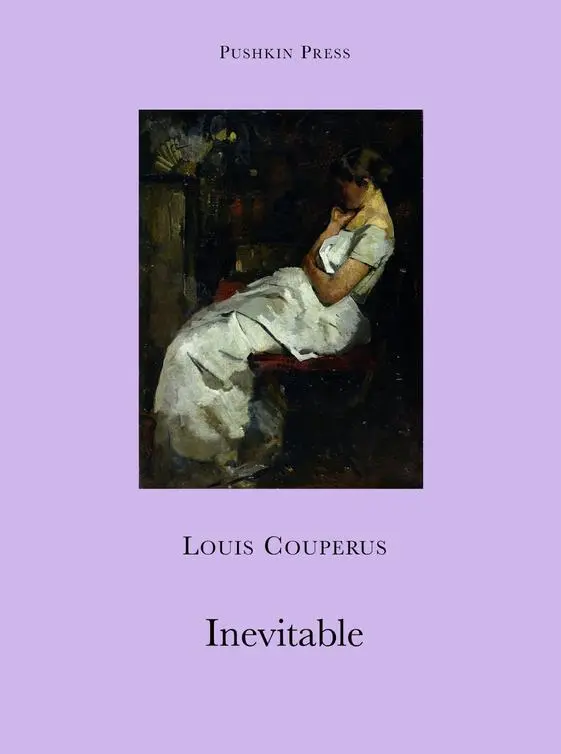
- Название:Inevitable
- Автор:
- Издательство:Pushkin Press
- Жанр:
- Год:2013
- ISBN:9781908968562
- Рейтинг книги:4 / 5. Голосов: 1
-
Избранное:Добавить в избранное
- Отзывы:
-
Ваша оценка:
Inevitable: краткое содержание, описание и аннотация
Предлагаем к чтению аннотацию, описание, краткое содержание или предисловие (зависит от того, что написал сам автор книги «Inevitable»). Если вы не нашли необходимую информацию о книге — напишите в комментариях, мы постараемся отыскать её.
Inevitable — читать онлайн бесплатно полную книгу (весь текст) целиком
Ниже представлен текст книги, разбитый по страницам. Система сохранения места последней прочитанной страницы, позволяет с удобством читать онлайн бесплатно книгу «Inevitable», без необходимости каждый раз заново искать на чём Вы остановились. Поставьте закладку, и сможете в любой момент перейти на страницу, на которой закончили чтение.
Интервал:
Закладка:
As she read the reviews of her pamphlet in Dutch newspapers and magazines — often disagreeing with her, but never dismissive, and always acknowledging her authority to speak out on this matter — as she re-read her pamphlet, a doubt rose in her about her own conviction. She felt how difficult it is to be pure in fighting for a cause, the way those symbolic women, there in the watercolour, went into battle. She felt she had written fresh from her own suffering, her own experience, and solely from her own suffering and experience; she realised that she had generalised her own feeling about life and suffering, but without a deeper vision of the core of things; not out of pure conviction, but rather out of bitterness and anger; not from reflection, but from sad dreaming about her own fate: not out of love for women, but rather out of petty hate for society. And she remembered Duco’s original silence; his silent disapproval, his intuitive feeling that the source of her inspiration was not pure, but full of the bitterness and murkiness of her own experience. Now she respected that intuition; now she realised his true purity; now she felt him — because of his art — to be exalted, noble, without ulterior motives in his actions, creating beauty for its own sake. But she also felt that she had roused him to this. That was her pride and happiness and she loved him even more deeply. But she was humble about herself. She felt her womanly nature, which prevented her from going on fighting for the goal of Women. And again she thought of her upbringing, her husband, their short but unhappy married life … and she thought of the prince. She felt herself to be so many people, and would have liked to be one. She lurched from contradiction to contradiction and admitted to herself: she did not know herself. It created a dusky melancholy in the days of her happiness …
The prince … Had she not asked him with only apparent pride not to tell Urania that she was living with Duco, because she would tell her herself? In fact she was afraid of Urania’s opinion … She was annoyed by the dishonesties of petty everyday life: she called the intersection of her line and those of other, petty people: petty everyday life. Why when she came to such an intersection did she feel as if by instinct that honesty was not always sensible? Where were her pride and self-confidence — not apparent, but real — the moment she was afraid of Urania’s criticism, the moment she feared that the criticism could harm her in some way? And why did she not mention Virgilio’s bracelet to Duco? She did not tell him about the thousand lire, since she knew that money matters oppressed him, and that he did not want to borrow from the prince. Because if he got to know of this he would not be able to work with his usual energy and gusto and concentration … As it was he had worked untroubled and her silence had been for a noble aim. But why did she not mention Gilio’s bracelet …?
She did not know. Several times she had had the impulse to say quite naturally: look what I was given by the prince, because I sold one bracelet … But she could not say it. Why, she did not know. Was it because of Duco’s jealousy? She did not know, she did not know. She thought it would create less trouble to say nothing about the bracelet and not to wear it. In fact, she would have preferred to return it to the prince. But she thought that that would be impolite after all his kindness, after all his readiness to help her.
And Duco… thought that she had sold the bracelets for a good price, and he knew that she had received money from her publisher, for her pamphlet. He asked no further questions, and thought no more about money. They lived very simply … Still, it troubled her that he did not know, even though it had been good for his work not to know.
They were small things. Small clouds in the golden skies of their great and noble life: their life of which they were proud. And only she saw them. And when she saw his eyes from which confidence in life shone, when she heard his voice sounding so sure of his new energy and pride, and when she felt his embrace, in which she felt all his happiness in her trembling … she no longer saw the little clouds, she felt all her happiness with him trembling inside her, and she loved him so much that she could have died in his arms.
XXXII
URANIA’S LETTER was very sweet. She wrote that they were leading a very quiet life at San Stefano with the old prince, that they had no guests because the castle was too gloomy, too run down, too isolated, but that they would be delighted if Cornélie could spend some time with them. And, she added, she would also send Mr Van der Staal an invitation. The letter was addressed to Via dei Serpenti and was forwarded to Cornélie from her previous residence. So she realised that Gilio had not mentioned her living in Duco’s studio, and also realised that Urania accepted their liaison, without criticism …
The Banner watercolour had been sent to London and in the studio, still cool while the city was sweltering, there was a slight air of idleness and boredom, now that Duco was no longer working. And Cornélie replied to Urania that that she would be delighted to accept and promised to come in a week. She was glad that she would not find any other guests at the castle, since she had no outfits for a vie-de-château. But with her usual flair she rejigged her wardrobe without spending much money. It took up all her time for days and she sewed while Duco lay on the sofa smoking cigarettes. He had accepted the invitation too, for Cornélie’s sake, and because the area around the lake of San Stefano appealed to him. Smiling, he promised Cornélie not to be so stiff. He would do his best to be friendly. He rather looked down on the prince. He thought him a rogue, if no longer a blackguard. He thought him a child, if not ignoble and base.
Cornélie left; he took her to the station. In the carriage she kissed him fervently and told him how much she would miss him for those few days … Would he come soon? In a week? She would be longing for him: she could not do without him. She looked deep into his eyes, which she loved. He too said how bored he would be without her. Couldn’t he come any sooner, she asked. No, Urania had fixed the date …
As he helped her into the second-class carriage, she was sad to be going without him. The compartment was full, and she got the last seat. She sat between a fat farmer and an old farmer’s wife: the farmer kindly helped her put her valise in the net, and asked her if she would mind if he smoked his pipe. She told him in a friendly tone that she would not. Opposite them sat two priests in worn cassocks and between their feet they had an unobtrusive brown wooden box: it was the Last Sacrament that they were taking to a dying soul.
The farmer made conversation with Cornélie and asked if she were a foreigner, English probably? The old farmer’s wife offered her a mandarine.
The rest of the compartment was occupied by a bourgeois family of father, mother, a little boy and two little sisters. The slow train shook, rattled and swayed, and kept stopping. The sisters hummed. At one station a lady got off with a little girl of five, in a white dress and white ostrich feathers on her hat.
“ Oh, che belleza! ” cried the little boy. “Mama, mama, look! Isn’t she beautiful? Isn’t she wonderful? Divinamente ! Oh, mama …!”
He closed his black eyes, in love, dazzled by the five-year-old-girl in white. The parents laughed, the priests laughed, everyone smiled. But the little boy was not embarrassed.
“ Era una belleza! ” he repeated with conviction and looked around.
It was very hot on the train. Outside the mountains glowed white on the horizon and shimmered like a fire-reflecting opal. Close to the railway rose a line of eucalyptus trees, their leaves sickle-shaped, exuding a pungent smell. On the plain, dry and scorched, wild buffalo were grazing, lifting their black curly heads indifferently towards the train. The slow train shook, rattled and swayed and kept stopping. In the stifling heat people’s heads nodded up and down, while an odour of sweat, tobacco smoke and orange peel mixed with the scent of the eucalyptus outside. The train rounded a corner, rattling like a toy train with tin carriages almost tumbling over each other. And a smooth strip of azure without a ripple: a mirror of metal, crystal, sapphire became visible and spread into an oval dish among the rolling mountain country, like a vase placed very low in which a sacred liquid was preserved, very blue and pure and still, and protected by a wall of rocky hills, which climbed higher until as the train rattled and careered around the clear dish a castle rose up high on a peak, rock-coloured, broad, massive and monastery-like, with arcades running down the slope. It rose nobly and with a gloomy melancholy and from the train it was hard to make out what was rock and what masonry, as if it were a single bleakness, as if the castle had grown naturally from the rock and in its growth had assumed something of the form of human habitation in distant times. And as if the oval dish with its sacred blue water was a divine sacrificial bowl, the mountain closed off the lake of San Stefano and the castle arose like its gloomy guardian.
Читать дальшеИнтервал:
Закладка:
Похожие книги на «Inevitable»
Представляем Вашему вниманию похожие книги на «Inevitable» списком для выбора. Мы отобрали схожую по названию и смыслу литературу в надежде предоставить читателям больше вариантов отыскать новые, интересные, ещё непрочитанные произведения.






Обсуждение, отзывы о книге «Inevitable» и просто собственные мнения читателей. Оставьте ваши комментарии, напишите, что Вы думаете о произведении, его смысле или главных героях. Укажите что конкретно понравилось, а что нет, и почему Вы так считаете.