Louis Couperus - Inevitable
Здесь есть возможность читать онлайн «Louis Couperus - Inevitable» весь текст электронной книги совершенно бесплатно (целиком полную версию без сокращений). В некоторых случаях можно слушать аудио, скачать через торрент в формате fb2 и присутствует краткое содержание. Год выпуска: 2013, ISBN: 2013, Издательство: Pushkin Press, Жанр: Классическая проза, на английском языке. Описание произведения, (предисловие) а так же отзывы посетителей доступны на портале библиотеки ЛибКат.
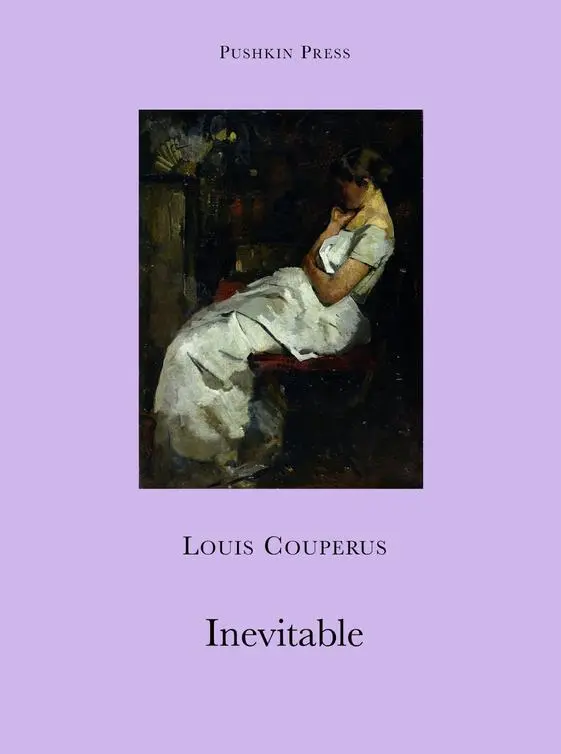
- Название:Inevitable
- Автор:
- Издательство:Pushkin Press
- Жанр:
- Год:2013
- ISBN:9781908968562
- Рейтинг книги:4 / 5. Голосов: 1
-
Избранное:Добавить в избранное
- Отзывы:
-
Ваша оценка:
Inevitable: краткое содержание, описание и аннотация
Предлагаем к чтению аннотацию, описание, краткое содержание или предисловие (зависит от того, что написал сам автор книги «Inevitable»). Если вы не нашли необходимую информацию о книге — напишите в комментариях, мы постараемся отыскать её.
Inevitable — читать онлайн бесплатно полную книгу (весь текст) целиком
Ниже представлен текст книги, разбитый по страницам. Система сохранения места последней прочитанной страницы, позволяет с удобством читать онлайн бесплатно книгу «Inevitable», без необходимости каждый раз заново искать на чём Вы остановились. Поставьте закладку, и сможете в любой момент перейти на страницу, на которой закончили чтение.
Интервал:
Закладка:
The train wound along the water in a sinuous swirl for a moment, described an arc and came to a halt: San Stefano. It was a small, silent town, sleepy in the sun, without any life or traffic, and only visited every day in winter by tourists who came from Rome to see the cathedral and the castle, and taste the local wine in the osteria. When Cornélie got out she saw the prince at once.
“How sweet of you to visit us in our eyrie!” he said excitedly, squeezing her hands.
He led her through the station to his carriage, a kind of gig with two little horses and a small groom. A porter would bring her case to the castle.
“It’s wonderful that you’ve come!” he repeated again. “Have you never been to San Stefano? You know that the cathedral is famous. I’ll drive right through the town, the road to the castle is round behind it …”
He was beaming with pleasure. He geed up the horse by clicking his tongue, with a repeated shaking of the reins, like a child. They flew down the road, among the low, sleepy houses, across the square where the splendid cathedral rose in the sun’s glow, Lombard Romanesque in style, begun in the eleventh century and added to century after century since, with the campanile on the left, the baptistery on the right: architectural wonders in marble, red, black and white, a single structure of angels, saints and prophets covered as it were in a thick dust of antiquity that had long ago tempered the colours of the marble into pink, grey and yellow and which hung mistily among the group as if it were the only thing that had remained of all those centuries as if they had crumbled to dust and vanished into every joint. The prince rode across a long bridge, whose arches were the remains of an ancient aqueduct, and now stood in the riverbed, which was completely dried up and had children playing in it. Then he let the horses climb at a walking pace; the road climbed steeply upwards, winding up dry and stony from the sunken valleys of olives to the castle, and looking out wider and wider over the ever expanding panorama of bluish white mountains dissolved in the glow of the sun and opal horizons, with a sudden glimpse of the lake: the oval dish, set deeper and deeper, now as if in a circle of channelled hills, gleaming blue, deeper and more fathomless, and absorbing in its mystical blue all the blue of the sky, until the air shimmered, as if in long spirals of light that swirled before one’s eyes. Until suddenly an overpowering scent of orange blossom wafted towards one, a breath heavy and sensual as that of a panting lover, as if thousands of mouths were exhaling scented breath that hung stiflingly in the becalmed atmosphere between sky and lake.
The prince, happy and hectic, talked a lot, pointed here, pointed there with his whip, smacked his lips at the horses, asked Cornélie things, whether she liked the area … The horses, flexing their muscular hind legs, slowly made headway. The castle, massive and monumental, extended in front of them. The lake dropped from sight. The horizons became wider, like a world; the hint of a breeze blew away something of the scent of orange blossom. The road became wide, easily negotiable, level. The castle extended like a fort, like a town, behind its turreted walls with gate after gate. They drove in, across a courtyard, under an arch into a second courtyard, and through a second arch into a third. Cornélie was enveloped by a sense of awe, a vision of columns, arches, statues, arcades and fountains. They alighted.
Urania came to meet her, embraced her, welcomed her warmly and led her up the stairs and down the corridor to her room. The windows were open; she looked out at the lake, the town and the cathedral. Again Urania kissed her and sat her down. And it struck Cornélie that Urania had become thin and no longer had her former dazzling young American girlish beauty, with that unconscious element of coquettishness in her eyes, her smile, her clothing. She had changed. She had lost a little weight, and was not as striking as before, as if her beauty had been a short-lived manifestation, more to do with freshness than with line. But if she had lost her sheen she had gained a certain distinction, a certain style: something that surprised Cornélie. Her gestures were calmer, her voice softer, her mouth seemed smaller and was not constantly opening to reveal white teeth; her outfit was the essence of simplicity: a blue skirt and a white blouse. Cornélie found it difficult to comprehend that the young Princess di Forte-Braccio, Duchess of San Stefano, was Miss Urania Hope from Chicago. A melancholy had descended on her that was very flattering, even though she was less beautiful. And Cornélie felt that there was some unhappiness that tempered her and gave her more depth, but that she also fitted tactfully into her new surroundings. She asked Urania if she was happy. Urania said yes, with her melancholy smile that was so new and surprising. And she talked about herself. They had had a pleasant winter in Nice. But with a cosmopolitan group of friends, because although her new family was very kind, they were very condescending and Virgilio’s friends — especially the women — excluded her almost insultingly. She had realised even at her wedding that the aristocracy would tolerate her, but that people would never forget that she was the daughter of Hope, the stocking-manufacturer from Chicago. She had seen that she was not the only one who even though she was now a princess was tolerated and tolerated only for her millions: there were others like her. She had not made friends. People had come to her at homes and balls: everyone was the best of friends and thick as thieves with Gilio; the ladies called him by his first name, laughed with him, flirted with him and seemed to think it a very good idea that he had married several millions … With Urania they were barely, brusquely polite. The women particularly, the gentlemen were easier-going. But it hurt her, particularly when those high-ranking aristocratic women — all the famous names in Italy — treated her with condescension, and always managed to exclude her from all intimacy, every intimate gathering, every intimate collaboration on parties for charity. Once everything had been discussed, they would ask the Princess di Forte-Braccio to join in, and offered her the place she deserved, with scrupulous exactness indeed. They treated her clearly as a princess and equal in the eyes of the world, the public. But in their own coterie she remained Urania Hope. And the few other bourgeois millionaire elements came to call, of course, but she kept them at bay and Gilio approved. And what had Gilio said when she had complained of her plight to him? That with tact she would certainly win a position for herself, but with great patience and after many, many years. Now she cried, with her head on Cornélie’s shoulder: oh, she thought, she would never win, with all those proud women! And anyway what was she, a Hope, compared to all those famous families who together created Italy’s ancient glory and who, like the Massimos, claimed a pedigree that went back to the Romans?
Was Gilio good to her? Certainly, but he had immediately treated her as “his wife”. All his charm, all his jollity was for others: he never talked much to her. And the young princess wept: she felt lonely, and was sometimes homesick for America. She had invited her brother to stay with her, a nice lad of seventeen, who had come over for her wedding and had travelled through Europe, before leaving for his farm out West. He was her favourite, and he consoled her, but he would be going in a few weeks’ time. What would she have left then? Oh, how glad she was that Cornélie had come! And how well she looked, more beautiful than she had ever seen her! Van der Staal had accepted: he would be coming in a week. She asked in a whisper whether they were considering getting married. Cornélie was adamant that they would not; she would not marry, she would never marry again. And suddenly, with complete honesty, not being able to dissemble with Urania, she announced that she was no longer living at Via dei Serpenti, but in Duco’s studio. Urania was shocked by that break with convention, but she regarded her friend as a woman who could do things that others could not. So just their happiness and love, she whispered as if afraid, without social sanction? Urania remembered Cornélie’s imprecations against marriage and before that, against the prince. But surely she liked Gilio a little now? Oh, she, Urania, would no longer be jealous. She thought it was marvellous that Cornélie had come, and Gilio too, who was bored, had also greatly looked forward to seeing her. Oh no, Urania was no longer jealous …
Читать дальшеИнтервал:
Закладка:
Похожие книги на «Inevitable»
Представляем Вашему вниманию похожие книги на «Inevitable» списком для выбора. Мы отобрали схожую по названию и смыслу литературу в надежде предоставить читателям больше вариантов отыскать новые, интересные, ещё непрочитанные произведения.











Обсуждение, отзывы о книге «Inevitable» и просто собственные мнения читателей. Оставьте ваши комментарии, напишите, что Вы думаете о произведении, его смысле или главных героях. Укажите что конкретно понравилось, а что нет, и почему Вы так считаете.