Louis Couperus - Inevitable
Здесь есть возможность читать онлайн «Louis Couperus - Inevitable» весь текст электронной книги совершенно бесплатно (целиком полную версию без сокращений). В некоторых случаях можно слушать аудио, скачать через торрент в формате fb2 и присутствует краткое содержание. Год выпуска: 2013, ISBN: 2013, Издательство: Pushkin Press, Жанр: Классическая проза, на английском языке. Описание произведения, (предисловие) а так же отзывы посетителей доступны на портале библиотеки ЛибКат.
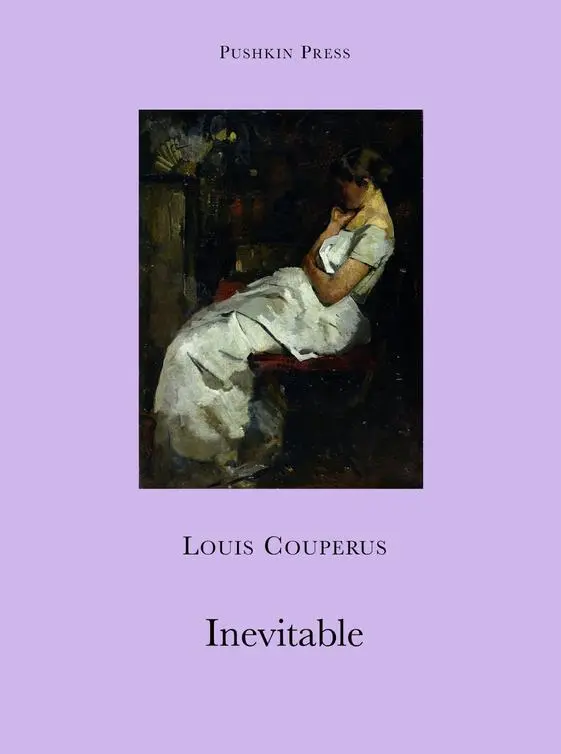
- Название:Inevitable
- Автор:
- Издательство:Pushkin Press
- Жанр:
- Год:2013
- ISBN:9781908968562
- Рейтинг книги:4 / 5. Голосов: 1
-
Избранное:Добавить в избранное
- Отзывы:
-
Ваша оценка:
Inevitable: краткое содержание, описание и аннотация
Предлагаем к чтению аннотацию, описание, краткое содержание или предисловие (зависит от того, что написал сам автор книги «Inevitable»). Если вы не нашли необходимую информацию о книге — напишите в комментариях, мы постараемся отыскать её.
Inevitable — читать онлайн бесплатно полную книгу (весь текст) целиком
Ниже представлен текст книги, разбитый по страницам. Система сохранения места последней прочитанной страницы, позволяет с удобством читать онлайн бесплатно книгу «Inevitable», без необходимости каждый раз заново искать на чём Вы остановились. Поставьте закладку, и сможете в любой момент перейти на страницу, на которой закончили чтение.
Интервал:
Закладка:
She also enjoyed a degree of success with her article: it was reviewed, attacked; her name was mentioned. But she felt a certain indifference when she read her name involved in the Women’s Movement. She shared rather in his life of observation and emotion and often contributed amid the haziness of his vision, in the excessive haze of his tinted dream, a glow of light, an enclosing horizon, a chink of reality, which gave substance to the mistiness of his ideal. With him she learned to distinguish and feel nature, art, the whole of Rome, and when a wave of symbolism came over him, she followed him completely. He drafted a great sketch of a theory of women ascending the climbing winding lifeline: they seemed to be moving from a collapsing city of antiquity, whose columns, linked by the occasional architrave, were wrapped in a shimmer of dusk; they seemed to be freeing themselves from the shadow of the ruin, which on the horizon was already dissolving in the night of oblivion — and they pushed forward, hailing each other with cries, waving to each other with a great outstretching of hands, above them a waving swirl of banners and blazons; with muscular arms they grasped hammers and pickaxes, and the throng moved upwards, along the line, to where the light became whiter and whiter, to where in a haze of light one could discern in the far distance a new city, whose iron buildings shone tall in the white shimmering light in the distance like central stations and Eiffel Towers with a reflection of glass arches and glass roofs, and high in the sky the musical bars of sound and conductivity …
And so the influences of each worked on the other’s soul, so that she learned to see and he learned to think; that she saw beauty, art, nature, haze and emotion and no longer conceived, but felt; that he saw as in his sketch — with its very vague modern city of glass and iron — a modern city rising from his dream haze of Rome’s past, and, in accordance with his own nature and disposition, thought about a modern question. She learned mainly to see and think as a woman in love, with the eyes and heart of the man she loved: he worked out the question in plastic terms. But whatever imperfections there were in the absolute nature of their new spheres of thought and feeling, the interaction that their love engendered brought them a happiness so great, so unified, that at the moment they could not comprehend or contemplate it, that it was almost like a state of ecstasy, a vague unreality in which they dreamed — though it was pure truth and tangible reality. The way they thought, felt and lived was an ideal of reality: ideally entered and achieved along the gradual line of their lives, along the golden thread of their love, and they scarcely registered or comprehended it, since ordinary life still clung to them. But only to an unavoidably small extent. They lived separately, but she would come to see him in the morning and would find him in front of his sketch, and would sit next to him, lean her head on his shoulder, and they would work it out together. He sketched his figures of the theory of woman separately, and he searched for the features and the modelling of the forms: some had the mongoloid quality of the angel of the Annunciation of Memmi; others the slenderness of Cornélie and her later robust, fuller figure; he searched for the folds: in the folds of their peplos robes the women freed themselves from the violet dusk of the ruined city and further on they changed their robes as a masquerade of the centuries: the noble lady’s dress with a train, the veils of the sultans, the woollen dresses of cleaning women, the wimple of the sisters of mercy — with the clothing becoming more modern as the wearer embodied a more modern age … And in that grouping the drawing had such an ethereal and sober quality, the transition from falling drapery to practical tight-fitting clothes was so gradual, that Cornélie could scarcely detect a transition and seemed to see a single style, a single style of dress, though every silhouette was dressed in a different cut and material, with a different line … In the drawing there was a purity recalling the Old Masters, a purity of outline, but modern — highly strung and morbid — and yet without a conventional ideal of symbolic bodily shapes; there was a Raphael-like harmony in the grouping; in the watercolour tint of the first studies the haze of Italy: the ruined city glimmered as she saw the Forum glimmer; the city of glass and iron glittered with its Crystal Palace-like construction, out of a white apotheosis of light, as he had seen around Naples from Sorrento. She felt that he was engaged on a great work and had never been so vitally involved in anything as she was now in his concept and his sketches. She sat still and silent behind him and followed his drawing of the swirling banners and winding blazons, and she held her breath when she saw how with a few smudges of white and dabs of light — as if he had light on his palette — he evoked the dreamlike glass city on the horizon. Then he would ask her something about a figure, put his arm round her waist, pull her towards him, and they would peer endlessly and work out line and concept, till evening fell, the evening chill pervaded the workplace and they slowly got up. They would go out and the Corso would bring them back to real life: sitting silently at Argano’s, they would survey the bustle; and in their little restaurant, looking deep into each other’s eyes, they would eat their simple meal, so visibly harmoniously happy that the Italians, the two who were always at the table furthest from them at the same time, smiled as they greeted them.
XXVII
AND HE FELT SUFFUSED with energy: so many thoughts kept looming in his mind that he was constantly finding new motifs and symbolising them in another figure. He sketched, life-size, a woman walking, with that mixture of child, woman and goddess that characterised his figures — and she followed a gradually descending line into gloomy depths without seeing or understanding; her staring eyes were drawn magnetically towards the abyss: indistinct hands hovered around her like a cloud and gently pushed and guided; above, on high rocks, other figures with harps, in bright light, called to her, but she went down into the depths, impelled by the hands; in the abyss strange purple orchids blossomed, like amorous mouths …
One morning when Cornélie arrived in his studio, he had suddenly sketched this idea. It was a surprise to her, as he had not talked about it: the idea had arisen suddenly; putting it down on paper, quickly and spontaneously, had taken him less than an hour. He almost apologised to her for it, when he saw her surprise. She found it beautiful, but spine-chilling and preferred Banners , the large watercolour, the procession of women advancing towards the fight for life …
And to please her he put the descending woman aside and worked only on the completion of the militant women. But new ideas kept disturbing his work and in her absence he sketched a new symbol, until the sketches piled up and were strewn everywhere. She put them away in portfolios; she removed them from the easel and the shelf; she stopped him from wandering too far from Banners , and this was the only work that he completed.
So their life seemed to want to move gently on, along a charming line, in a single golden direction, while his symbols flowered to the side, while the azure of their love was like the firmament above, but she pruned the overabundance of flowers and only Banners waved above their path, in the firmament of their ecstasy, just as they waved above the militant women …
There was only one diversion: the wedding of the prince and Urania: a dinner, a ball and the ceremony in San Carlo, in the presence of the entire Roman aristocracy, though they welcomed the rich American with some reserve. But when the Prince and Princess of Forte-Braccio left for Nice, that was the end of distractions and the days again glided past along the same charming golden line. Cornélie had only one unpleasant memory: her encounter during the festivities with Mrs Van der Staal, who had cut her dead, turned her back on her and given her to understand that all friendship between them was over. She had resigned herself; she had understood how difficult it was — even if Mrs Van der Staal had been willing to talk to her — to explain her own proud ideas of freedom, independence and happiness to a woman like that set fast in her social and worldly conventions. And she had also snubbed the girls, sensing that that was what Mrs Van der Staal wanted. She was not angry about this, or offended; she could understand this attitude in Duco’s mother: it simply saddened her a little, because she liked Mrs Van der Staal, and she liked the two girls … But she understood completely: it must be that Mrs Van der Staal knew, or suspected everything. Duco’s mother could not act otherwise, although the prince and Urania, out of friendship, denied any relationship between Duco and her, Cornélie — even though the Roman world treated them simply as friends, acquaintances, compatriots — whatever people whispered behind their fans. But the festivities were now over, they had passed that crossroad with the world and people: now their gold course undulated softly and smoothly before them …
Читать дальшеИнтервал:
Закладка:
Похожие книги на «Inevitable»
Представляем Вашему вниманию похожие книги на «Inevitable» списком для выбора. Мы отобрали схожую по названию и смыслу литературу в надежде предоставить читателям больше вариантов отыскать новые, интересные, ещё непрочитанные произведения.











Обсуждение, отзывы о книге «Inevitable» и просто собственные мнения читателей. Оставьте ваши комментарии, напишите, что Вы думаете о произведении, его смысле или главных героях. Укажите что конкретно понравилось, а что нет, и почему Вы так считаете.