Louis Couperus - The Hidden Force
Здесь есть возможность читать онлайн «Louis Couperus - The Hidden Force» весь текст электронной книги совершенно бесплатно (целиком полную версию без сокращений). В некоторых случаях можно слушать аудио, скачать через торрент в формате fb2 и присутствует краткое содержание. Год выпуска: 2012, ISBN: 2012, Издательство: Pushkin Press, Жанр: Классическая проза, на английском языке. Описание произведения, (предисловие) а так же отзывы посетителей доступны на портале библиотеки ЛибКат.
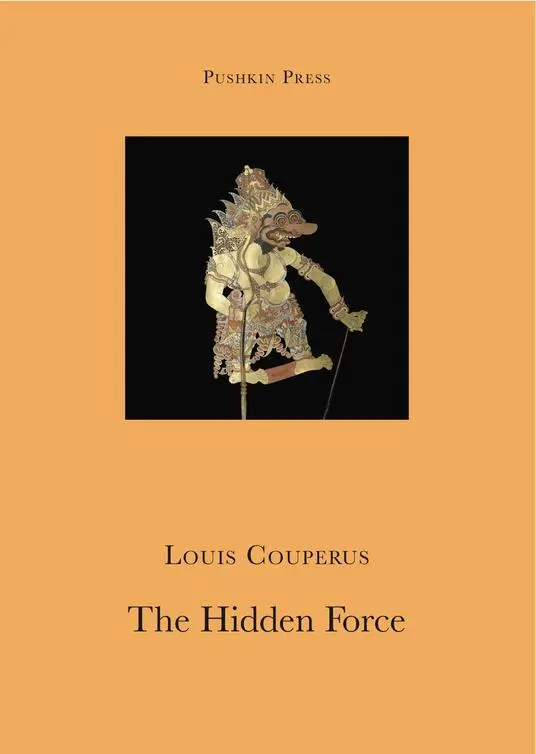
- Название:The Hidden Force
- Автор:
- Издательство:Pushkin Press
- Жанр:
- Год:2012
- ISBN:9781908968227
- Рейтинг книги:4 / 5. Голосов: 1
-
Избранное:Добавить в избранное
- Отзывы:
-
Ваша оценка:
The Hidden Force: краткое содержание, описание и аннотация
Предлагаем к чтению аннотацию, описание, краткое содержание или предисловие (зависит от того, что написал сам автор книги «The Hidden Force»). Если вы не нашли необходимую информацию о книге — напишите в комментариях, мы постараемся отыскать её.
The Hidden Force — читать онлайн бесплатно полную книгу (весь текст) целиком
Ниже представлен текст книги, разбитый по страницам. Система сохранения места последней прочитанной страницы, позволяет с удобством читать онлайн бесплатно книгу «The Hidden Force», без необходимости каждый раз заново искать на чём Вы остановились. Поставьте закладку, и сможете в любой момент перейти на страницу, на которой закончили чтение.
Интервал:
Закладка:
And she admired him, and her admiration was a kind of revelation that art was not always paramount in human existence. She suddenly understood that the exaggerated posturing with art in the modern era was a sickness from which she had suffered and still suffered. Because what was she and what did she do? Nothing. Her parents were both great artists, pure creators, and their house was a temple and their fixation could be understood and forgiven. But what about her? She played the piano quite well, that was all. She had some ideas and some taste, that was all. In the past she had enthused with other young girls, and she remembered now that silly phase of writing each other letters in a derivative style, with echoes of romantic poetry. In that way, in her depression, her thinking progressed, and she underwent an evolution. It was almost incredible that as her parents’ child she should not value art above all things.
A process of seeking and thinking moved to and fro in her as she tried to find her way, now that she had lost herself completely in a country that was alien to her nature, among people on whom, without letting them notice, she looked down. She tried to find the good things in that country, in order to assimilate and appreciate them; among people she was happy to find those few who evoked her sympathy and admiration. But good experiences remained just episodes, and those few people exceptions, and despite all her searching and thinking, she could not find her way and was left with the resentment of a woman who was too European, too artistic — despite her self-knowledge and denial of art — to live contentedly and comfortably in a provincial town in the Indies, by the side of her husband who had been swallowed up by office work, in a climate that made her ill, a nature that overwhelmed her, and in company she disliked.
And in the most lucid moments of this movement to and fro it was fear that she felt clearest of all, the fear that she felt softly approaching, she did not know from where it came or where it was bound, but seething above her head, as if with the swishing veils of a fate that moved through the sultry rainy skies…
In this resentful mood she did not gather her loyal coterie around her, she herself couldn’t be bothered and her acquaintances did not know her well enough to visit her. They no longer found in her the cheerfulness that had first attracted them. Now jealousy and hostility gained the upper hand and there was much gossip about her: she put on airs, she was pedantic, vain, proud, and aimed always to be first in the town; she acted as if she were a commissioner’s wife and bossed everyone about. She wasn’t really beautiful, but dressed outrageously, and her house was furnished in an incomprehensible style. Then there was her relationship with Van Helderen, their evening walks to the lighthouse. In Tosari, in the hive of gossip in the small, cramped hotel, where the guests are bored if they do not go on excursions and so are almost on top of each other in their narrow verandas, peering into each other’s rooms, eavesdropping by the thin partitions — in Tosari Ida heard about it and it was enough to awaken her Eurasian instincts and make her suddenly, without explanation, remove her children from Eva’s care. Van Helderen, while visiting his wife for a few days, asked for an explanation, asked her why she was insulting Eva by removing her children from her care without any reason and bringing them up to stay with her in Tosari, which considerably increased the hotel bill. Ida made a scene, with hysterical fits, which made the whole hotel tremble, which made everyone prick up their ears, and like a gale whipped up the babble of gossip into a sea. Without further explanation, Ida broke off relations with Eva. Eva withdrew. Even as far away as Surabaya, where she went to shop, she heard the slanders and smears, and she became so sick of her world and her people that she withdrew silently into herself. She wrote to Van Helderen and told him not to come any more, and entreated him to make it up with his wife. She no longer received him, and was now completely alone. She felt that she was in no mood to seek consolation with anyone in her circle. In the Indies there was no sympathy or fellow feeling for moods like hers, and so she shut herself away. Her husband worked. But she devoted more time to her son; she immersed herself completely in the love of her child. She withdrew into the love of her house. It now became a life of never going out, never seeing anyone, never speaking to anyone, never hearing any music except her own. She now sought consolation in her own home, her child and her reading. This was the lonely self to which she had been reduced after her first illusions and bursts of energy. Now she felt a constant homesickness for Europe, for Holland, for her parents, for people with an artistic culture. Now there was hatred for the country that she had at first seen as overwhelmingly great and beautiful, with its majestic mountains, and with the soft cloud of mystery in nature and in the people.
Now she filled her life with thoughts of her child. Her son, little Onno, was three. She would guide him, make a man of him. As soon as he was born, she’d had vague illusions of one day seeing him as a great artist, preferably a great writer, world-renowned. But she had learnt since then. She felt that art is not always paramount. She felt that there were higher things, which, though she might sometimes deny them in her depression, were nonetheless there, great and gleaming. Those things were about shaping the future; those things were in particular about peace, justice and brotherhood. Oh, the great brotherhood of rich and poor — now, in her loneliness, she thought about it as the highest ideal, at which one could work, like sculptors on a monument. Justice and peace would then follow of their own accord. But brotherhood must be approached first, and she wanted her son to work at it. Where? In Europe? In the Indies? She didn’t know; she couldn’t see that in front of her. She thought Europe more probable than the Indies. In the Indies all her thoughts remained fixed on the inexplicable, the mysterious, the fearful. How strange that was…
She was a woman of ideals. Perhaps this alone was the simple explanation of what she felt and feared in the Indies.
“You’ve got entirely the wrong idea about the Indies,” her husband sometimes said. “Your view of the Indies is completely mistaken. Quiet? You think it’s quiet here? Why would I have so much work to do in the Indies if Labuwangi were quiet? We promote hundreds of interests of the Dutch and Javanese. Agriculture is pursued here as vigorously as anywhere… The population goes on increasing… Run down, a colony where so much is happening?… These are those idiotic ideas of Van Helderen. Abstract ideas, plucked out of the air, which you brood on. I can’t understand how you see the Indies as you do today… There was a time when you were receptive to what was beautiful and interesting… That seems to be all in the past… Actually you ought to go back to Holland…”
But she knew that he would be very lonely, and that was why she did not want to go. Later, when her son was older, then she would have to leave. But by that time Eldersma would definitely have become an assistant commissioner. Now he still had seventeen controllers and secretaries above him. That had been the case for years, that looking forward to a distant future of promotion like the pursuit of a mirage — he didn’t even think of becoming a commissioner. A few years as an assistant commissioner, and then back to Holland on a pension…
She found it a desolate existence, toiling away like that, for Labuwangi…
She was suffering from malaria and her maid, Saina, was massaging her sore limbs with her supple fingers.
“Saina, when I’m sick it’s inconvenient your being in the native quarter. Why don’t you move in here this evening with your four children?”
Читать дальшеИнтервал:
Закладка:
Похожие книги на «The Hidden Force»
Представляем Вашему вниманию похожие книги на «The Hidden Force» списком для выбора. Мы отобрали схожую по названию и смыслу литературу в надежде предоставить читателям больше вариантов отыскать новые, интересные, ещё непрочитанные произведения.










Обсуждение, отзывы о книге «The Hidden Force» и просто собственные мнения читателей. Оставьте ваши комментарии, напишите, что Вы думаете о произведении, его смысле или главных героях. Укажите что конкретно понравилось, а что нет, и почему Вы так считаете.