Louis Couperus - The Hidden Force
Здесь есть возможность читать онлайн «Louis Couperus - The Hidden Force» весь текст электронной книги совершенно бесплатно (целиком полную версию без сокращений). В некоторых случаях можно слушать аудио, скачать через торрент в формате fb2 и присутствует краткое содержание. Год выпуска: 2012, ISBN: 2012, Издательство: Pushkin Press, Жанр: Классическая проза, на английском языке. Описание произведения, (предисловие) а так же отзывы посетителей доступны на портале библиотеки ЛибКат.
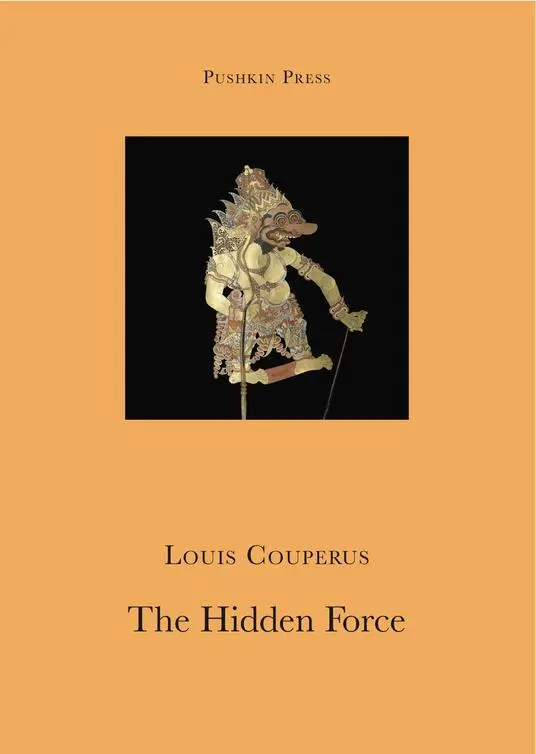
- Название:The Hidden Force
- Автор:
- Издательство:Pushkin Press
- Жанр:
- Год:2012
- ISBN:9781908968227
- Рейтинг книги:4 / 5. Голосов: 1
-
Избранное:Добавить в избранное
- Отзывы:
-
Ваша оценка:
The Hidden Force: краткое содержание, описание и аннотация
Предлагаем к чтению аннотацию, описание, краткое содержание или предисловие (зависит от того, что написал сам автор книги «The Hidden Force»). Если вы не нашли необходимую информацию о книге — напишите в комментариях, мы постараемся отыскать её.
The Hidden Force — читать онлайн бесплатно полную книгу (весь текст) целиком
Ниже представлен текст книги, разбитый по страницам. Система сохранения места последней прочитанной страницы, позволяет с удобством читать онлайн бесплатно книгу «The Hidden Force», без необходимости каждый раз заново искать на чём Вы остановились. Поставьте закладку, и сможете в любой момент перейти на страницу, на которой закончили чтение.
Интервал:
Закладка:
She began to feel unhappy. She was too versatile a woman to seek her happiness solely in her little boy, though with the minor immediate concerns and with thoughts of his future, he did fill part of her life. She had even devised a complete theory of child-rearing. But it didn’t fill her life completely. She was seized with homesickness for Holland, for her parents, for their beautiful artistic home, where one always met painters, writers, composers — an exceptional artistic salon for Holland, where the various branches of art, usually isolated in Holland, came together for a moment.
The image appeared in her mind’s eye like a distant dream as she listened to heralding thunderclaps in the sultry air, close to bursting point, awaiting the deluge that would follow. There was nothing for her here. She felt out of place: she had her faithful group who gathered around her because she was so cheerful, but no deeper sympathy, intimate conversation — except with Van Helderen. And she wanted to be cautious with him so as not to give him any ideas.
Except for Van Helderen. And she thought of the other people around her here in Labuwangi. She thought of people, people from everywhere. And pessimistic as she was in these days, she found in all of them only the egotistical, selfishness, and the less endearing self-absorption; she could scarcely express it to herself, distracted by the massive power of the rain. But she found in everyone conscious and unconscious things that were unattractive. In her faithful friends, too, and in her husband. In the men, young women, young men around her. Everyone had their ego. In no one was there a harmony between the self and others. That which she disapproved of in one person; in another she found something else unpleasant. It was a critical view that made her feel desolate and gloomy, because it was contrary to her nature: she liked to love. She liked to live in company, spontaneously, harmoniously with many others: at the beginning she had been filled with a love of human beings, a love of humanity. Great issues evoked an emotional response in her, but there was no response to all she felt. She found herself empty and alone in a country, a town, in surroundings where absolutely everything — things large and small — grated on her soul, her body, her character, her nature. Her husband worked. Her son was already going native. Her piano was out of tune.
She got up and tried the piano, with long runs that turned into the Feuerzauber from Die Walküre . But the roar of the rain drowned out her music. As she got up again, desperately listless, she saw Van Helderen standing there.
“You gave me a fright,” she said.
“Can I stay to lunch?” he asked. “I’m alone at home. Ida has gone to Tosari for her malaria and taken the children with her. It’s an expensive business. How I’m supposed to stand this for a month, I don’t know.”
“Send the children over here after they’ve been up in Tosari for a few days…”
“Won’t that be a lot of trouble?”
“Of course not… I’ll write to Ida…”
“That really is very sweet of you… It would be a big help.”
She laughed flatly.
“Aren’t you well?”
“I feel like I’m dying.”
“How do you mean?”
“I feel like I’m dying a little every day.”
“Why?”
“It’s terrible here. We were longing for the rains, and now they’re here they’re driving me crazy. And — I don’t know — I can’t stand it here any longer.”
“Where?”
“In the Indies. I taught myself to see all that was good and beautiful in this country. It was all for nothing. I can’t take it any more.”
“Go to Holland,” he said softly.
“My parents would certainly be glad to see me back. It would be good for my son, because every day he’s forgetting more of his Dutch, which I had started teaching him so enthusiastically, and is talking Malay — or worse still, patois. But I can’t leave my husband alone here. Without me he’d have nothing left here. At least — I think so — I like to think so. Perhaps it’s not true.”
“But if you get ill…”
“Oh… I don’t know…”
There was an unusual sense of exhaustion in her whole being.
“Perhaps you’re exaggerating!” he began cheerfully. “Come on, perhaps you’re exaggerating. What’s the matter, what’s upsetting you, what’s making you so unhappy? Let’s draw up an inventory.”
“An inventory of my calamities. My garden is a swamp. Three chairs on my front veranda are cracking apart. White ants have eaten my lovely Japanese rugs. For some inexplicable reason, a new silk dress has come out in damp stains. Another, purely from the heat, I think, has disintegrated into a few threads. In addition, various minor disasters of the kind. To console myself I plunged into Wagner. My piano was off-key; I think there are cockroaches running around between the strings.”
He gave a little laugh.
“What idiots we are here, we Westerners in this country. Why do we bring all the trappings or our precious civilization, which cannot survive here anyway! Why don’t we live in fresh bamboo huts, sleep on a mat, dress in a sarong and a linen jacket with a scarf over our shoulders and a flower in our hair. All your culture, with which you hope to become rich — it’s a Western idea, and in the long run it will collapse. All our administration — it’s exhausting in the heat. Why, if we want to be here, don’t we live simply and plant rice and live on nothing?…”
“You’re talking like a woman,” he said, half laughing.
“Possibly,” she said. “I’m speaking half in jest. But one thing that is certain is that here I feel a force that opposes me, opposes all my Westernness, a force that thwarts me. Sometimes I’m afraid here. Here I always feel on the point of being overwhelmed, I don’t know by what: by something out of the ground, by a power in nature, by a secret in the souls of those black people, whom I don’t know… At night especially I’m afraid.”
“You’re nerves are bad,” he said tenderly.
“Perhaps,” she answered flatly, seeing that he did not understand her, and too tired to go on explaining. “Let’s talk about something else. That table-turning is strange, isn’t it?”
“Yes,” he said.
“Recently when the three of us did it — Ida, you and me…”
“It certainly was very strange.”
“Do you remember the first time? Addy de Luce… It seems to be true after all about him and Mrs Van Oudijck… and the revolt… The table predicted it.”
“Couldn’t it be unconscious suggestion by us?”
“I don’t know. But just imagine if we’re all playing fair and the table starts tapping and talks to us, using an alphabet.”
“I really wouldn’t do it too often, Eva.”
“No. I find it all inexplicable, and yet it’s already beginning to bore me. People get used to the incomprehensible.”
“Everything is incomprehensible…”
“Yes… and everything is banal.”
“Eva,” he said, rebuking her with a gentle laugh.
“I’m giving up the struggle completely. I’ll just look at the rain… and rock.”
“Once you saw the beauty of my country.”
“Your country? Which you’d gladly leave tomorrow to go to the Paris Exhibition.”
“I’ve never seen anything.”
“You’re so humble today.”
“I’m sad, for you.”
“Oh come on, don’t be.”
“Play some more…”
“Here, drink your gin and bitters. Pour yourself one. I’ll play on my out-of-tune piano, which will be in tune with my soul, which is also confused…”
She went back to the central gallery and played from Parsifal . He, on the front veranda, sat and listened. The rain lashed down and the garden was flooded. A violent thunderbolt seemed to split the world asunder. Nature was all-powerful and in its gigantic revelation the two people in this damp house were small: his love was nothing, her melancholy was nothing, and the mystical music of the Grail was like a nursery rhyme amid the booming mysticism of that thunderbolt, with which fate itself seemed to be passing with its heavenly cymbals over the human beings drowning in the deluge.
Читать дальшеИнтервал:
Закладка:
Похожие книги на «The Hidden Force»
Представляем Вашему вниманию похожие книги на «The Hidden Force» списком для выбора. Мы отобрали схожую по названию и смыслу литературу в надежде предоставить читателям больше вариантов отыскать новые, интересные, ещё непрочитанные произведения.









Обсуждение, отзывы о книге «The Hidden Force» и просто собственные мнения читателей. Оставьте ваши комментарии, напишите, что Вы думаете о произведении, его смысле или главных героях. Укажите что конкретно понравилось, а что нет, и почему Вы так считаете.