Louis Couperus - The Hidden Force
Здесь есть возможность читать онлайн «Louis Couperus - The Hidden Force» весь текст электронной книги совершенно бесплатно (целиком полную версию без сокращений). В некоторых случаях можно слушать аудио, скачать через торрент в формате fb2 и присутствует краткое содержание. Год выпуска: 2012, ISBN: 2012, Издательство: Pushkin Press, Жанр: Классическая проза, на английском языке. Описание произведения, (предисловие) а так же отзывы посетителей доступны на портале библиотеки ЛибКат.
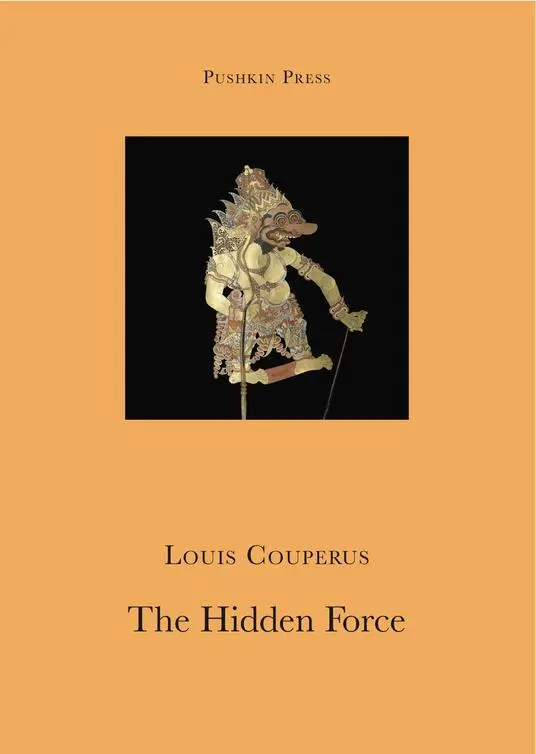
- Название:The Hidden Force
- Автор:
- Издательство:Pushkin Press
- Жанр:
- Год:2012
- ISBN:9781908968227
- Рейтинг книги:4 / 5. Голосов: 1
-
Избранное:Добавить в избранное
- Отзывы:
-
Ваша оценка:
The Hidden Force: краткое содержание, описание и аннотация
Предлагаем к чтению аннотацию, описание, краткое содержание или предисловие (зависит от того, что написал сам автор книги «The Hidden Force»). Если вы не нашли необходимую информацию о книге — напишите в комментариях, мы постараемся отыскать её.
The Hidden Force — читать онлайн бесплатно полную книгу (весь текст) целиком
Ниже представлен текст книги, разбитый по страницам. Система сохранения места последней прочитанной страницы, позволяет с удобством читать онлайн бесплатно книгу «The Hidden Force», без необходимости каждый раз заново искать на чём Вы остановились. Поставьте закладку, и сможете в любой момент перейти на страницу, на которой закончили чтение.
Интервал:
Закладка:
2
VAN HELDEREN’S TWO CHILDREN, a boy and a girl of six and seven, were staying with Eva, and Van Helderen came regularly for a meal once a day. He never spoke again of his innermost feelings, as if he didn’t want to disturb the soothing sweetness of their time together every day. And she accepted his daily visits, unable to deny him access. He was the only man she knew to whom she could talk and with whom she could think aloud, and he was a comfort to her in these gloomy days. She did not understand how she had got into this state, but she gradually fell into total apathy, a kind of nihilism in which nothing seemed necessary. She had never been like that. She had a lively, cheerful nature, she sought and admired beauty, poetry, music and art: things that, from her very first children’s books, she had seen around her and felt and discussed. In the Indies she had gradually begun to miss everything she needed. She was seized by a desperate nihilism that made her ask: what is it all for; what is all that piffling whirling about for? When she read about social forces, the great social question in Europe, in the Indies the emerging issue of the Eurasians, she thought: what is the world for if human beings remain eternally the same — small and passive and oppressed in the misery of their humanity? She couldn’t see the point. Half of humanity suffered from poverty and struggled to rise from that darkness — towards what? The other half vegetated stupidly and drowsily in money. Between the two there was a stairway of shades from dark poverty to anaesthetized wealth. Above them arched the same rainbow of eternal illusions: love, art, big questions marks concerning justice and peace and an ideal future… She found it all futile, she couldn’t see the point and thought: why is the world as it is, and why are there poor people?…
She had never felt like this before, but she couldn’t fight it. Slowly, day by day, the Indies made her spiritually ill. Frans van Helderen was her only consolation: this young controller, blond and distinguished, who had never been in Europe, who had been educated entirely in Batavia, had taken his exams in Batavia, had with his supple courtesy, his indescribably strange nationality, by virtue of his almost exotic education, become a dear friend. She told him how much she treasured that friendship and he no longer responded by declaring his love. As it was, there was so much tenderness in their relationship, something idealistic, which they both needed. In the ordinariness that surrounded them, that friendship shone forth as something most exquisite and glorious, of which they were both proud. He was a frequent visitor — especially now his wife was at Tosari — and in the dusk they would walk to the lighthouse, which stood by the shore like a miniature Eiffel Tower. There was much talk about those walks, but that did not bother them. They sat down on the base of the lighthouse, looked out to sea, and listened to sounds in the distance. Ghostly proas, with sails like nocturnal birds, slid into the canal, to the aching crooning of the fishermen. A melancholy air of desolation, of a small world of small people, spread eerily under the twinkling starry skies, where the mystical Southern Cross appeared diamond-like, or the crescent moon sometimes shone, and above the melancholy of the fishermen’s droning song, battered proas, the little people at the bottom of the little lighthouse, floated an unfathomable immensity: skies and eternal lights. And out of the immensity the ineffable approached as the superhumanly divine in which all petty humanity submerged, melted.
“Why should I attach any value to life, when I may be dead tomorrow?” thought Eva. “Why all that human entanglement and bustle, when we all may be dead tomorrow?…”
She told him. He replied that individuals did not live for themselves and their own present time, but for all human beings and for the future… But she laughed bitterly, shrugged her shoulders, and found him trite. She found herself trite, too, thinking such things, which had been thought so often before. Yet, despite her self-criticism, she remained oppressed by her obsession with the pointlessness of life, when everything might cease to exist tomorrow. A humiliating sense of atomic smallness overcame both of them as they sat there, looking at the vast skies and eternal starlight.
Yet they loved those moments, which meant everything to them, since when they were not too aware of their smallness, they talked about books, music, art and the bigger things in life. They felt that despite the subscription library and the Italian opera in Surabaya, they were no longer in touch. They felt that the great, exalted things were very far removed from them, and they were seized, both of them, by a homesickness for Europe, a desire no longer to feel so small. They would have both liked to go away, to Europe, but neither of them could. They were trapped by humdrum everyday life. Then, almost automatically, in perfect harmony, they talked about the soul and the essence of things and its great mystery.
All its mystery. They could feel it from the sea, in the air, but secretly they also sought it in the dancing leg of a table. They could not understand how a spirit or soul could reveal itself through a table on which they earnestly placed their hands, and through which the energy passing through was transformed from something dead to something alive. But when they placed their hands on it, the table did come alive, and they couldn’t help believing. The letters that they counted sometimes came out in a confused form in a strange alphabet, as if directed by a mocking spirit intending constantly to tease and confuse, suddenly to stop and become coarse and filthy. They read books about spiritualism together, and weren’t sure whether to believe or not.
These were silent days — silent, monotonous days — in the town, where rain gushed everywhere. Their life together seemed unreal, like a dream that wove through the rain like a mist. And for Eva it was like a sudden awakening when one afternoon, walking outside down the damp avenue and waiting for Van Helderen, she saw Van Oudijck approaching.
“I was just on my way to see you, dear lady!” he said excitedly. “I wanted to ask you something. Will you help me again?”
“With what, Commissioner?”
“But first tell me, are you not well? You don’t look well at the moment.”
“It’s nothing serious,” she said with a flat laugh. “It will pass. What can I do for you, Commissioner?”
“Something has got to be done, dear lady, and we can’t do without you. My wife said only this morning: ask Mrs Eldersma…”
“What is it?”
“You know Mrs Staats, the wife of the stationmaster who passed away? The poor woman has been left with nothing, just her five children and a few debts.”
“He committed suicide, didn’t he?”
“Yes. It’s a very sad case. We must help her. We need a large sum. Circulating lists won’t produce much. People are generous enough, but recently they’ve made such a lot of sacrifices. At the gala they went crazy. They won’t have a lot to give now at the end of the month. But at the beginning of next month, January, dear lady, there’ll be a production by Thalia. Very quick, a couple of drawing-room pieces, without great overheads. Tickets at one guilder fifty or two-fifty, and if you organize it, the house will be full and they will come from Surabaya. You must help me dear lady. You will, won’t you?”
“But Commissioner,” said Eva wearily. “We’ve just had the tableaux vivants . Don’t be angry, but I don’t feel like playacting all the time.”
“Yes, yes, you must…” Oudijck insisted rather imperiously, excited about his plan.
She became peevish. She liked her independence and particularly in these days of depression she was too gloomy, in these dreamlike days she felt too woolly to accede sweetly and at once to the request from on high.
Читать дальшеИнтервал:
Закладка:
Похожие книги на «The Hidden Force»
Представляем Вашему вниманию похожие книги на «The Hidden Force» списком для выбора. Мы отобрали схожую по названию и смыслу литературу в надежде предоставить читателям больше вариантов отыскать новые, интересные, ещё непрочитанные произведения.





Обсуждение, отзывы о книге «The Hidden Force» и просто собственные мнения читателей. Оставьте ваши комментарии, напишите, что Вы думаете о произведении, его смысле или главных героях. Укажите что конкретно понравилось, а что нет, и почему Вы так считаете.