Louis Couperus - The Hidden Force
Здесь есть возможность читать онлайн «Louis Couperus - The Hidden Force» весь текст электронной книги совершенно бесплатно (целиком полную версию без сокращений). В некоторых случаях можно слушать аудио, скачать через торрент в формате fb2 и присутствует краткое содержание. Год выпуска: 2012, ISBN: 2012, Издательство: Pushkin Press, Жанр: Классическая проза, на английском языке. Описание произведения, (предисловие) а так же отзывы посетителей доступны на портале библиотеки ЛибКат.
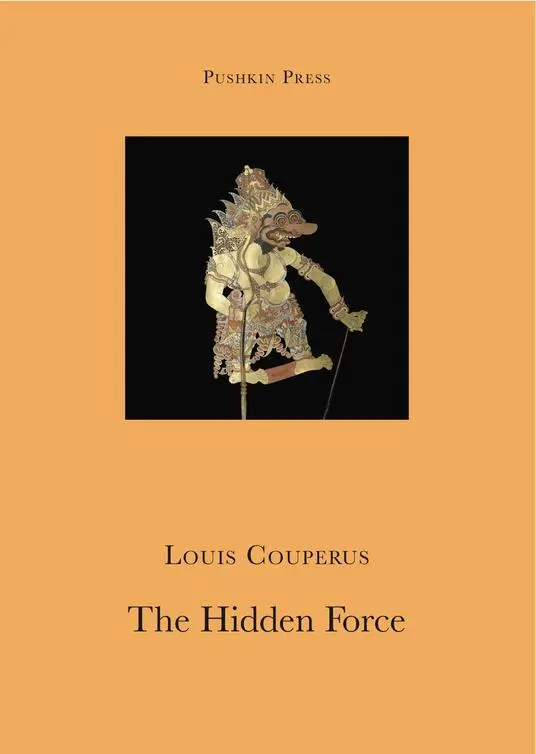
- Название:The Hidden Force
- Автор:
- Издательство:Pushkin Press
- Жанр:
- Год:2012
- ISBN:9781908968227
- Рейтинг книги:4 / 5. Голосов: 1
-
Избранное:Добавить в избранное
- Отзывы:
-
Ваша оценка:
The Hidden Force: краткое содержание, описание и аннотация
Предлагаем к чтению аннотацию, описание, краткое содержание или предисловие (зависит от того, что написал сам автор книги «The Hidden Force»). Если вы не нашли необходимую информацию о книге — напишите в комментариях, мы постараемся отыскать её.
The Hidden Force — читать онлайн бесплатно полную книгу (весь текст) целиком
Ниже представлен текст книги, разбитый по страницам. Система сохранения места последней прочитанной страницы, позволяет с удобством читать онлайн бесплатно книгу «The Hidden Force», без необходимости каждый раз заново искать на чём Вы остановились. Поставьте закладку, и сможете в любой момент перейти на страницу, на которой закончили чтение.
Интервал:
Закладка:
Saina thought that was a nuisance, too much fuss.
“Why?”
Saina explained. The house had been left to her by her husband. She was attached to it, although it was very dilapidated. Now, during the wet monsoon, rainwater often came in, and then she couldn’t cook and the children had nothing to eat. Having it repaired was difficult. She earned two and a half guilders a week from the lady, and sixty cents of that went on rice. Then every day she spent a few cents on fish, coconut oil, betel, and a few cents on fuel… No, it was impossible to repair the house. She would be much better off with the good lady, in the compound. But it would be a lot of fuss finding a tenant for the house because it was so run down and the good lady knew that no house in the native quarter must stand empty: it carried a hefty fine… So she preferred to go on living in her wet house… At night she could stay and look after the good lady; her eldest daughter could look after the little ones.
Accepting her petty existence with its petty miseries, Saina slid her supple fingers over the sick limbs of her mistress, pressing firmly and gently.
Eva found it a bleak existence, living on two and a half guilders a week, with four children, in a house that let the rain in so that it was impossible to cook.
“Let me look after your second daughter, Saina,” said Eva another time.
Saina hesitated, and smiled: she would rather not, but didn’t dare say so.
“Come on,” Eva insisted. “Let her come here: you’ll see her all day long; she can sleep in cook’s room; I’ll get her some clothes and all she’ll have to do is tidy up my bedroom. You can show her how to do that.”
“She’s still so young, nyonya , only ten.”
“Come on,” Eva insisted. “Let her help you now. What’s her name?”
“Mina, nyonya .”
“Mina? No! That’s the seamstress’s name. We’ll find another name for her…”
Saina brought the child, who was very shy, with a streak of rice powder on her forehead, and Eva dressed her in some nice clothes. She was a very pretty child, a softy downy brown, and looked sweet in her fresh clothes. She made a neat pile of all the sarongs in the wardrobe and put fragrant white flowers between them: the flowers had to be replaced with fresh ones every day. For a joke, because she was so good with flowers, Eva called her Melati.
A few days later Saina again squatted at her mistress’s feet.
“What is it, Saina?”
“Could the child come back to the wet house in the native quarter?”
“Why?!” asked Eva, astonished. “Isn’t your little girl happy here then?”
“Oh yes, but the child simply likes the cottage better,” said Saina in embarrassment; the nyonya was very nice, but little Mina liked the cottage better.
Eva was angry and let the child go, with the new clothes, which Saina simply took with her.
“Why wasn’t the child allowed to stay?” Eva asked the cook.
At first the cook did not dare say.
“Come on, why not, cook?” Eva insisted.
“Because the nyonya had called the girl Melati… Flower and fruit names… are given only… to dancing girls,” explained the cook mysteriously.
“But why didn’t Saina tell me?” asked Eva angrily. “I had no idea!”
“Shy…” said the cook, apologetically. “Forgive me, nyonya .”
These were small incidents in her daily life as a housewife — anecdotes from her household. But they made her bitter because she felt them as a division, which was always there between her and the people and things in the Indies. She did not know the place and she would never know the people.
And the small disappointment over those episodes filled her with as much bitterness as the larger one of her shattered illusions, because her everyday life among the recurring trivialities of her household was itself growing smaller and smaller.
BOOK VI
1
THE MORNINGS WERE OFTEN COOL, washed clean by the abundant rains, and in the sunshine of the early morning hours a soft haze rose from the earth, a bluish blurring of any line or colour that was too sharp, so that Long Avenue with its villas and enclosed gardens was shrouded in the charm and vagueness of a dream avenue: its pillars rose ethereally like a vision of serene columns, the lines of the roofs ennobled by their vagueness; the tints of the trees in silhouette were refined into soft pastel washes of hazy pink, and even hazier blue, with an occasional yellow glow, and a distant streak of dawn, and over all this breaking day was a dewy freshness that spurted upwards out of the drenched ground and whose droplets were caught in the childlike softness of the very first rays of the sun. It was as if the earth began for the first time every morning and as if human beings were only then created, in a youth of naivety and paradisaical ignorance. But the illusion of this daybreak lasted only briefly, no more than a few minutes: the sun, rising higher, broke through the virginal haze, its proud halo of piercing rays pouring forth burning gold sunlight, divinely proud to rule for a brief moment, since the clouds were already gathering, approaching in a grey mass like battle-ready hordes of dark spirits, ghostlike and bluey deep black, their thick and heavy lead grey overwhelming the sun and crushing the earth under white torrents of rain. And the evening twilight, grey and hurried, one shroud falling on another, was like an overwhelming sadness falling over earth, nature and life, in which that second of paradise in the morning was forgotten; the white rain rushed down like a drowning gloom; the roads and the gardens drank in the waterfall until they glowed like swamp pools in the falling dusk: a chill, spectral mist rose like the movement of languid ghostly garments, which floated over the ponds and the houses, dimly lit by smoking lamps around which clouds of insects swarmed, plummeting to their death with scorched wings. The air was filled with a chill melancholy, a shadowy anxiety about the approaching threat from outside, about the omnipotent hordes of clouds, about the boundless immensity that wafted rustling from the far, unknown distance: as big and wide as the firmament, against which the houses did not seem protected, in which the people — with all their culture and science and inward emotion — were small and insignificant, as small as writhing insects, helpless against the interplay of gigantic mysteries borne from afar.
Léonie van Oudijck, in the half-lit back veranda of the Commissioner’s house, was talking in a soft voice to Theo, with Urip squatting down beside her.
“It’s nonsense, Urip!” she said in irritation.
“No, it isn’t, nyonya , it isn’t nonsense,” said the maid. “I hear them every evening.”
“Where?” asked Theo.
“In the banyan tree in the grounds behind the house, on the highest branches.”
“They’re wildcats!” said Theo.
“They’re not wildcats, kanjeng !” the maid maintained. “ Massa , goodness me! As if Urip didn’t know how wildcats miaow! Creeow, creeow, is the sound they make. What we hear every night now are the ghosts! They are the little children crying in the trees. The souls of the little children crying in the trees!”
“It’s the wind, Urip…”
“Goodness me, nyonya . As if Urip couldn’t hear the wind! Boo-oh is how the wind goes, and then the branches move. These are the little children moaning in the highest branches and the main branches do not move. Then everything is deathly quiet… This spells doom, ma’am.”
“And why should it spell doom…”
“Urip knows, but dare not say. Ma’am is bound to be angry.”
Читать дальшеИнтервал:
Закладка:
Похожие книги на «The Hidden Force»
Представляем Вашему вниманию похожие книги на «The Hidden Force» списком для выбора. Мы отобрали схожую по названию и смыслу литературу в надежде предоставить читателям больше вариантов отыскать новые, интересные, ещё непрочитанные произведения.












Обсуждение, отзывы о книге «The Hidden Force» и просто собственные мнения читателей. Оставьте ваши комментарии, напишите, что Вы думаете о произведении, его смысле или главных героях. Укажите что конкретно понравилось, а что нет, и почему Вы так считаете.