Louis Couperus - The Hidden Force
Здесь есть возможность читать онлайн «Louis Couperus - The Hidden Force» весь текст электронной книги совершенно бесплатно (целиком полную версию без сокращений). В некоторых случаях можно слушать аудио, скачать через торрент в формате fb2 и присутствует краткое содержание. Год выпуска: 2012, ISBN: 2012, Издательство: Pushkin Press, Жанр: Классическая проза, на английском языке. Описание произведения, (предисловие) а так же отзывы посетителей доступны на портале библиотеки ЛибКат.
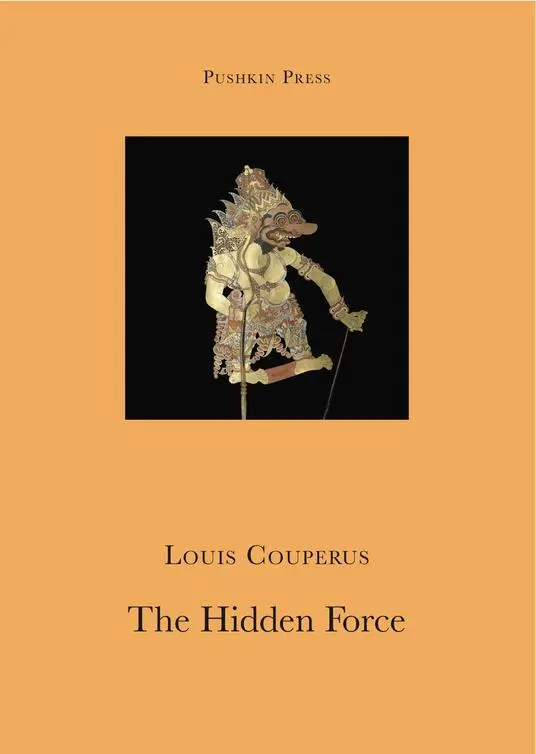
- Название:The Hidden Force
- Автор:
- Издательство:Pushkin Press
- Жанр:
- Год:2012
- ISBN:9781908968227
- Рейтинг книги:4 / 5. Голосов: 1
-
Избранное:Добавить в избранное
- Отзывы:
-
Ваша оценка:
The Hidden Force: краткое содержание, описание и аннотация
Предлагаем к чтению аннотацию, описание, краткое содержание или предисловие (зависит от того, что написал сам автор книги «The Hidden Force»). Если вы не нашли необходимую информацию о книге — напишите в комментариях, мы постараемся отыскать её.
The Hidden Force — читать онлайн бесплатно полную книгу (весь текст) целиком
Ниже представлен текст книги, разбитый по страницам. Система сохранения места последней прочитанной страницы, позволяет с удобством читать онлайн бесплатно книгу «The Hidden Force», без необходимости каждый раз заново искать на чём Вы остановились. Поставьте закладку, и сможете в любой момент перейти на страницу, на которой закончили чтение.
Интервал:
Закладка:
“Come on, Urip, out with it!”
“It’s because of the tuan kanjeng , the tuan commissioner.”
“Why?”
“Recently at the fair on the square and the fair for white people, in the town park…”
“Well, what about it?”
“The day wasn’t properly calculated, according to the almanacs. It was an unlucky day… And with the new well…”
“Well, what about the new well?”
“There was no ritual offering of food. So no one uses the new well. Everyone draws their water from the old well… Even though the water is not good. Because the woman with the bleeding hole in her breast rises from the new well… And Miss Doddy…”
“What?”
“Miss Doddy saw him, the white haji ! That is not a good pilgrim, the white pilgrim… That is a ghost. Miss Doddy has seen him twice, at Pajaram and here… Listen, ma’am.”
“What?”
“Can’t you hear? The children’s souls are moaning in the topmost branches. There is no wind at the moment. Listen, listen, they are not wildcats! The wildcats go cree-ow, creeow when they are on heat! That is the souls!..”
All three listened. Instinctively Léonie pressed closer to Theo. She was deathly pale. The spacious back veranda, with the table permanently set, stretched away in the gloomy light of a single hanging paraffin lamp. The waterlogged back garden was dimly visible against the blackness of the banyans, from which a stream of droplets was falling, but whose impenetrable, velvety masses of foliage were immobile. And an inexplicable, scarcely perceptible groaning, like a faint secret of tormented young souls persisted high above, as if in the sky, as if in the topmost branches of the trees. At times it was a short cry, at others a faint sobbing as if of tortured girls…
“What kind of animals can they be?” asked Theo. “Are they birds or insects?…”
The groaning and the sobbing were clearly audible. Léonie was as white as a sheet and was trembling all over her body.
“Don’t be frightened,” said Theo. “They must be animals…”
But he himself was as pale as a ghost, and when they looked into each other’s eyes, she realized that he was afraid, too. She squeezed his arm tightly and pressed up against him. The maid squatted humbly, hunched up, as if accepting whatever fate brought as an inexplicable mystery. She would not take flight. But in the eyes of the white people there seemed to be a single thought, to flee. Suddenly the two of them — the stepmother and the stepson who were bringing shame on the house — felt fear, a single fear, as if of punishment. They didn’t speak, they said nothing to each other, just stayed resting against each other, understanding each other’s trembling, the two white children of the mysterious Indies earth — who from their childhood onwards had breathed the mysterious air of Java; unconsciously they had heard the vague, softly approaching mystery, like ordinary music, a music that they had not heeded, as if mystery were ordinary. As they stood trembling and looking at each other, the wind got up and brought with it the secret of the souls, and carried them away; the branches moved about wildly and fresh rain poured down. A chilly breeze filled the house; a gust extinguished the lamp and they were left in darkness for a moment. She, despite the openness of the veranda, almost in the arms of her son and lover; the maid cringed at their feet. But then she disengaged herself from him, disengaged herself from the black oppression of darkness and fear through which the rain roared; a chilly wind blew and she stumbled indoors, almost fainting. Theo and Urip followed her. The central gallery was lit, and Van Oudijck’s office was open. He was working. Léonie stood there indecisively, with Theo, not knowing what to do. The maid disappeared, muttering under her breath. It was then that Léonie heard a whooshing sound and a small round stone flew through the veranda and fell somewhere. She gave a cry and stepped behind the screen that separated the office where Van Oudijck was sitting at his desk, then she cast caution to the winds and again threw herself into Theo’s arms. They stood shivering and clinging to each other. Van Oudijck had heard her, stood up and came out from behind the partition. His eyes were blinking rapidly, as if tired from working. Léonie and Theo regained their composure.
“What is it, Léonie?…”
“Nothing,” she said, not daring to say anything about the souls or the stone, afraid of the imminent punishment. She and Theo stood guiltily, both white as a sheet and trembling. Van Oudijck, with his mind still on his work, saw nothing.
“Nothing,” she said. “The mat is worn, and… I almost stumbled. But I wanted to mention something, Otto…”
Her voice was trembling but he didn’t hear it, blind and deaf to her as he was, still absorbed in his documents.
“What?”
“Urip suggested to me that the servants would like to have an offering, since a new well has been sunk in the grounds…”
“The well that is two months old?”
“They don’t draw water from it.”
“Why not?”
“They’re superstitious, you see; they don’t want to use the water until the offering has been made.”
“Then it should have been done immediately. Why didn’t they let me know through Kario? I can’t think of all that nonsense by myself. But I would have arranged an offering at the time. Now it’s like shutting the stable door after the horse has bolted. The well is two months old.”
“It would be good in any case,” said Theo. “Papa, you know yourself what the Javanese are like: they won’t use the well if they aren’t granted an offering.”
“No,” said Van Oudijck stubbornly, shaking his head. “Making an offering now would be quite senseless. I would have been happy to do it, but now, after two months, it’s absurd. They should have asked straight away.”
“Come on, Otto,” begged Léonie. “Why don’t you make the offering. As a favour to me.”
“Mama has already half-promised Urip…” said Theo with gentle insistence.
They stood before him, trembling, white as a sheet, like supplicants.
But, worn out as he was, and with his mind on his documents, he was filled with a stubborn reluctance, though he could seldom refuse his wife anything.
“No, Léonie,” he said firmly. “You must never promise anything you’re not sure of…”
He turned away, went round the screen, and sat down to continue his work.
They looked at each other, the stepmother and her stepson. Slowly, aimlessly, they moved from where they were onto the front veranda, where a damp darkness floated between the imposing pillars. They saw a white figure approaching through the sodden garden. They were alarmed, frightened of everything now, each silhouette reminding them of the strange punishment that would befall them so long as they remained in the parental home on which they had brought shame. But when they peered more closely they recognized Doddy. She said that she had been to see Eva Eldersma. In fact she had been walking with Addy de Luce, and they had sheltered from the rain in the native quarter. She was very pale and shivering, but Léonie and Theo couldn’t see it in the dark front veranda, just as she couldn’t see that her stepmother was pale, and Theo too. She was shivering so violently because she had been pelted with stones in the garden — Addy had left her at the gate. She thought of an impudent Javanese, who hated her father and his house and his family, but on the dark front veranda, where she saw her stepmother and brother sitting silently close together, as if helpless, she suddenly felt — she knew not why — that it had not been an impudent Javanese…
She sat down with them in silence. They looked out onto the dark, damp garden, over which night approached as if on giant bat’s wings. And in the wordless melancholy that filtered between the stately white pillars in the grey dusk, all three of them — Doddy alone; her stepmother and stepson together — frightened to death and crushed by the strange event that was about to happen…
Читать дальшеИнтервал:
Закладка:
Похожие книги на «The Hidden Force»
Представляем Вашему вниманию похожие книги на «The Hidden Force» списком для выбора. Мы отобрали схожую по названию и смыслу литературу в надежде предоставить читателям больше вариантов отыскать новые, интересные, ещё непрочитанные произведения.








Обсуждение, отзывы о книге «The Hidden Force» и просто собственные мнения читателей. Оставьте ваши комментарии, напишите, что Вы думаете о произведении, его смысле или главных героях. Укажите что конкретно понравилось, а что нет, и почему Вы так считаете.