Louis Couperus - The Hidden Force
Здесь есть возможность читать онлайн «Louis Couperus - The Hidden Force» весь текст электронной книги совершенно бесплатно (целиком полную версию без сокращений). В некоторых случаях можно слушать аудио, скачать через торрент в формате fb2 и присутствует краткое содержание. Год выпуска: 2012, ISBN: 2012, Издательство: Pushkin Press, Жанр: Классическая проза, на английском языке. Описание произведения, (предисловие) а так же отзывы посетителей доступны на портале библиотеки ЛибКат.
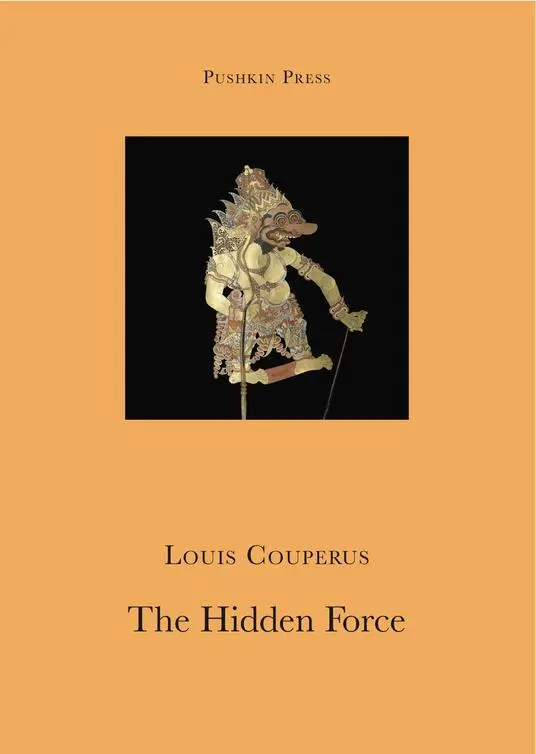
- Название:The Hidden Force
- Автор:
- Издательство:Pushkin Press
- Жанр:
- Год:2012
- ISBN:9781908968227
- Рейтинг книги:4 / 5. Голосов: 1
-
Избранное:Добавить в избранное
- Отзывы:
-
Ваша оценка:
The Hidden Force: краткое содержание, описание и аннотация
Предлагаем к чтению аннотацию, описание, краткое содержание или предисловие (зависит от того, что написал сам автор книги «The Hidden Force»). Если вы не нашли необходимую информацию о книге — напишите в комментариях, мы постараемся отыскать её.
The Hidden Force — читать онлайн бесплатно полную книгу (весь текст) целиком
Ниже представлен текст книги, разбитый по страницам. Система сохранения места последней прочитанной страницы, позволяет с удобством читать онлайн бесплатно книгу «The Hidden Force», без необходимости каждый раз заново искать на чём Вы остановились. Поставьте закладку, и сможете в любой момент перейти на страницу, на которой закончили чтение.
Интервал:
Закладка:
“Really, Commissioner, I can’t think of anything this time,” she answered abruptly. “Why doesn’t Mrs Van Oudijck do it herself?…”
She startled herself by saying that peevishly. As he walked next to her, he became upset and his face darkened. The excited, cheerful look, the jovial laugh around his thick moustache had suddenly disappeared. She saw that she had been cruel and regretted it. And for the first time she realized that however much in love he might be with his wife, he did not approve of her shirking all her duties.
He was lost for an answer, and as he hunted for words, she was silent.
Then she said, in a sweet tone: “Don’t be angry, Commissioner. That wasn’t very kind of me. I know very well that Mrs Van Oudijck doesn’t like that kind of thing. I’m happy to take it off her hands. I shall do whatever you want.”
She was so nervous that her eyes filled with tears.
Smiling now, he gave her a quizzical sideways look.
“How on edge you are. But I knew that your heart was in the right place, and you wouldn’t let me down with my plan, and would want to help poor Mrs Staats. But nothing too expensive, dear lady, no lavish expenditure, and no new scenery. Just your wit, your talent, your beautiful diction in French or Dutch — whatever you want. We’re proud of that in Labuwangi, and all those wonderful things — which you will provide free of charge — will be quite enough to make the performance a success. But how nervous you are, dear lady. Why are you crying? Are you not well? Tell me if there is anything I can do for you.”
“Don’t give my husband so much work, Commissioner. I scarcely ever see him.”
He made a gesture of helplessness.
“It’s true, it’s terribly busy,” he admitted. “Is that the heart of the matter?”
“Show me the good things about the Indies.”
“Is that the problem?”
“And lots more besides…”
“Are you homesick? Don’t you like the Indies any more, don’t you care for Labuwangi, where we all think the world of you?… You’ve got the wrong idea about the Indies. Try to see the good side.”
“I’ve tried.”
“Is it no use any longer?”
“No…”
“You’re too sensible not to see the good things about this country.”
“You’re too fond of the country to be impartial. And I can’t be impartial either. But tell me the good things.”
“Where shall I begin? The good that we can do as officials for the country and its people, and the satisfaction we derive from it. The wonderful, marvellous work we do for the country and its people; the great amount of hard work that fills a whole life here… I’m not talking about all the office work of your husband, who is a secretary, I’m talking of later on, when he is an assistant commissioner!”
“How much longer will that be?…”
“And what about the comfortable life here then?”
“That the white ants gnaw away at.”
“That’s a cheap joke, madam.”
“That may be, Commissioner. Everything is out of tune in and around me. My cleverness, my piano, and my poor soul.”
“What about nature then?”
“It makes me feel so insignificant. Nature overwhelms me and consumes me.”
“Your work?”
“My work… one of the good things in the Indies…”
“Yes. The work of occasionally inspiring us humdrum people with your wit.”
“Commissioner, so many compliments! Is that all because of the performance!”
“And using that wit to help widow Staats?”
“Couldn’t I do good in Europe?”
“Of course,” he said curtly. “Off you go to Europe, madam. Join a charity organization in The Hague, with a collection box at your door and two and a half guilders… how often?”
She laughed.
“Don’t be unfair. A lot of good is done in Holland too.”
“But doing what you’re going to do for one unfortunate… is that ever done in Holland? And don’t tell me there’s less poverty here.”
“So?…”
“So there are a lot of good things here for you. Your work. Working for others, materially and morally. Don’t let Van Helderen become too infatuated with you, madam. He’s a charming chap, but too literary in his monthly controller’s reports. I can see him coming and I must go. So I can count on you?”
“Absolutely.”
“When shall we have the first meeting, with the theatre committee, and the ladies?”
“Tomorrow evening, Commissioner, at your house?”
“Excellent. I’ll circulate subscription lists. We must raise a lot of money, dear lady.”
“We’ll help Mrs Staats,” she said softly.
He shook her hand and left. She felt limp, without knowing why.
“The Commissioner warned me about you, because you were too literary!” she teased Van Helderen.
They sat on the front veranda. The heavens opened: a white curtain of rain descended in vertical folds. A plague of locusts leapt through the veranda. A cloud of tiny flies hummed like an Aeolian harp in the corners. Eva and Van Helderen lay their hands on the table and it raised a leg with a jerk, while the beetles swarmed around them.
3
LISTS CIRCULATED. The performance was rehearsed and three weeks later was performed, and the theatre committee presented the commission with the sum of almost fifteen hundred guilders for widow Staats; a house was rented for her, and she was set up in a small dress shop, for which Eva had called on connections in Paris. All the ladies of Labuwangi had placed an order with widow Staats, and in less than a month the woman had not only been saved from complete disaster, but her life had been arranged, her children were back at school, and she had a thriving business. All of this had happened quickly and unostentatiously: subscribers had given generously; the ladies were so quick to order a dress or a hat that they didn’t need, that Eva was astonished. She had to admit that the egotistical, self-obsessed, less appealing side that she so often saw in their social life — in their daily dealings, conversation, intrigues and gossip — had suddenly been pushed into the background by a collective talent for doing good, quite simply because it had to be done, because there was no alternative, because the woman had to be helped. After the day-to-day concerns of the performance had roused her from her gloom, and she had been galvanized into acting quickly, she learnt to appreciate this benevolent aspect of her surroundings and wrote so enthusiastically about it to Holland that her parents, for whom the Indies were a closed book, could not help smiling. But although this episode had awakened in her something soft and weak and appreciative, it was only an episode, and when the surrounding emotion had subsided, she was the same. Despite the disapproval that she felt around her in Labuwangi, she continued to centre her whole life around her friendship with Van Helderen.
Because there was so little else. The loyal coterie that she had gathered around her with such hopes, whom she invited to dinner, to whom her house was always open — what did it really amount to? Nowadays she regarded the Doorn de Bruins and the Rantzows as indifferent acquaintances, no longer as friends. She suspected that Mrs Doorn de Bruin was not to be trusted, Dr Rantzow was too bourgeois, too common for her taste, and his wife an insignificant German housewife. Yes, they joined in the table-turning, but they enjoyed the inept stupidities, the indecent comments of the mocking spirit. She and Van Helderen took it extremely seriously, although she actually found the table comical. So there was no one left but Van Helderen to whom she felt close.
She had come to admire Van Oudijck, though. She had suddenly seen his true character and, although it was completely different from the artistic charm that had hitherto attracted her in people’s characters, she saw the line of beauty in this man too, who was utterly inartistic, who had not the slightest notion of art, and yet had such beauty in his simple masculine ideas of duty and in the equanimity with which he bore the disappointment of his domestic life. Because Eva saw that although he adored his wife, he did not approve of Léonie’s indifference to all the interests that constituted his life. If he saw nothing else, if apart from that he was blind to everything in the domestic sphere, this disappointment was his secret and his sorrow, to which, deep down, he was not blind.
Читать дальшеИнтервал:
Закладка:
Похожие книги на «The Hidden Force»
Представляем Вашему вниманию похожие книги на «The Hidden Force» списком для выбора. Мы отобрали схожую по названию и смыслу литературу в надежде предоставить читателям больше вариантов отыскать новые, интересные, ещё непрочитанные произведения.







Обсуждение, отзывы о книге «The Hidden Force» и просто собственные мнения читателей. Оставьте ваши комментарии, напишите, что Вы думаете о произведении, его смысле или главных героях. Укажите что конкретно понравилось, а что нет, и почему Вы так считаете.