Louis Couperus - The Hidden Force
Здесь есть возможность читать онлайн «Louis Couperus - The Hidden Force» весь текст электронной книги совершенно бесплатно (целиком полную версию без сокращений). В некоторых случаях можно слушать аудио, скачать через торрент в формате fb2 и присутствует краткое содержание. Год выпуска: 2012, ISBN: 2012, Издательство: Pushkin Press, Жанр: Классическая проза, на английском языке. Описание произведения, (предисловие) а так же отзывы посетителей доступны на портале библиотеки ЛибКат.
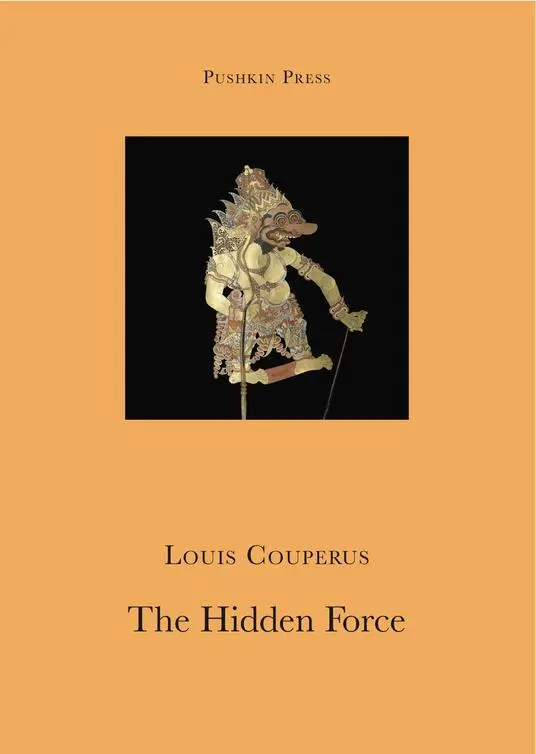
- Название:The Hidden Force
- Автор:
- Издательство:Pushkin Press
- Жанр:
- Год:2012
- ISBN:9781908968227
- Рейтинг книги:4 / 5. Голосов: 1
-
Избранное:Добавить в избранное
- Отзывы:
-
Ваша оценка:
The Hidden Force: краткое содержание, описание и аннотация
Предлагаем к чтению аннотацию, описание, краткое содержание или предисловие (зависит от того, что написал сам автор книги «The Hidden Force»). Если вы не нашли необходимую информацию о книге — напишите в комментариях, мы постараемся отыскать её.
The Hidden Force — читать онлайн бесплатно полную книгу (весь текст) целиком
Ниже представлен текст книги, разбитый по страницам. Система сохранения места последней прочитанной страницы, позволяет с удобством читать онлайн бесплатно книгу «The Hidden Force», без необходимости каждый раз заново искать на чём Вы остановились. Поставьте закладку, и сможете в любой момент перейти на страницу, на которой закончили чтение.
Интервал:
Закладка:
The revellers made their way home. The carriages trundled up to the main entrance; their owners got in and the carriages trundled off. In the road, in front of the club, Van Oudijck saw a Javanese: his upper body bare, he had lost his turban and his long black hair waved freely about, while he gesticulated violently and talked loudly. Groups formed in the dim shadows, watching from afar.
Van Oudijck recognized the Prince of Ngajiwa. The Prince had already behaved without self-control during the ball, after losing large sums at cards and drinking all sorts of different wines indiscriminately.
“Hadn’t the Prince already gone home?” asked Van Oudijck.
“Certainly, kanjeng !” wailed the prince’s assistant. I had already taken the Prince home, when I saw that he was out of control. He had already thrown himself down on his bed; I thought he was fast asleep. But as you see, he woke and got up; he left the palace and came back here. Look how he’s behaving! He’s drunk and he’s forgetting who he is and who his fathers were!”
Van Oudijck went outside with Vermalen. He approached the Prince, who was gesticulating wildly and declaiming an incomprehensible speech.
“Prince!” said the Commissioner. “Have you forgotten where and who you are?”
The Prince did not recognize him. He flared up at Van Oudijck and hurled every conceivable insult at his head.
“Prince,” said the assistant commissioner. “Don’t you know who is talking to you and whom you are talking to?”
The Prince railed at Vermalen. His bloodshot eyes flashed fury and madness. Van Oudijck tried to help him into a carriage but he refused. Sublimely grand in his downfall he revelled in the craziness of his tragedy, and stood there as if he had burst out of himself, half-naked with waving hair. His expansive gestures were no longer coarse or bestial, but became tragic, heroic. He was wrestling with his fate on the brink of an abyss… The excess of his drunkenness seemed through some strange power to lift him out of his slow descent into bestiality, and in his drunken state he grew in stature and towered dramatically high above those Europeans. Van Oudijck looked at him stupefied. The Prince was in a tussle with the assistant commissioner, who pleaded with him… Along the road the population gathered, silent, appalled: the last guests left the club and the lights were dimmed. Among them were Léonie van Oudijck, Doddy and Addy de Luce. All three of them still had the weary delight of the last waltz in their eyes.
“Addy!” said the Commissioner. “You’re on close terms with the Prince. See if he recognizes you.”
The young man spoke to the drunken madman in soft Javanese. At first the Prince went on cursing, and his crazy gestures became huge; but then he seemed to recognize in the softness of the language a familiar memory. He looked at Addy for a long time. His gestures subsided, his glorification of drunkenness petered out. It was suddenly as if his blood understood the blood of the young man, as if their souls were communicating. The Prince nodded gloomily and began to wail, at length, with his arms raised. Addy tried to help him into his carriage, but the Prince resisted: he did not want to go. Then Addy took his arm gently but firmly, and slowly walked off with him. The Prince, still wailing with a tragic, despairing gesture, let himself be led away. The Prince’s assistant followed with a few retainers, who had trailed the Prince from the palace, helplessly… The procession vanished into the darkness.
Léonie, with a smile, got into the assistant commissioner’s carriage. She remembered the argument over cards at Pajaram; she enjoyed watching such a slow, public decline, an obvious undermining through passion, uncontrolled by any tact or correct moderation. As far as she was concerned, she felt stronger than ever, because she enjoyed her passions and controlled and made them the slaves of her pleasure… She despised the Prince and it gave her a Romantic satisfaction, a literary frisson, to catch a glimpse of the successive phases of that downfall. In the carriage she looked at her husband who sat there gloomily. His gloominess delighted her, because she thought him sentimental in his support of the Javanese aristocracy. A sentimental official instruction, which Van Oudijck interpreted even more sentimentally. And she revelled in his sorrow. Then she looked at Doddy and glimpsed in her stepchild’s eyes, tired with dancing, jealousy at that very, very last waltz of hers with Addy, and she was delighted at that jealousy. She felt happy, because sorrow had no hold over her, nor did passion. She played with the elements of life and they slid off her and left her just as unmoved and calmly smiling and unwrinkled and milky-white as ever.
Van Oudijck did not go to bed. His head on fire, raging sorrow in his heart, he immediately took a bath, put on his pyjama bottoms and a jacket and ordered coffee to be brought to him on the veranda outside his room. It was six o’clock, and there was a wonderful, cool, morning freshness in the air. But he was in such a bad mood that his temples were throbbing as if congested, his heart was pounding and his nerves were trembling. He could still see the scene at dawn in his mind’s eye, flickering like a silent film, full of teeming changes in attitude. What upset him most of all was the impossibility of the incident, the illogicality, the inconceivability. That a high-born Javanese, despite all the noble tradition in his veins, could behave as the Prince of Ngajiwa had that night, had never seemed possible to him, and he would never have believed it if he hadn’t seen it with his own eyes. For this man of predetermined logic, this truth was simply as monstrous as a nightmare. Highly susceptible to surprises that he did not consider logical, he was angry at reality. He wondered whether he himself had not been dreaming, or drunk. The fact that the scandal had taken place infuriated him, but now that things were as they were, well, he would recommend that the Prince be dismissed… There was nothing else for it.
He got dressed, talked to Vermalen and then went with him to the Prince’s palace; they both forced their way into the Prince’s presence, notwithstanding the vacillation of the retainers, notwithstanding the breach of etiquette. They didn’t see the Prince’s wife, the radèn-ayu , but found the Prince in his bedroom. He was lying on the bed with his eyes open, coming round in a melancholy mood, but not yet sufficiently himself to understand fully the oddness of the visit, with the Commissioner and the assistant commissioner at his bedside. Although he recognized them, he did not speak. While the two officials each tried to make him see how extremely improper his behaviour had been, he stared at them brazenly and persisted in his silence. It was so strange that they looked at each other and wondered whether the Prince had not perhaps gone insane and whether he was responsible for his actions. He had not spoken a word so far, and still refused to speak. When Van Oudijck threatened him with dismissal, he remained silent, staring shamelessly into the Commissioner’s eyes. He did not part his lips, but maintained his complete silence. There was the slightest suggestion of irony around his mouth. The officials, convinced that the Prince was mad, shrugged their shoulders and left the room.
On the veranda they met the radèn-ayu , a small downtrodden woman like a beaten dog, a slave girl. She approached them in tears and asked, begged, for forgiveness. Van Oudijck told her that the Prince was still refusing to speak. No matter what he had threatened him with, the Prince had inexplicably but clearly deliberately refused to speak, The radèn-ayu then whispered that the Prince had consulted a native healer, who had given him a talisman and assured him that if he persisted in complete silence, his enemy would not be able to gain a hold over him. Anxiously she begged for help and forgiveness, gathering her children around her. After summoning the Prince’s assistant and charging him with guarding the Prince as far as possible, the officials left. Although Van Oudijck had often had to deal with Javanese superstition, it still infuriated him, contradicting as it did what he called the laws of nature and life. Yes, only superstition could lead the Javanese to stray from the true path of their innate courtesy. Whatever representation they made to him now, the Prince would remain tight-lipped, persisting in his total silence that the native healer had imposed on him. In this way he imagined himself safe from all those he considered his enemies. This preconceived notion of enmity with someone Van Oudijck would have liked to regard as a younger brother and co-administrator was what upset him most of all.
Читать дальшеИнтервал:
Закладка:
Похожие книги на «The Hidden Force»
Представляем Вашему вниманию похожие книги на «The Hidden Force» списком для выбора. Мы отобрали схожую по названию и смыслу литературу в надежде предоставить читателям больше вариантов отыскать новые, интересные, ещё непрочитанные произведения.








Обсуждение, отзывы о книге «The Hidden Force» и просто собственные мнения читателей. Оставьте ваши комментарии, напишите, что Вы думаете о произведении, его смысле или главных героях. Укажите что конкретно понравилось, а что нет, и почему Вы так считаете.