Louis Couperus - The Hidden Force
Здесь есть возможность читать онлайн «Louis Couperus - The Hidden Force» весь текст электронной книги совершенно бесплатно (целиком полную версию без сокращений). В некоторых случаях можно слушать аудио, скачать через торрент в формате fb2 и присутствует краткое содержание. Год выпуска: 2012, ISBN: 2012, Издательство: Pushkin Press, Жанр: Классическая проза, на английском языке. Описание произведения, (предисловие) а так же отзывы посетителей доступны на портале библиотеки ЛибКат.
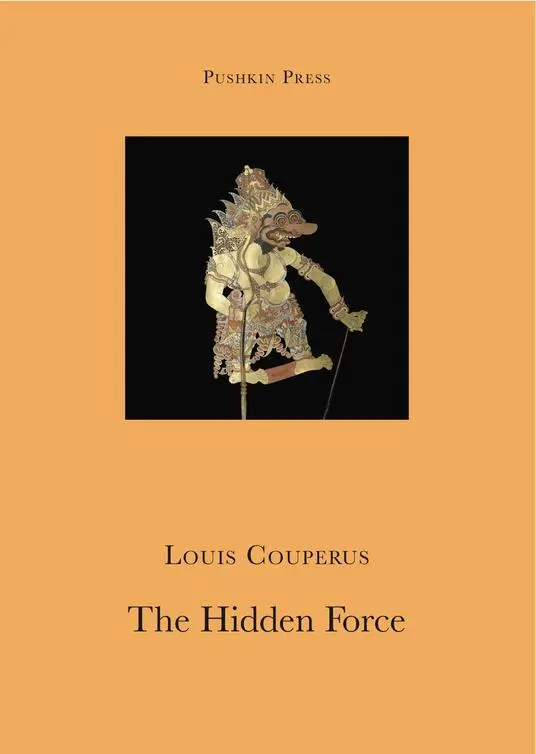
- Название:The Hidden Force
- Автор:
- Издательство:Pushkin Press
- Жанр:
- Год:2012
- ISBN:9781908968227
- Рейтинг книги:4 / 5. Голосов: 1
-
Избранное:Добавить в избранное
- Отзывы:
-
Ваша оценка:
The Hidden Force: краткое содержание, описание и аннотация
Предлагаем к чтению аннотацию, описание, краткое содержание или предисловие (зависит от того, что написал сам автор книги «The Hidden Force»). Если вы не нашли необходимую информацию о книге — напишите в комментариях, мы постараемся отыскать её.
The Hidden Force — читать онлайн бесплатно полную книгу (весь текст) целиком
Ниже представлен текст книги, разбитый по страницам. Система сохранения места последней прочитанной страницы, позволяет с удобством читать онлайн бесплатно книгу «The Hidden Force», без необходимости каждый раз заново искать на чём Вы остановились. Поставьте закладку, и сможете в любой момент перейти на страницу, на которой закончили чтение.
Интервал:
Закладка:
Perhaps if he had given way, his life would have turned out differently. Yet he had no inkling of the sacred moments when a man must not assert his own will, but must be piously carried along by the impulse of the silent powers. He did not respect, acknowledge or comprehend such powers, and never would. He was a man with a lucid, logical, simple male sense of duty; a man of the clear, simple life. He would never know the silent forces lurking beneath the simple life. He would have scoffed at the suggestion that there are peoples who have more control of that force than Westerners. The very idea that there are a few individuals among those peoples in whose hands the force loses its omnipotence and becomes a tool — would make him shrug his shoulders and continue on his way. No experience would teach him. Perhaps he would be perplexed for a moment… But then, immediately afterwards, his man’s hand would firmly grasp the chain of his logic and fit the iron factual links together…
Perhaps, if he had given in, his life would have turned out differently.
He saw Léonie helping the old Princess, broken and sobbing, out of his office.
A deep emotion, a pity that touched him to the core, brought tears to his eyes, and through those tears there appeared the image of the Javanese whom he had loved like a father.
But he did not give in.
5
THERE WERE REPORTS from Ternate and Halmaheira that a terrible submarine earthquake had devastated a group of islands in the area, that whole villages had been washed away and that thousands were homeless. The telegrams had caused greater consternation in Holland than in the Indies, where people were more accustomed to earthquakes at sea and on land. There had been much talk about the Dreyfus trial in France, and people were beginning to discuss the Transvaal, but almost nothing was said about Ternate. Nevertheless, a coordinating committee was set up in Batavia and Van Oudijck convened a meeting. It was decided to arrange a charity gala in the club and its gardens as soon as possible. Mrs Van Oudijck, as usual, left everything to Eva Eldersma and took no part at all. For a fortnight, a frenzy of activity engulfed Labuwangi. In the deathly quiet provincial Indies town, a tumult of petty passions, jealousies and enmities arose. Eva had her loyal clique — the Van Helderens, the Doorn de Bruijns, the Rantzows — and, competing with them, all kinds of little coteries. So-and-so had fallen out with so-and-so; so-and-so wasn’t taking part because so-and-so was; so-and-so insisted on taking part just because Mrs Eldersma must not think she was almighty; and X and Y and Z felt that Eva was getting above herself and mustn’t imagine she was the local first lady, just because Mrs Van Oudijck left everything to her. However, Eva had spoken to the commission and agreed to organize the event, but only if she had a totally free hand. She had no objection to the Commissioner choosing someone else to run the show, but if he chose her , a completely free hand was a precondition, because having to accommodate twenty different opinions and tastes would mean endless discussions. Van Oudijck laughed and gave in, but impressed upon her that she mustn’t upset people, must respect people’s feelings and be as conciliatory as possible so that the charity gala would leave behind pleasant memories. Eva promised: she was not argumentative by nature.
Doing something — organizing something, achieving something, expressing her artistic energy — was Eva’s main joy, her consolation in the dreariness of Indies life. Because although she had found much in the Indies that she had come to love and admire, social life for her, with the exception of her little group, lacked all attraction. But now the chance of organizing a gala, one that would be talked of as far away as Surabaya, flattered her vanity and her energy.
She sailed through every difficulty, and because people realized that she knew best and had the most practical solutions, they let her have her own way. But while she was busy devising her fancy fair stalls and tableaux vivants , and while the pressure of preparations for the gala spread through the principal families of Labuwangi, something seemed to spread through the soul of the native population, nothing as frivolous as charitable festivities. For the past few days the Chief of Police, who presented a brief report to Van Oudijck every morning, usually in just a few words — that he had made his rounds and found everything in order — was having longer conversations with his superior, and seemed to have weightier matters to report to him; and the attendants whispered more mysteriously outside the office. The Commissioner summoned Eldersma and Van Helderen, and the secretary wrote to Vermalen in Ngajiwa to the commanding officer of the garrison; and the controller patrolled the town more and more often, at unaccustomed hours. In their flurry of activity the ladies sensed little of the mysterious activity, and only Léonie, who was not concerned with the gala, noticed an unusual, silent concern in her husband. She quickly and accurately sensed that something was wrong, and since Van Oudijck — who was in the habit of often talking about business at home — had been tight-lipped for the last few days, she asked where the Prince of Ngajiwa was now that he had been dismissed by the government at the instigation of Van Oudijck, and who was to replace him. His vague reply put her on her guard and worried her. One morning, passing through her husband’s bedroom, she was struck by the whispered conversation between Van Oudijck and the Chief of Police, and she listened for a moment with her ear to the screen. The conversation was muted because the garden doors were open: the attendants were sitting on the garden steps; a few gentlemen, needing to speak to the Commissioner, were walking up and down the side veranda after writing their names on a slate, which the head attendant had brought in. But they had to wait, because the Commissioner was talking to the Chief of Police… Léonie listened by the screen. And she turned pale when she caught a few words. She went quietly to her room, afraid. At lunch she asked if it would really be necessary for her to attend the gala, since she had been having such a toothache recently, and she needed to go to Surabaya to the dentist. It would take some time: she had not been to the dentist for ages. But Van Oudijck, severe in his gloomy mood of secret concern and silence, told her that she couldn’t go, that she must be present on an evening like that of the gala, as the district commissioner’s wife. She pouted, sulked and held a handkerchief to her mouth, making Van Oudijck nervous. That afternoon she didn’t sleep, didn’t read, didn’t dream because of her unusual agitation. She was afraid and wanted to get away. And at afternoon tea in the garden she started crying, saying that her toothache was making her head hurt and she was becoming ill, that she could not stand it any more. Van Oudijck, nervous and worried, was touched; he could never bear to see her cry. And he gave in, as he always did to her, where her personal affairs were concerned. The following day she left for Surabaya, where she stayed at the commissioner’s house and really did have the dentist treat her teeth. It was always wise to do it once a year. This time it cost her about five hundred guilders.
By now, casually, the other ladies also sensed something of what was happening in Labuwangi behind a haze of mystery. Because Ida van Helderen told Eva Eldersma, her tragic white Eurasian eyes aghast with fear, that her husband and Eldersma and the Commissioner too were afraid of a revolt by the population, stirred up by the Prince’s family, which could never forgive the dismissal of the Prince of Ngajiwa. However, the men gave nothing away and reassured their wives. But a dark turbulence continued to bubble under the ostensible calm of their provincial life. And gradually the rumours leaked out and alarmed the European population. Vague reports in the newspapers — commenting on the dismissal of the Prince — also played a part. Meanwhile, the busy preparations for the gala continued, but people were no longer involved heart and soul. People’s lives were hectic and restless, and they became sick with nerves. At night, houses were made more secure, weapons put out close to hand; people woke suddenly in a fright, listening to the muffled sounds of the night in the great outdoors. Opinion condemned the hastiness of Van Oudijck, who after the scene at the ball following the races had no longer been able to exercise any patience, and had not hesitated to recommend the dismissal of the Prince, whose family was so attached to and so identified with the territory of Labuwangi.
Читать дальшеИнтервал:
Закладка:
Похожие книги на «The Hidden Force»
Представляем Вашему вниманию похожие книги на «The Hidden Force» списком для выбора. Мы отобрали схожую по названию и смыслу литературу в надежде предоставить читателям больше вариантов отыскать новые, интересные, ещё непрочитанные произведения.










Обсуждение, отзывы о книге «The Hidden Force» и просто собственные мнения читателей. Оставьте ваши комментарии, напишите, что Вы думаете о произведении, его смысле или главных героях. Укажите что конкретно понравилось, а что нет, и почему Вы так считаете.