Louis Couperus - The Hidden Force
Здесь есть возможность читать онлайн «Louis Couperus - The Hidden Force» весь текст электронной книги совершенно бесплатно (целиком полную версию без сокращений). В некоторых случаях можно слушать аудио, скачать через торрент в формате fb2 и присутствует краткое содержание. Год выпуска: 2012, ISBN: 2012, Издательство: Pushkin Press, Жанр: Классическая проза, на английском языке. Описание произведения, (предисловие) а так же отзывы посетителей доступны на портале библиотеки ЛибКат.
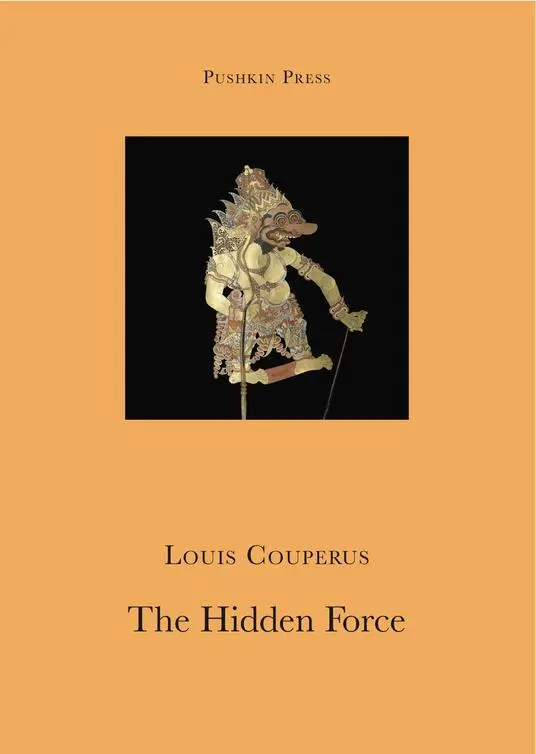
- Название:The Hidden Force
- Автор:
- Издательство:Pushkin Press
- Жанр:
- Год:2012
- ISBN:9781908968227
- Рейтинг книги:4 / 5. Голосов: 1
-
Избранное:Добавить в избранное
- Отзывы:
-
Ваша оценка:
The Hidden Force: краткое содержание, описание и аннотация
Предлагаем к чтению аннотацию, описание, краткое содержание или предисловие (зависит от того, что написал сам автор книги «The Hidden Force»). Если вы не нашли необходимую информацию о книге — напишите в комментариях, мы постараемся отыскать её.
The Hidden Force — читать онлайн бесплатно полную книгу (весь текст) целиком
Ниже представлен текст книги, разбитый по страницам. Система сохранения места последней прочитанной страницы, позволяет с удобством читать онлайн бесплатно книгу «The Hidden Force», без необходимости каждый раз заново искать на чём Вы остановились. Поставьте закладку, и сможете в любой момент перейти на страницу, на которой закончили чтение.
Интервал:
Закладка:
He returned to Labuwangi with Léonie and Doddy. Back home he felt a momentary pleasure at being in his own house again, a delight in his own domesticity that he had always found soothing: the material pleasure of being in his own bed, with his own desk and chairs, drinking his own coffee, prepared the way he liked it. Those small consolations restored his good humour for a second, but he immediately felt all his old bitterness returning when under a pile of letters on his desk he recognized the tortuous handwriting of a couple of shadowy letter-writers. Mechanically he opened the first and was disgusted to find Léonie’s name linked with that of Theo. Nothing was sacred to those wretches: they invented the most monstrous combinations, the most unnatural slanders, and the most gruesome allegations up to and including incest. All the mud that was slung at his wife and son raised them to an even greater height and purity in his love, to a peak of inviolability, and he loved them both with an even greater and more fervent tenderness. But all his churning bitterness brought back his ill humour in full force. It was based on reality, since he had to recommend the Prince of Ngajiwa for dismissal, and was reluctant to do so. Yet this unavoidable necessity soured his whole existence, and made him nervous and ill. When he could not follow the course that he set out, when life deviated from the events predetermined a priori by himself — Van Oudijck — this recalcitrance, this revolt by life, made him nervous and ill. After the death of the old pangéran he had simply resolved to raise up the floundering dynasty of the Adiningrats, both in loving memory of the exemplary Javanese prince and because of his mandate as a commissioner, and out of a feeling of humanity and hidden poetry in himself. And he had never been able. From the outset he had been thwarted — unconsciously, through the power of things — by the old radèn-ayu pangéran , who lost everything at cards, gambled everything away and ruined herself and her family. He had censured her as a friend. She was not unreceptive to his advice but her passion had proved stronger. Van Oudijck had immediately judged her son, Sunario, the Prince of Labuwangi, even before his father’s death, as unfit for the actual post of prince: pettily proud of his noble blood, insignificant, never informed about real life, without any talent for government or concern for the ordinary people, extremely fanatical, always consorting with native healers and with sacred calculations, always withdrawn and living in a dream of obscure mysticism, and blind to what might bring prosperity and justice to his Javanese subjects. And yet the population worshipped him, both because of his nobility and because of his reputation for holiness and far-reaching powers: a divine magical power. Secretly the women of the palace sold the water that had flowed over his body when he bathed, bottled as a medicine, a cure for various afflictions. That was what the elder brother was like, and this morning the younger had lost all control of himself, obsessed by the craving for gambling and drink… With these sons, the dynasty — once so brilliant — was tottering to its downfall: their children were young, some cousins were assistant princes in Labuwangi in neighbouring districts, but not one drop of noble blood flowed in their veins. No, he, Van Oudijck, had never been able to do what he wanted. The people whose interests he was defending were themselves fighting against him. They had no future.
But he could not understand why this had to be so; it upset and embittered him.
The fact was that he had imagined a quite different course — a splendid upward curve, the way he envisaged his own life — whereas the curve of their lives meandered chaotically downwards. He could not understand what could be stronger than him, if he wanted something. Had it not always been the case in his life and his career that whatever he wanted fervently had happened with the logic that he himself day by day had imposed on the things that were about to happen? His ambition had simply imposed that logic of the upward curve, since the aim his ambition had set itself was the restoration of this Javanese dynasty…
Would he fail? He would never forgive himself if he failed in striving to achieve an aim he had set himself as an official. Up to now he had always been able to achieve what he wanted. But what he was trying to achieve now — unbeknown to himself — was not just the aim of an official, part of his work. What he was now striving for was an aim that issued from his humanity, the noble part of himself. What he was now trying to achieve was an ideal, an ideal of a Westerner in the East, and of a Westerner who saw the East in the only way he knew how, the only way he could see it.
And he would never be prepared to admit that there were forces that combined into a single force that opposed him, that mocked his ideas, that scoffed at his ideals, and that was stronger the deeper it was hidden away: his was not the kind of nature to recognize them, and even its clearest revelation would be a mystery to his soul, and remain a myth.
4
VAN OUDIJCK had been to the office that day and on returning home was immediately met by Léonie.
“The radèn-ayu pangéran is here. She’s been here an hour, Otto. She would like to talk to you. She’s been waiting for you.”
“Léonie,” he said. “Have a look at these letters. I receive a lot of these sorts of communication, and I’ve never mentioned them to you. But perhaps it’s better if you are not left in the dark. Perhaps it’s better for you to know. But please don’t distress yourself about them. I don’t have to assure you that I don’t believe one jot of all that filth. So don’t be upset, and return the letters to me in person later. Don’t leave them lying around… And ask the Princess dowager to come to my office…”
Léonie, with the letters in her hand, brought the Princess from the back veranda. She was a dignified, grey-haired woman with a proud, regal bearing in her still slim figure. Her eyes were a sombre black; her mouth made broader by the betel juice, in which her filed-down black-painted teeth grinned, was like a grimacing mask and spoiled the lofty nobility of her expression. She wore a black satin jacket fastened with jewels. Her grey hair and sombre eyes gave her an unusual mix of venerability and smouldering passion. Her old age was tinged with tragedy. She herself felt a fate pressing tragically on her and her family, and placed her sole hope in the far-reaching, god-like power of her eldest son Sunario, the Prince of Labuwangi. While she preceded Van Oudijck into the office, Léonie glanced at the letters in the central gallery. They were vulgar verses about her and Addy and Theo. Permanently wrapped up in the dream of her own life, she never took much notice of what people were thinking and saying, because she knew she could immediately win them over again, with her appearance and her smile. She had that calm charisma that was irresistible. She never spoke ill of anyone, out of indifference; she was conciliatory and forgiving to everything and everyone; and she was popular — when she was present. But she found these dirty letters, spewed out of some dark corner, unpleasant and annoying, even though Van Oudijck did not believe them. What if he did begin to believe them? She must be prepared for that eventuality. In particular, if that day should ever come, she must retain her most charming equanimity, all her invulnerability and inviolability. Where could those letters have come from? Who hated her so much? In whose interest was it to write about her in such terms to her husband? How strange that it should have got out… Addy, Theo? How did people know? Urip? No, not Urip… But who then, who? So was everything known? The fact was that she had always thought that what happened in secret niches would never be public knowledge. She had even thought — naively — that men never talked to each other about her; about other women, yes, but not about her… Despite all her experience her mind was full of such naive illusions: a naivety that chimed with the poetry — half perverse, half childlike — of her rose-tinted imagination. So, could she not keep secret the hidden depths of her mystery, the hidden depths of reality for ever? For a moment it upset her. Despite all her propriety, reality nevertheless revealed itself… Thoughts and dreams always remained secret. Actual facts were such a nuisance. For a moment she considered being more careful in future, practising abstinence… But in her mind’s eye she saw Theo, she saw Addy, her blond and brown loves, and felt too weak… She knew she wouldn’t be able to overcome her passions, even if she controlled them. Might they not, for all her tact, one day lead to her downfall? But she found the idea laughable; she had a firm belief in her invulnerability, her inviolability. Life had no hold on her.
Читать дальшеИнтервал:
Закладка:
Похожие книги на «The Hidden Force»
Представляем Вашему вниманию похожие книги на «The Hidden Force» списком для выбора. Мы отобрали схожую по названию и смыслу литературу в надежде предоставить читателям больше вариантов отыскать новые, интересные, ещё непрочитанные произведения.






Обсуждение, отзывы о книге «The Hidden Force» и просто собственные мнения читателей. Оставьте ваши комментарии, напишите, что Вы думаете о произведении, его смысле или главных героях. Укажите что конкретно понравилось, а что нет, и почему Вы так считаете.