Louis Couperus - The Hidden Force
Здесь есть возможность читать онлайн «Louis Couperus - The Hidden Force» весь текст электронной книги совершенно бесплатно (целиком полную версию без сокращений). В некоторых случаях можно слушать аудио, скачать через торрент в формате fb2 и присутствует краткое содержание. Год выпуска: 2012, ISBN: 2012, Издательство: Pushkin Press, Жанр: Классическая проза, на английском языке. Описание произведения, (предисловие) а так же отзывы посетителей доступны на портале библиотеки ЛибКат.
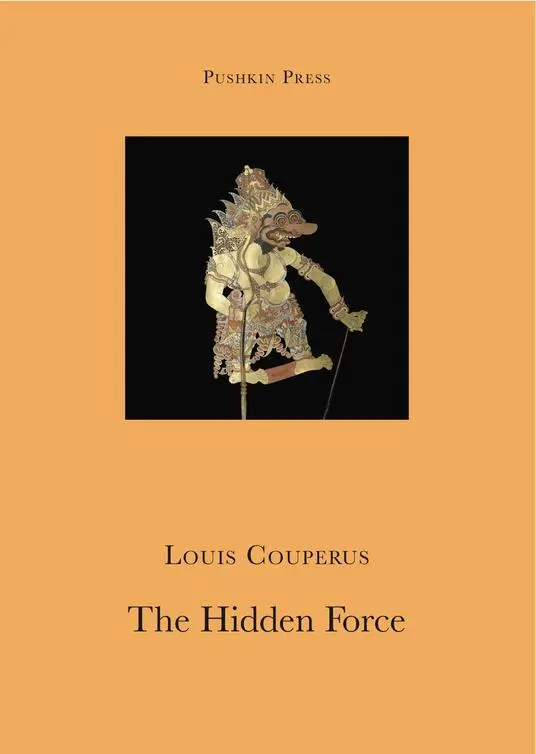
- Название:The Hidden Force
- Автор:
- Издательство:Pushkin Press
- Жанр:
- Год:2012
- ISBN:9781908968227
- Рейтинг книги:4 / 5. Голосов: 1
-
Избранное:Добавить в избранное
- Отзывы:
-
Ваша оценка:
The Hidden Force: краткое содержание, описание и аннотация
Предлагаем к чтению аннотацию, описание, краткое содержание или предисловие (зависит от того, что написал сам автор книги «The Hidden Force»). Если вы не нашли необходимую информацию о книге — напишите в комментариях, мы постараемся отыскать её.
The Hidden Force — читать онлайн бесплатно полную книгу (весь текст) целиком
Ниже представлен текст книги, разбитый по страницам. Система сохранения места последней прочитанной страницы, позволяет с удобством читать онлайн бесплатно книгу «The Hidden Force», без необходимости каждый раз заново искать на чём Вы остановились. Поставьте закладку, и сможете в любой момент перейти на страницу, на которой закончили чтение.
Интервал:
Закладка:
Van Oudijck was in a gloomy frame of mind. He was used to receiving occasional, regular anonymous letters, slanders spat out poisonously from quiet corners — one defaming an assistant district commissioner, another a controller, then smearing the native chiefs or his own family — sometimes in the form of a friendly warning, sometimes in that of vicious schadenfreude , wishing mainly to open his eyes to the shortcomings of his officials and the misdemeanour of his wife.
He was so used to these uncountable letters, which he read fleetingly, if at all, then tore them up without the slightest concern. Since he was used to making up his own mind, the spiteful warnings made no impression on him, however much they reared their heads, like hissing snakes among all the letters that arrived daily in the post. And he’d always had such a blind spot for his wife. He had continued to see Léonie in the serenity of her smiling indifference and in the circle of domestic warmth that she certainly created around her — in the cavernous emptiness of the commissioner’s mansion that with its chairs and ottomans seemed constantly arranged for receptions — that he could never believe one jot of those slanders. He never talked about them. He loved his wife devotedly, and since in company he always saw her virtually silent, since she never flirted or behaved coquettishly, he never caught a glimpse of the depravity of her soul. In fact, he was quite blind in domestic matters. At home he had the kind of utter blindness that so often afflicts men who are extremely knowledgeable and competent in their business or professional life, eagle-eyed at work but myopic at home; used to analysing things en masse, and not the details of an individual soul; whose knowledge of humanity is based on principle, and who divides human beings into types, as if casting an old-fashioned play; who can immediately assess the work capacity of their subordinates, but who have no inkling of the psychological complexity of the members of their household, with its intertwined, tangled arabesques like overgrown vines — constantly looking over their heads, constantly missing the inner meaning of their words, with no interest in the multicoloured emotions of hate, envy and love unfolding rainbow-like before their very eyes. He loved his wife and he loved his children, because of his need for paternal feelings, for fatherhood, but he knew neither his wife nor his children. He knew nothing about Léonie and had never suspected that Theo and Doddy had secretly remained faithful to their mother, so far away in Batavia, living in unspeakable degradation, and had no love for him. He believed that they did love him, and when he thought about them, it aroused a dormant tenderness in him.
He received the poison-pen letters every day. They had never made any impression on him, but recently he no longer tore them up, but read them carefully and put them away in a secret drawer. Why, he could not have said. They were accusations against his wife, smears against his daughter. They were alarmist suggestions that he might be stabbed in the dark. They were warnings that his spies were totally unreliable. They told him that his rejected wife was living in poverty and hated him; they told him that he had a son whose existence he had ignored. They quietly rummaged about in all the dark, secret areas of his life and work. Despite himself, he felt depressed by them. It was all vague and he had nothing to reproach himself with. For himself and for the world he was a good official, a good husband and a good father, a good person. The fact that he was accused of having judged unfairly here, of having acted cruelly and unfairly there, of having rejected his first wife, of having an unacknowledged son living in the native quarters, the fact that people were slinging mud at Theo and Doddy — all this was making him gloomy at present. Because it was incomprehensible that anyone should behave in this way. For this practically minded man it was the vagueness that was most irritating. He would not fear an open conflict, but this shadow-boxing played on his nerves and his health. He had no inkling of why it was happening. There was nothing tangible. He could not picture the face of an enemy. And every day the letters came, and every day there was hostility in the shadows around him. It was too mystical for someone like him and was bound to make him bitter and gloomy. Then there appeared in the local newspapers pieces originating from a small, hostile press, accusations that were vague or demonstrably untrue. Hatred bubbled up everywhere. He could not think why, and pondering on the question was making him ill. He talked to no one about it and hid his pain deep inside.
He couldn’t understand it. He couldn’t conceive why things were as they were and becoming worse. There was no logic to it. Since the logical reaction would be for them to love him, however high and mighty and strict they found him. And indeed, did he not so often temper that authoritarian severity with the genial laugh beneath the wide moustache, under a more easygoing friendliness or warning and correction? On official tours was he not the sociable commissioner, who regarded the tour with his officials as a sport, as a wonderful excursion on horseback through the coffee plantations, calling at the coffee warehouses? Did he not regard it as a pleasant trip, which relaxed the muscles after so many weeks of office work? The great procession of district heads following on their little ponies, riding their frisky mounts like nimble monkeys, flags in hand, the gamelan orchestras sprinkling their crystalline notes of welcome wherever he went, and in the evening the carefully prepared meal in the hostels and late into the night the games of cards.
Hadn’t they said, his officials, in informal moments, that he was a commissioner after their own hearts, a tireless horseman, good company at meals and young enough to take the shawl from the dancing girl and dance with her for a moment, cleverly performing the lithe, stylized movements of the hands, feet and hips — instead of excusing himself by paying her money and letting her dance with the native official? He never felt as comfortable as on tour. And now he was gloomy, discontent, not understanding what forces were thwarting him in the dark — him, the man of honesty and light, of simple ethical principles, of serious dedication to work. He thought of going on tour soon and using the physical activity to throw off the gloom oppressing him. He would ask Theo to come with him and take some exercise for a few days. He loved his son, though he thought him unwise, rash, hot-headed, lacking perseverance in his work, never satisfied with his superiors, resisting his manager too tactlessly until he made his position untenable at yet another coffee plantation or sugar factory where he was working. He believed that Theo must make his own way in life, just as he, Van Oudijck, had done, instead of relying completely on his father’s protection and position as a district commissioner. He was not a man for nepotism. He would never prefer his son above someone else with equal rights. He had often said to nephews, who were keen on obtaining concessions in Labuwangi, that he preferred not to have relatives in his district, and that they should expect nothing from him except complete impartiality. That was how he had made it, and that was how he expected them to make it, and Theo too. And yet, he secretly observed Theo, with all his father’s love; secretly, he deeply regretted the fact that Theo lacked perseverance and no longer focused on his future, his career, an honourable place in society, based on either esteem or money. The boy lived from day to day, without a thought for tomorrow… Perhaps he was outwardly cool towards Theo: well, he would have a confidential chat with him, give him some advice, and he would ask at any rate if Theo would come on tour with him. The thought of just under six days’ riding in the pure mountain air — through the coffee plantations, inspecting the irrigation works, doing the most pleasant part of his work — so broadened his mind, clarified his outlook, that he stopped thinking about the letters. He was a man with a clear, simple view of life: of course he found life natural and not confused or complicated. His life had progressed up a visible staircase openly and gradually, with a view of a gleaming pinnacle of ambition, and he had never been able or willing to see what writhed, what churned in the dark shadows, what bubbled up from the abyss, close to his feet. He was blind to the life that operates beneath the surface. He didn’t believe in it, just as a mountain-dweller who has for a long time lived near a dormant volcano does not believe in the fire inside it, that survives deeply hidden and escapes only as hot steam or sulphurous air. He believed neither in the power above things nor in the power that resided in things themselves. He didn’t believe in silent fate or in silent gradualness. He believed only what he saw with his own eyes: in the harvest, the roads, the districts and villages, and in the prosperity of his district, in his career that he saw as an upward curve ahead of him. In this unclouded clarity of a simple male nature, in this universal axiom of just rule, just ambition and a practical sense of duty there was only one weakness: the deep tenderness that he felt for his own home, which, being blind, he did not see for what it was deep down, but only according to his fixed principles as to how his wife and his children should be.
Читать дальшеИнтервал:
Закладка:
Похожие книги на «The Hidden Force»
Представляем Вашему вниманию похожие книги на «The Hidden Force» списком для выбора. Мы отобрали схожую по названию и смыслу литературу в надежде предоставить читателям больше вариантов отыскать новые, интересные, ещё непрочитанные произведения.







Обсуждение, отзывы о книге «The Hidden Force» и просто собственные мнения читателей. Оставьте ваши комментарии, напишите, что Вы думаете о произведении, его смысле или главных героях. Укажите что конкретно понравилось, а что нет, и почему Вы так считаете.