Louis Couperus - The Hidden Force
Здесь есть возможность читать онлайн «Louis Couperus - The Hidden Force» весь текст электронной книги совершенно бесплатно (целиком полную версию без сокращений). В некоторых случаях можно слушать аудио, скачать через торрент в формате fb2 и присутствует краткое содержание. Год выпуска: 2012, ISBN: 2012, Издательство: Pushkin Press, Жанр: Классическая проза, на английском языке. Описание произведения, (предисловие) а так же отзывы посетителей доступны на портале библиотеки ЛибКат.
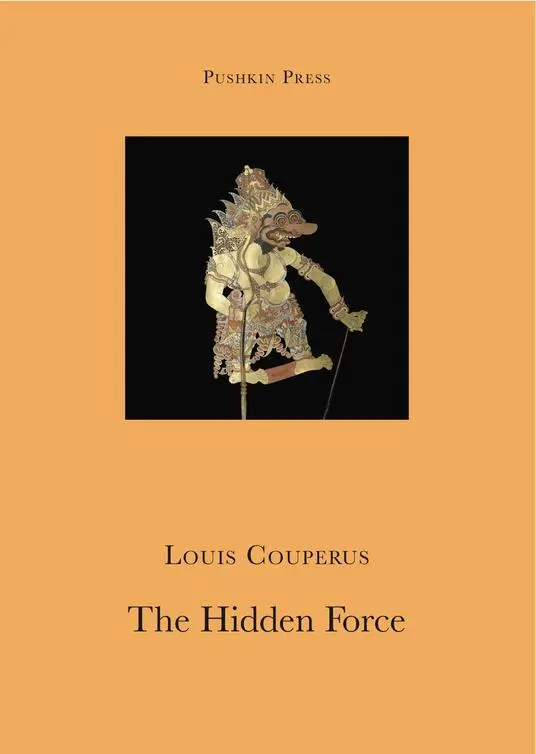
- Название:The Hidden Force
- Автор:
- Издательство:Pushkin Press
- Жанр:
- Год:2012
- ISBN:9781908968227
- Рейтинг книги:4 / 5. Голосов: 1
-
Избранное:Добавить в избранное
- Отзывы:
-
Ваша оценка:
The Hidden Force: краткое содержание, описание и аннотация
Предлагаем к чтению аннотацию, описание, краткое содержание или предисловие (зависит от того, что написал сам автор книги «The Hidden Force»). Если вы не нашли необходимую информацию о книге — напишите в комментариях, мы постараемся отыскать её.
The Hidden Force — читать онлайн бесплатно полную книгу (весь текст) целиком
Ниже представлен текст книги, разбитый по страницам. Система сохранения места последней прочитанной страницы, позволяет с удобством читать онлайн бесплатно книгу «The Hidden Force», без необходимости каждый раз заново искать на чём Вы остановились. Поставьте закладку, и сможете в любой момент перейти на страницу, на которой закончили чтение.
Интервал:
Закладка:
“Your brother,” replied Addy.
Si-Oudijck suddenly looked up.
“Well, well,” he said, speaking a mixture of broken Dutch, Javanese and Malay. I recognize him, my legitimate brother. And what has the fellow come for?”
“Just to see what you look like…”
The two brothers surveyed each other, Theo with curiosity, pleased to have made this discovery as a weapon to be used against the old man, if such a weapon should ever be necessary; the other, si-Oudijck, keeping hidden within himself — behind his shrewd brown leering face — all his jealousy, bitterness and hatred.
“Do you live here?” asked Theo, just for something to say.
“No, I’m staying with her for the moment,” answered si-Oudijck nodding towards the woman.
“Did your mother die a long time ago?”
“Yes. Yours is still alive, isn’t she? She’s in Batavia. I know her. Do you ever see her?”
“No.”
“Hmm… Do you like your stepmother better?”
“We get on all right,” said Theo drily. “I don’t think the old man knows you exist.”
“Oh, yes, he does.”
“No, I don’t think so. Have you ever talked to him?”
“Yes. In the past. Years ago.”
“And?…”
“Did no good. He says I’m not his son…”
“It’s probably difficult to prove.”
“Legally, yes. But it’s a fact, common knowledge. Known all over Ngajiwa.”
“Have you no proof at all?”
“Only my mother’s oath on her deathbed, before witnesses.”
“Come on, tell me a bit more. Come for a walk with us, it’s stuffy in here…”
They left the hut and strolled back through the native quarters, while si-Oudijck talked. They walked along the Brantas, which wound along in the dim evening light under a sprinkling of stars.
It did Theo good to hear about this, about his father’s housekeeper when he was just a controller, rejected after being unjustly accused of unfaithfulness: the child born later and never recognized, never supported; the boy, roaming from one native quarter to another, romantically proud of his degenerate father, whom he observed from afar, following with his leering gaze as that father became an assistant commissioner and then a commissioner, married, divorced, remarried; occasionally learning to read and write after a fashion from a native clerk with whom he was on friendly terms… It did the legitimate son good to hear this, because deep down, however blond and white he might be, he was more the son of his Eurasian mother than his father’s son; because deep down he hated his father, not for any specific reason, but because of a secret instinctive antipathy, because, despite his appearance and demeanour of a blond, white-skinned European, he felt a secret affinity with this illegitimate brother, felt a vague sympathy for him, since they were both sons of the same motherland, with which their father had no emotional ties except those he had acquired during his training: the artificial, humanely cultivated love of the rulers for the land they ruled. Since childhood Theo had felt like this, far removed from his father; and later that antipathy had become a smouldering hatred. He enjoyed hearing his father’s irreproachable reputation being demolished: a high-minded man, a senior official of absolute integrity, who loved his family, who loved his district, who loved the Javanese, who wanted to support the Prince’s family — not only because his instructions set out in the Government Gazette required him to respect the position of the Javanese nobility, but because his own heart spoke to his, whenever he remembered the noble old pangéran … Theo knew, of course, that his father was like that — so exalted, so noble, that he had such integrity — and it did him good, in the mystery-filled evening by the Brantas, to hear that irreproachable character, that exalted, noble integrity being picked apart; it did him good to meet an outcast who in an instant had covered that high and mighty father figure in slime and filth, torn him from his pedestal, brought him down to the abject level of everyone else — sinful, evil, heartless, ignoble. He felt a wicked joy in his heart, like the one felt at possessing the wife that his father adored. He did not yet know what to do with that dark secret, but he accepted it as a weapon; he sharpened it that evening, as he listened to the half-caste with his leer, who became worked up and started ranting. And Theo put away his secret in a safe place, storing his weapon deep inside. Old grievances came to the surface, and he, too, the legitimate son, launched into a tirade against his father, admitted that the Commissioner no longer tried to gain advancement for his son, any more than he would for any clerk: that he had once recommended him to the managers of an impossible company, a rice plantation, where he, Theo, had not been able to stand it for more than a month, that he had left Theo to his fate, was obstructive when he tried to obtain concessions, even in districts other than Labuwangi, even in Borneo, until he had been forced to kick his heels and live on charity, finding no work because of his father’s attitude, tolerated in that house where he hated everything.
“Except your stepmother!” si-Oudijck interjected drily.
But Theo went on, giving vent to his feelings in turn and telling his brother that even if he was recognized and legitimized, things would still be pretty lean. In this way they egged each other on, glad to have met and to have become friends for this brief hour. Next to them walked Addy, amazed at this rapid sympathy but, apart from that, without a thought in his head. They had crossed a bridge and via a detour had arrived behind the factory buildings at Pajaram. Here si-Oudijck took his leave from them, shaking Theo’s hand, which slipped him a few two-and-a-half-guilder coins that were eagerly accepted, with a flicker of the furtive look but without a word of thanks. And Theo and Addy headed past the now silent factory towards the mansion, where the family were walking around outside in the garden and in the avenue of cemaras. And as the two young men approached, the eight-year-old golden child, the old mama’s foster-princess, came to meet them, with her fringe and her rice-powdered forehead, in her sumptuous doll’s clothes. She walked towards them, suddenly stopping when she reached Addy and looking up at him. Addy asked what she wanted but the child didn’t reply, just looked up at him, and then, stretching out her hand, she stroked his hand with hers. Some obviously irresistible magnetism had drawn the shy child to him, making her walk up to them, stop and stroke him, so that Addy laughed out loud, bent down and kissed her light-heartedly. The child skipped away contentedly. And Theo, still worked up from that afternoon — first by his conversation with Urip, then by his confrontation with Addy, his meeting with his half-brother, the confidences about his father — feeling bitter and full of his own problems, was so irritated by the trivial behaviour of Addy and the little girl, that he exclaimed, almost angrily: “You’re hopeless… you’ll never be anything but a ladykiller!”
BOOK IV
1
OVERALL, LIFE HAD BEEN KIND to Van Oudijck. Born into a simple Dutch family with no money, he had spent his youth at a harsh, though never cruel, school. Serious from an early age, he had worked hard from the outset, looking towards the distant future, to a career, to the honourable position he was eager to assume as soon as possible among his fellow men. His time as a student of colonial administration in Delft had been fun enough for him to feel that he had once been young, and because he had once taken part in a masquerade, he actually believed that he had had a very wild youth, squandering money and painting the town red. His character was composed of a great deal of quiet Dutch solidity, a generally somewhat sombre and dreary earnestness, intellectual and practical: used to seeking his rightful place in human society, his ambition had developed rhythmically and steadily into a temperate professional ambition, but had developed only along the lines his eye tended to focus on — the hierarchical line of the Colonial Service. Things had always gone his way: his considerable capacities won him considerable esteem, he had become an assistant commissioner earlier than most and a commissioner at a young age, and his ambition had actually already been satisfied, since his position of authority was in complete harmony with his nature, whose desire for power had kept pace with its ambition. He was actually quite content, and although his eye saw much further and he glimpsed a seat on the Council of the Indies, and even the governor general’s throne, there were days when, serious and contented, he maintained that becoming a commissioner first class — besides the higher pension — had little to commend it except at Samarang and Surabaya, but East Java was very troublesome, Batavia had such an odd and almost diminished position, amid so many senior officials, members of the Council of the Indies and heads of department. And so, although he kept one eye on possible preferment, his practical and moderate nature would have been quite satisfied if someone had been able to predict that he would die as commissioner of Labuwangi. He loved his district and he loved the Indies; he felt no nostalgia for Holland or the trappings of European civilization, and yet he himself remained extremely Dutch, with a particular hatred for anything mixed-race. This was the contradiction in his character, since he had married his first, Eurasian wife purely out of love, and he loved his children, whose Indies blood was clearly apparent — outwardly with Doddy, inwardly with Theo, while René and Ricus were thoroughgoing young Eurasians — with a pronounced paternal love, full of the latent tenderness and sentimentality hidden deep inside: a need to give and receive in the bosom of the family. Gradually this need had extended to the circle of his district: he took a paternal pride in his assistant district commissioners and controllers, among whom he was popular and liked; only once in the six years that he had been district commissioner of Labuwangi had he been unable to work with a controller, a half-caste, whom after a period of patience with the man and with himself he’d had him transferred, or had fired him as he put it. And he was proud that, despite his authoritarian regime, despite his strict insistence on hard work, he was popular among his staff. He was all the more distressed by that mysterious, persistent enmity with the Prince, his “younger brother” according to Javanese titulature, in whom he would have liked to find a real younger brother, who under his tutelage governed his Javanese population. It pained him that this was his lot, and he thought of other princes, not only the noble pangéran , but others that he knew: the Prince of D—, educated, speaking and writing pure Dutch, the author of crystal-clear Dutch articles in newspapers and magazines; the Prince of S—, a little frivolous and vain but an extremely wealthy benefactor, a dandy in European society, gallant with the ladies. Why was he in Labuwangi saddled with this silent, angry, secretly fanatical shadow puppet, with his reputation as a saint and a magician, stupidly idolized by the people, in whose welfare he took no interest and who worshipped him only because of the prestige of his ancient name, and in whom he, Van Oudijck, always felt a resistance to his authority, never openly expressed but tangible beneath the Prince’s icy correctness. And on top of that, the brother in Ngajiwa, the card-player, the gambler — what had he done to deserve such princes?
Читать дальшеИнтервал:
Закладка:
Похожие книги на «The Hidden Force»
Представляем Вашему вниманию похожие книги на «The Hidden Force» списком для выбора. Мы отобрали схожую по названию и смыслу литературу в надежде предоставить читателям больше вариантов отыскать новые, интересные, ещё непрочитанные произведения.






Обсуждение, отзывы о книге «The Hidden Force» и просто собственные мнения читателей. Оставьте ваши комментарии, напишите, что Вы думаете о произведении, его смысле или главных героях. Укажите что конкретно понравилось, а что нет, и почему Вы так считаете.