Louis Couperus - The Hidden Force
Здесь есть возможность читать онлайн «Louis Couperus - The Hidden Force» весь текст электронной книги совершенно бесплатно (целиком полную версию без сокращений). В некоторых случаях можно слушать аудио, скачать через торрент в формате fb2 и присутствует краткое содержание. Год выпуска: 2012, ISBN: 2012, Издательство: Pushkin Press, Жанр: Классическая проза, на английском языке. Описание произведения, (предисловие) а так же отзывы посетителей доступны на портале библиотеки ЛибКат.
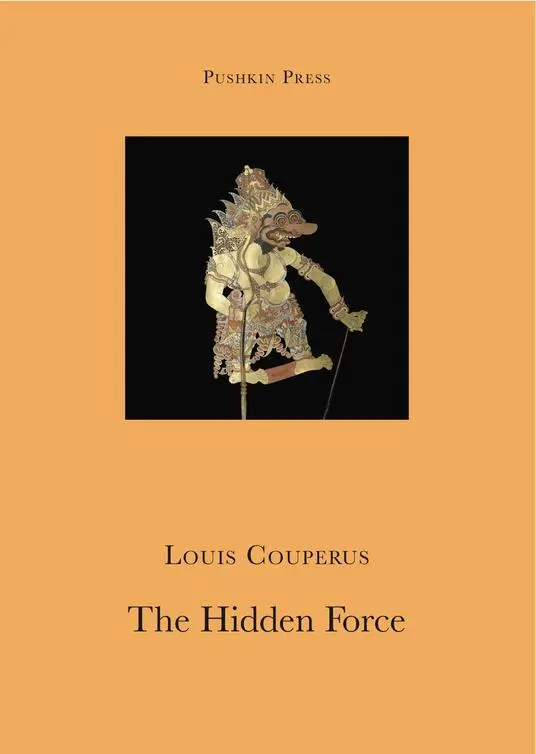
- Название:The Hidden Force
- Автор:
- Издательство:Pushkin Press
- Жанр:
- Год:2012
- ISBN:9781908968227
- Рейтинг книги:4 / 5. Голосов: 1
-
Избранное:Добавить в избранное
- Отзывы:
-
Ваша оценка:
The Hidden Force: краткое содержание, описание и аннотация
Предлагаем к чтению аннотацию, описание, краткое содержание или предисловие (зависит от того, что написал сам автор книги «The Hidden Force»). Если вы не нашли необходимую информацию о книге — напишите в комментариях, мы постараемся отыскать её.
The Hidden Force — читать онлайн бесплатно полную книгу (весь текст) целиком
Ниже представлен текст книги, разбитый по страницам. Система сохранения места последней прочитанной страницы, позволяет с удобством читать онлайн бесплатно книгу «The Hidden Force», без необходимости каждый раз заново искать на чём Вы остановились. Поставьте закладку, и сможете в любой момент перейти на страницу, на которой закончили чтение.
Интервал:
Закладка:
He had not learnt from experience, since he had loved his first wife as much as he now loved Léonie.
He loved his wife because she was his wife — the centre of his circle. He loved the circle for its own sake and not the individuals, the links of which it was composed. He had not learnt from experience. He did not think according to life’s changing hues, he thought according to his ideas and principles. They had made him a man and made him powerful, as well as a good administrator. They had also generally made him, in accordance with his nature, a good person. But because there was so much unconscious tenderness in him, unanalysed and simply deeply felt, and because he did not believe in the hidden force, in the life hidden within — in what writhed and churned like volcanic fires under mountains of majesty, like troubles under a throne — because he did not believe in the mysticism of visible things, life could sometimes find him unprepared and weak, when — divinely serene and stronger than mankind — it deviated from what he thought logical.
2
THE MYSTICISM OF VISIBLE THINGS on the island of mystery called Java… outwardly a docile colony with a subject race that was no match for the rough merchants, who in the heyday of their Dutch Republic, with the youthful strength of a young nation eager and hungry for profit, rotund and cool-blooded, planted their feet and their flag in the collapsing empires, the thrones tottering as if there had been an earthquake. But deep down this island had never been conquered. Although smiling with dignified contempt — resigned, bowing to its fate — deep down, despite a grovelling veneration, it was living freely its own mysterious life, hidden from Western eyes, however hard they tried to fathom the mystery — as if there had been a philosophy of being sure to preserve one’s dignified equilibrium with a smile, giving way flexibly, apparently politely seeking rapprochement — but deep down with a divine certainty about its own opinion, and so far removed from the thinking of the rulers, the civilization of the rulers, that there would never be solidarity between master and servant, because the insurmountable distance remains, that goes on proliferating in one’s mind and blood. And the Westerner, proud of his power, of his civilization, his humanity is seated high on his throne, blind, selfish, self-obsessed within the intricate mechanism of his authority within which he operates as precisely as clockwork, controlling each revolution until to the foreigner looking from outside this conquest of the visible, this colonization of a land physically and spiritually alien, appears a masterpiece, the creation of a new world.
But beneath all this outward show lurks the hidden force, slumbering now and not ready for battle. Under all that semblance of visible things is the ominous essence of silent mysticism, like smouldering fire in the ground and like hate and mystery in the heart. Under all this calm grandeur the danger threatens, and the future rumbles like the subterranean thunder in volcanoes, inaudible to the human ear. It is as if the conquered peoples know and simply abandon the pressure of things, waiting for the sacred moment, which will come if the mysterious calculations are correct. They understand the rulers with a single searching look, see them with their illusions of civilization and humanity, and know that they do not exist. Though they give him the title of lord and the respect due to a master, they see right through his democratic businessman’s nature, and secretly despise him and judge him with a smile, comprehensible to their brothers, who smile the same way. They never contravene the code of abject servitude and with the semba greeting pretend to be inferior while secretly knowing themselves to be superior. He is aware of the unspoken hidden force: they feel the soft approach of the mystery in the sweltering hot wind from their mountains, in the silence of the mysteriously silent nights, and he has a presentiment of distant events. What is, will not always remain so: the present disappears. They harbour the unexpressed hope that one day, one day in the far distant eddies of the dawning future, God will raise up those who are oppressed. But they feel it, hope it and know it in the depths of their soul, which they never reveal to their rulers and which they never could reveal. It remains for ever like the illegible book, in an unknown, untranslatable language, in which, though the words are the same, the colours of the words are different and the nuances of two thoughts have a different spectrum: prisms in which the colours are different, as if refracting the light of two different suns — rays from two different worlds. There is never the harmony that understands; the love that feels in unison never blossoms; and between them there is always the rift, the depths, the abyss, the vast distance, the wide horizon from which the mystery softly approaches, in which, as in a cloud, the hidden force bursts forth…
So it was that Van Oudijck did not feel the mystery of visible things.
And the divine, tranquil life could find him unprepared and weak.
3
NGAJIWA WAS a more cheerful place than Labuwangi: there was a garrison; administrators and clerks often came down from the interior for some fun; twice a year there were races, and the attendant festivities took up a whole week — commissioner’s reception, horse lottery, flower parade and an opera, two or three balls, which the revellers divided into a masked ball, a gala ball and a soirée dansante: a time of early rising and late retiring, of going through hundreds of guilders in a few days at cards and at the bookmaker’s… During those days the urge for pleasure and sheer enjoyment of life simply burst out. Coffee planters and sugar clerks looked forward to those days for months; people saved for six months. People poured in from all directions, into the two hotels; every family took in lodgers; people wagered with passion in a flood of champagne, the public, including the ladies, as familiar with the racehorses as if they were their personal property; quite at home at the balls, with everyone knowing each other, as if at family parties, while the waltzes and the Washington Post and Graziana were danced with the languorous grace of the Eurasian dancers of both sexes, with a swooning rhythm, trains softly billowing, a smile of calm rapture on the half-opened mouths, with that dreamy ecstasy of dance that the dancers of the Indies, men and women, express so charmingly, not least those with Javanese blood in their veins. For them, dance is not a wild sport, crude leaping around and bumping into each other with loud laughter, not the crude confusion of the lancers at young people’s balls in Holland, rather it is pure courtesy and grace, particularly among those of mixed race: a calm unfolding of elegant movement, a gracefully described arabesque of a precise step perfectly in time across the floor of club ballrooms; a harmonious blend of almost eighteenth-century youthful, noble, flowing movement, and languorous, floating steps, accompanied by the decidedly primitive booming rhythm of the Indies musicians. That was how Addy de Luce danced, with the eyes of all the women and girls fixed on him, following him, begging him with their eyes to take them with him into the undulating swell, like dreamily entering the water… That came from his mother’s side, that was an echo of the grace of royal dancers among whom his mother had lived as a child, and the mixture of modern Western and ancient Javanese gave him an irresistible attraction…
Now, at the ball, the soirée dansante, he danced like that with Doddy and afterwards with Léonie. It was already late at night, early in the morning. Outside, the day was breaking. Exhaustion lay over the whole ballroom, and finally Van Oudijck indicated to Vermalen, the assistant commissioner with whom he and his family were staying, that he wished to leave. At that moment he was standing on the front veranda of the club, talking to Vermalen, when the prince’s assistant suddenly came straight towards him out of the shadow of the garden and, clearly upset, squatted down, made the semba and spoke: “ Kanjeng! Kanjeng ! Advise me, tell me what to do! The Prince is drunk and is walking about the street and has completely lost his sense of dignity.”
Читать дальшеИнтервал:
Закладка:
Похожие книги на «The Hidden Force»
Представляем Вашему вниманию похожие книги на «The Hidden Force» списком для выбора. Мы отобрали схожую по названию и смыслу литературу в надежде предоставить читателям больше вариантов отыскать новые, интересные, ещё непрочитанные произведения.






Обсуждение, отзывы о книге «The Hidden Force» и просто собственные мнения читателей. Оставьте ваши комментарии, напишите, что Вы думаете о произведении, его смысле или главных героях. Укажите что конкретно понравилось, а что нет, и почему Вы так считаете.