Louis Couperus - The Hidden Force
Здесь есть возможность читать онлайн «Louis Couperus - The Hidden Force» весь текст электронной книги совершенно бесплатно (целиком полную версию без сокращений). В некоторых случаях можно слушать аудио, скачать через торрент в формате fb2 и присутствует краткое содержание. Год выпуска: 2012, ISBN: 2012, Издательство: Pushkin Press, Жанр: Классическая проза, на английском языке. Описание произведения, (предисловие) а так же отзывы посетителей доступны на портале библиотеки ЛибКат.
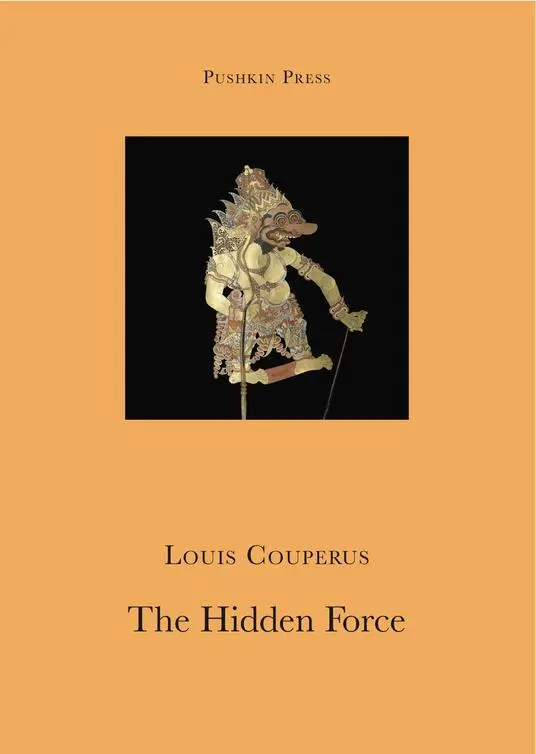
- Название:The Hidden Force
- Автор:
- Издательство:Pushkin Press
- Жанр:
- Год:2012
- ISBN:9781908968227
- Рейтинг книги:4 / 5. Голосов: 1
-
Избранное:Добавить в избранное
- Отзывы:
-
Ваша оценка:
The Hidden Force: краткое содержание, описание и аннотация
Предлагаем к чтению аннотацию, описание, краткое содержание или предисловие (зависит от того, что написал сам автор книги «The Hidden Force»). Если вы не нашли необходимую информацию о книге — напишите в комментариях, мы постараемся отыскать её.
The Hidden Force — читать онлайн бесплатно полную книгу (весь текст) целиком
Ниже представлен текст книги, разбитый по страницам. Система сохранения места последней прочитанной страницы, позволяет с удобством читать онлайн бесплатно книгу «The Hidden Force», без необходимости каждый раз заново искать на чём Вы остановились. Поставьте закладку, и сможете в любой момент перейти на страницу, на которой закончили чтение.
Интервал:
Закладка:
5
YES, THEO KNEW. After lunch he had talked to Urip and although at first the maid had tried to deny everything, frightened of losing the sarongs, she had not been able to keep up the pretence, merely protesting weakly: “No, no…” Early that same afternoon, he had called on Addy, raging with jealousy. But the untroubled composure of the handsome young man with the Moorish face had calmed him down, so sated with all his conquests that he himself never felt jealousy. He had been placated by the total absence of any kind of thought in the Seducer, who had forgotten everything instantly, after his hour of love, and had looked up with naive astonishment when Theo, red-face, seething with rage, had entered his room and stood in front of his bed — where he lay completely naked, as was his habit during his siesta, young and magnificent as bronze, sublime as a classical statue — and declared that he would punch him in the face… And Addy’s amazement had been so artless, so harmonious in its indifference, so totally did he appear to have forgotten last night’s hour or so of love, so calmly had he laughed at the idea of fighting over a woman, that Theo had calmed down and sat on the edge of Addy’s bed. Addy — a few years younger, but with his unparalleled experience — had said to him that he really mustn’t do that again, get so angry because of a woman: mistresses gave themselves to others. And Addy had patted him sympathetically on the shoulder, almost paternally, because they now understood each other, and had talked and listened to each other in confidence. They confided other secrets to each other, about women and girls. Theo asked if Addy planned to marry, but Addy said that he wasn’t thinking of marriage, and the Commissioner would not approve anyway, since he did not approve of the De Luces and considered them too Indies in their ways. In passing, he indicated his pride in his Solo origins, and his pride in the halo that shone palely behind the heads of all the De Luces. Then Addy asked Theo if he knew that there was a brother of his in the native village. Theo knew nothing about it, but Addy assured him: a son of his papa, from the time when the old man had been controller in Ngajiwa; a man of their age, gone completely native; the mother was dead. Perhaps the old man didn’t know himself that he had a child living in the native village, but it was true, everyone knew; the Prince knew, the Prince’s counsellor knew, the native district official knew, the most humble coolie knew. There was no conclusive proof, but something that was known by the whole world was as true as the existence of the world. What did the fellow do? Nothing but curse, maintaining he was the son of the Lord Commissioner who was leaving him to rot in the native quarter. What did he live on? On nothing, on what he begged brazenly, on what he was given, and apart from that… on all kinds of practices: by going round the districts, through all the villages, asking if there were any complaints and drawing up petitions; by urging people to go to Mecca and book their passages on very cheap steamship lines, for which he was a freelance agent. He went to the furthest village and showed them advertising posters depicting a steamship full of pilgrims to Mecca, and the Kaaba and the Sacred Tomb of the Holy Prophet. So he pottered about, often involved in fights, and once in a robbery, sometimes dressed in a sarong, sometimes in an old striped cotton suit, and sleeping where he could. And when Theo showed surprise, maintaining that he had never heard a word about that half-brother, and was curious, Addy suggested going to see him, if he was perhaps to be found in the native quarter.
Addy, in a cheerful mood, quickly had his bath, changed into a fresh white suit, and they went along the road past the paddy fields into the native quarter. It was already growing dark under the huge trees: the banana plants raised their leaves like fresh green oars, and under the stately canopy of the coconut palms nestled the bamboo houses, poetically Oriental, idyllic with their thatched roofs, the doors usually closed and, if they were open, framing a small black interior with a vague outline of a sleeping bench with a darkening figure squatting on it. The mangy dogs barked; the children, naked, with bells attached to their bellies, ran away and peered from the houses. The women remained calm when they recognized the Seducer, and laughed, blinking as he passed in all his glory. Addy pointed out the house where his old nursemaid Tijem lived, the woman who helped him, who always opened her door to him whenever he needed her hut, who worshipped him, just as his mother adored him and his sisters and little nieces. He showed Theo the house and thought of last night’s walk with Doddy, under the cemaras. Tijem the nursemaid saw him and came towards him in delight. She squatted down by him, hugged his leg to her withered breast, rubbed her forehead against his knee, then she kissed his white shoe and looked at him as if enraptured: her handsome prince, her radèn , whom she had rocked to sleep as a chubby little boy, already in love as she held him in her arms. He patted her on the shoulder, gave her two and a half guilders, and asked if she knew where si-Oudijck was, as his brother wanted to see him.
Tijem got up and beckoned them to follow her. It was a long walk. They left the native quarter and found themselves on an open road along which lay rails and the bamboo baskets in which sugar was transported to the boats lying ready there at a jetty on the River Brantas. The sun was setting, in a huge fan-shaped display of orange rays; the distant lines of trees were like dark, plump velvet blurred in the splendid glow, marking the limit of the paddy fields that were not yet planted, the gloomy land lying fallow. A few men and women issued from the factory on their way home. At the river, beneath a sacred banyan tree consisting of five intertwined trunks with an extensive root system, a small market with portable kitchens had been set up. Tijem called the ferryman and he took them across the orange-tinted Brantas, the last light of the sun fanning out like a peacock’s tail. Once they reached the other side, night descended hurriedly with curtains of mist, and the clouds, which all through that November had been threatening on the low horizons, created an oppressive, sultry atmosphere. And they entered another native quarter, illuminated here and there by a paraffin lamp. Until they finally came to a house made half of bamboo, half of Devoe crates, and covered half in tiles, half in thatch. Tijem pointed and, again crouching to hug and kiss Addy’s knee, she asked his leave to go back. Addy knocked on the door: there was the sound of some grumbling and stumbling, but when Addy called out the door was opened with a single kick and the two young men entered the only room in the house — half bamboo, half wood from crates. There was a sleeping bench with a few dirty cushions in a corner, in front of which dangled a limp, chintz curtain, plus a rickety table and a pair of chairs, a paraffin lamp without a globe on it on the table, and small household items cluttered on a crate in a corner. A sour opium smell permeated everything.
And at the table sat si-Oudijck with an Arab, while a Javanese woman squatted on a sleeping couch, preparing herself some betel. The half-caste hurriedly screwed up some sheets of paper lying on the table between them, visibly annoyed at the unexpected visit. But he soon recovered and put on a jovial air, calling out: “Well, Prince, Susuhunan! Sultan of Pajaram! Sugar Baron! How are you, handsome one, ladies’ man?”
His jovial torrent of greetings went on and on, as he gathered the papers together and signalled to the Arab, who promptly disappeared through the other door at the back.
“And who have you got with you, Lord Adrianus, pretty Lucius?…”
Читать дальшеИнтервал:
Закладка:
Похожие книги на «The Hidden Force»
Представляем Вашему вниманию похожие книги на «The Hidden Force» списком для выбора. Мы отобрали схожую по названию и смыслу литературу в надежде предоставить читателям больше вариантов отыскать новые, интересные, ещё непрочитанные произведения.











Обсуждение, отзывы о книге «The Hidden Force» и просто собственные мнения читателей. Оставьте ваши комментарии, напишите, что Вы думаете о произведении, его смысле или главных героях. Укажите что конкретно понравилось, а что нет, и почему Вы так считаете.