Pearl Buck - Kinfolk
Здесь есть возможность читать онлайн «Pearl Buck - Kinfolk» весь текст электронной книги совершенно бесплатно (целиком полную версию без сокращений). В некоторых случаях можно слушать аудио, скачать через торрент в формате fb2 и присутствует краткое содержание. Год выпуска: 2012, Издательство: Open Road Media, Жанр: Классическая проза, на английском языке. Описание произведения, (предисловие) а так же отзывы посетителей доступны на портале библиотеки ЛибКат.
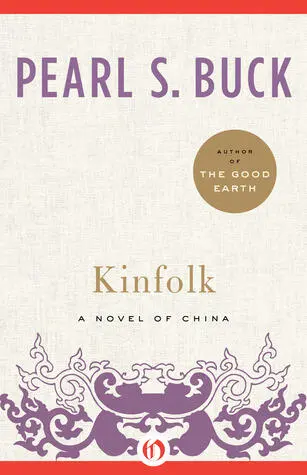
- Название:Kinfolk
- Автор:
- Издательство:Open Road Media
- Жанр:
- Год:2012
- ISBN:нет данных
- Рейтинг книги:4 / 5. Голосов: 1
-
Избранное:Добавить в избранное
- Отзывы:
-
Ваша оценка:
Kinfolk: краткое содержание, описание и аннотация
Предлагаем к чтению аннотацию, описание, краткое содержание или предисловие (зависит от того, что написал сам автор книги «Kinfolk»). Если вы не нашли необходимую информацию о книге — напишите в комментариях, мы постараемся отыскать её.
, a sharp dissection of the expatriate experience, Pearl S. Buck unfurls the story of a Chinese family living in New York. Dr. Liang is a comfortably well-off professor of Confucian philosophy, who spreads the notion of a pure and unchanging homeland. Under his influence, his four grown children decide to move to China, despite having spent their whole lives in America. As the siblings try in various ways to adjust to a new place and culture, they learn that the definition of home is far different from what they expected.
Kinfolk — читать онлайн бесплатно полную книгу (весь текст) целиком
Ниже представлен текст книги, разбитый по страницам. Система сохранения места последней прочитанной страницы, позволяет с удобством читать онлайн бесплатно книгу «Kinfolk», без необходимости каждый раз заново искать на чём Вы остановились. Поставьте закладку, и сможете в любой момент перейти на страницу, на которой закончили чтение.
Интервал:
Закладка:
“Slow!” Peter cried. “So slow that we’ll all be dead before we see the change.”
Only Louise was not moved. Her face was set in its lines of prettiness. “It all sounds horrible,” she said and wiped her hand daintily on the napkin, which to the astonishment of Little Dog’s mother she insisted on having fresh at every meal.
Alone that night for a few minutes after the others had gone to their rooms, Chen said to Jim, “Do you remember the child that was born while you were away in Shanghai, whose mother died, to my shame, because she was my patient?”
“The one I gave into Mary’s charge?” Jim asked.
Chen nodded. “Rose came to me a few days ago and asked me to come and see him. It is a boy, you know.”
Jim nodded.
“That child,” Chen said with peculiar emphasis, “is not all Chinese.”
“No!” James cried. “But you said the mother—”
“The mother was certainly Chinese. She was a young girl — not a student, not a girl of good family, but one of these young moderns — you know them, Jim. She had left her family. I supposed she was a prostitute but she was quite clean and the child is healthy. Well, that’s not too strange, But—” Chen pressed his lips together.
“Go on,” Jim said. “How can there be anything you fear to tell me?”
Chen said, hesitating very much and turning red. “Here it is, then. After the dance, late that night, Louise went to see this child.”
“But why?” James exclaimed.
“I don’t know why,” Chen said. “She came alone and she asked the nurse in charge to show her the child. She used your name to get in.”
11
THE WINTER WAS DRAWING ON in New York and for Dr. Liang the best part of the year was at hand. Now that he had got used to a quiet house he was beginning to like it. Moreover, the presence of the children in China gave him protection. When some of his enemies, and he was always pained by their number, mentioned their surprise that he continued to stay abroad when his country so obviously needed all well-educated citizens, he could smile rather sadly and say, “I am supporting four young citizens now in China. Somebody unfortunately has to pay the bills, and with inflation what it is, this is done more easily with American money than Chinese.”
The fact that he had not yet sent them any money was beginning to weigh on his conscience. Neither he nor Mrs. Liang had ever mentioned the concubine quarrel again, but she had asked him several times whether and when he was going to send the children money.
“Even though James and Mary have jobs, I am sure it is not enough,” she said one day with the stubbornness natural to her. “Besides, we are the parents and we should support the younger ones at least enough to pay for their rice.”
“Certainly you are right,” he replied with unusual politeness to her. “As soon as the lecture season begins, I intend to double my engagements and send them a generous amount.”
“Meantime?” she asked.
“Well, well,” he said impatiently.
The end of this was that Mrs. Liang began another private savings account. One she already had. She had begun it aimlessly, merely for her own comfort in case she should decide someday that she could not bear America any more and that even respect for a husband was not everything in a woman’s life. The money was not deposited in a bank. Instead she had put it thriftily out to loan in Chinatown, and Billy Pan managed it for her, as a favor to the famous Dr. Liang, who knew nothing about it. Each month the capital increased with pleasant regularity. Mrs. Liang was sometimes a little angry because the interest rate was low, but Mr. Pan declared that he could not break the American law, which could be invoked if those who borrowed felt themselves ill used.
“It seems strange that I cannot lend my own money on my own terms,” Mrs. Liang said.
“Well, you can’t except in China,” Billy Pan said flatly. He did not propose to break American law, however absurd. America was still greater than the Chinese Dr. Liang.
“It is another way of stealing,” Mrs. Liang exclaimed. But she did not withdraw her accumulating capital.
The second savings account she merely put into a box which she kept behind the towels and sheets in a closet. She thought of it as the children’s money, though she had no idea how to get it to them. Had Lili married James it would have been easy to ask Mr. Li to exchange the American dollars for Chinese ones in Shanghai, but the Liangs now saw very little of the Li family, who, it was said, were about to join Lili in England. Yet the important thing was to have the money in hand. Mrs. Liang got it by charging Dr. Liang more for everything she bought. This, she told him, was the high cost of living, and if he looked at American papers, he could see for himself that prices were rising every day. She herself followed the price lists closely and made a new rise whenever they did, at the same time continuing to inquire of Dr. Liang when he was going to send the children some money.
Thus, Mary’s letter could not have reached them at a better time. It was written to them both. After some thought Mary had decided not to try to explain any of her feelings about the village or even about Uncle Tao. She would merely say that she and James thought they ought to do something for the ancestral village, where the people were very poor and Uncle Tao himself was sick and James said he needed an operation. “We think of going there to live and to see what we can do for them,” she wrote. “It made me sad to see the children growing up with no chance to go to school and no one even telling them to wipe their noses. Really, Pa and Ma, you should have told us what things here are like, instead of letting us think that our country is one beautiful cloud of Confucianism. But maybe you have been away so long that you have forgotten.”
Her father was displeased with this. “I don’t see what Confucianism has to do with wiping children’s noses,” he said.
“That is not what she is really talking about,” Mrs. Liang said. “So Uncle Tao needs to be cut! Eh, I hope James won’t do it. It is much better to let Uncle Tao die naturally. Sooner or later it must happen. Why prevent fate?”
“When you talk like that I wonder whether you have learned anything in all these years you have had the advantages of America,” Dr. Liang said angrily.
“Please excuse me,” she replied, having learned submission in small matters.
Dr. Liang read on. “Now you will wonder what we can live on,” Mary wrote. “We have thought that all out. Food and room we can have under the ancestral roof. But I need money if I am to have a school, and James will need some too.”
Here Dr. Liang paused and looked severely at his wife. “Why should she need money for a school when the government sets up schools everywhere free?”
“You know they would not put a school in that dead little village of your ancestors,” Mrs. Liang exclaimed. “Please go on.”
Dr. Liang hesitated, decided not to answer and read on, “Uncle Tao says he sends you some money every year for land rent. Pa, I want this money. Put into American money it will mean very little to you. It is so little that you have never even mentioned it to us. But in the village it will be enough for me. And there is something good in using that money for the ancestral village. It comes from our land. I feel it is right to keep it here.”
At this point Dr. Liang became really annoyed. “I cannot understand why Uncle Tao said anything about that money,” he said. “It is no one’s business but mine.”
Mrs. Liang’s surprise was great indeed. “But Liang, you have never told even me you had this money!”
Читать дальшеИнтервал:
Закладка:
Похожие книги на «Kinfolk»
Представляем Вашему вниманию похожие книги на «Kinfolk» списком для выбора. Мы отобрали схожую по названию и смыслу литературу в надежде предоставить читателям больше вариантов отыскать новые, интересные, ещё непрочитанные произведения.

Обсуждение, отзывы о книге «Kinfolk» и просто собственные мнения читателей. Оставьте ваши комментарии, напишите, что Вы думаете о произведении, его смысле или главных героях. Укажите что конкретно понравилось, а что нет, и почему Вы так считаете.