Jonathan Foer - Here I Am
Здесь есть возможность читать онлайн «Jonathan Foer - Here I Am» весь текст электронной книги совершенно бесплатно (целиком полную версию без сокращений). В некоторых случаях можно слушать аудио, скачать через торрент в формате fb2 и присутствует краткое содержание. Год выпуска: 2016, Издательство: Hamish Hamilton, Жанр: Историческая проза, на английском языке. Описание произведения, (предисловие) а так же отзывы посетителей доступны на портале библиотеки ЛибКат.
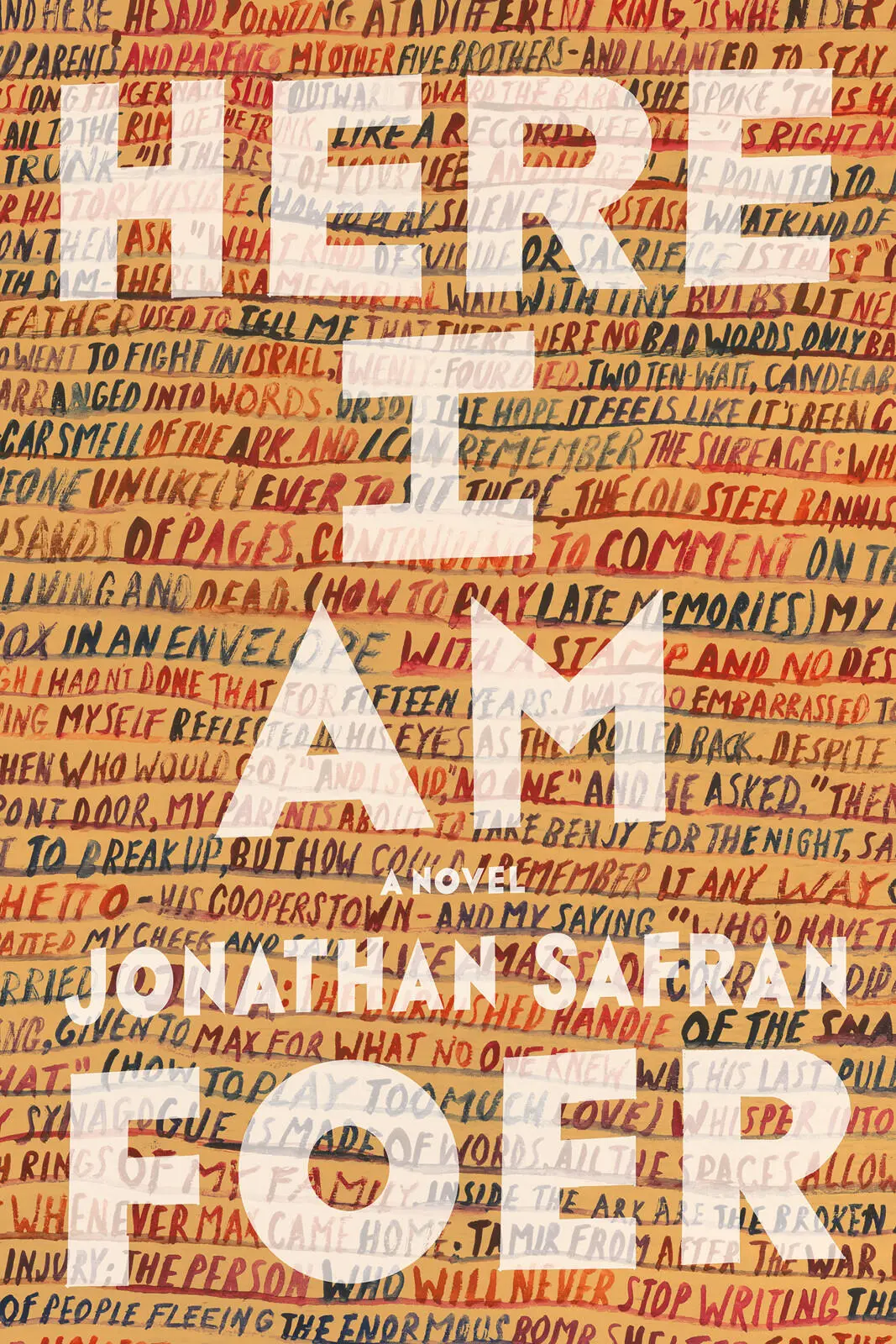
- Название:Here I Am
- Автор:
- Издательство:Hamish Hamilton
- Жанр:
- Год:2016
- ISBN:нет данных
- Рейтинг книги:5 / 5. Голосов: 1
-
Избранное:Добавить в избранное
- Отзывы:
-
Ваша оценка:
Here I Am: краткое содержание, описание и аннотация
Предлагаем к чтению аннотацию, описание, краткое содержание или предисловие (зависит от того, что написал сам автор книги «Here I Am»). Если вы не нашли необходимую информацию о книге — напишите в комментариях, мы постараемся отыскать её.
How do we fulfill our conflicting duties as father, husband, and son; wife and mother; child and adult? Jew and American? How can we claim our own identities when our lives are linked so closely to others’? These are the questions at the heart of Jonathan Safran Foer’s first novel in eleven years-a work of extraordinary scope and heartbreaking intimacy.
Unfolding over four tumultuous weeks in present-day Washington D.C.,
is the story of a fracturing family in a moment of crisis. As Jacob and Julia and their three sons are forced to confront the distances between the lives they think they want and the lives they are living, a catastrophic earthquake sets in motion a spiraling conflict in the Middle East. At stake is the very meaning of home — and the fundamental question of how much life one can bear.
Showcasing the same high-energy inventiveness, hilarious irreverence, and emotional urgency that readers and critics loved in his earlier work,
is Foer’s most searching, hard-hitting, and grandly entertaining novel yet. It not only confirms Foer’s stature as a dazzling literary talent but reveals a mature novelist who has fully come into his own as one of the most important writers of his generation.
Here I Am — читать онлайн бесплатно полную книгу (весь текст) целиком
Ниже представлен текст книги, разбитый по страницам. Система сохранения места последней прочитанной страницы, позволяет с удобством читать онлайн бесплатно книгу «Here I Am», без необходимости каждый раз заново искать на чём Вы остановились. Поставьте закладку, и сможете в любой момент перейти на страницу, на которой закончили чтение.
Интервал:
Закладка:
> How many are you transferring?
> All of them.
> What?
> 1,738,341.
> HOLY FUCKING SHIT! You have that many banked?
> I’m giving you a total transfusion.
> What?
> Listen, I have to get myself ready to go.
> Where?
> Jerusalem. My unit was mobilized. But don’t tell my father, OK?
> Why not?
> He’ll worry.
> But he should worry.
> But his worrying won’t help him, and it won’t help me.
> I don’t even need all of this. I only had 45,000 when my dad killed me.
> Make yourself great.
> My avatar.
> Your great-grandfather.
> This is too much.
> I should let it rot? Make resilience cider?
> You should use it.
> But I won’t. And you will.
The images came more quickly, so quick they could enter only subliminally; they overlapped, blended, and from the corner a light, bleeding from a few pixels to stain the screen, and spreading, a light like the darkness a broken pipe leaves on the ceiling, a light flooding the perpetually refreshing images, and then more light than image, and then an almost entirely white screen, but brighter than white, vague images as if seen through an avalanche.
In perhaps the purest moment of empathy of Sam’s life, he tried to imagine what Noam was seeing on his screen at that moment. Was a darkness like light spreading? Was he receiving warnings about low levels of vitality? Sam imagined Noam clicking IGNORE to those warnings, over and over, and ignoring the annoying alerts, and clicking CONFIRM when finally prompted to confirm his ultimate choice.
The lion walked to the old man, knelt beside him, laid his immense and proud paws on Eyesick’s stooped shoulders, licked at whatever one calls a white five o’clock shadow (a five o’clock brightness?), licked him over and over, as if to will Eyesick back to life, when in fact he was willing himself back to what comes before life.
> Look at you, Bar Mitzvah.
He rested his massive head on Eyesick’s sunken chest. Eyesick hid his fingers in the lion’s streaming mane.
In the middle of his great-grandfather’s funeral reception, Sam started to cry. He didn’t cry often. He hadn’t cried since Argus returned from his second hip replacement, two years before, his back half shaved to reveal Frankenstein stitches, his eyes lowered in his lowered head.
“It’s just what getting better looks like,” Jacob had said. “In a month, he’ll be his old self.”
“A month ?”
“It’ll pass quickly.”
“Not for Argus, it won’t.”
“We’ll spoil him.”
“He can barely walk.”
“And he shouldn’t walk any more than is necessary. The vet said that’s the most important thing for his recovery, to keep him off his leg as much as possible. All walks have to be on-leash. And no stairs. We have to keep him on the first floor.”
“But how will he come up to bed?”
“He’s going to have to sleep down here.”
“But he’ll go up.”
“I don’t think so. He knows how weak his leg is.”
“He’ll go up.”
“I’ll put some books on the stairs to block the way.”
Sam set his alarm for 2:00 a.m., to go down and check on Argus. He snoozed once, and then again, but with the third buzz, his guilt was awakened. He plodded down the stairs, only half aware of being out of bed, nearly paralyzed himself with the help of the stacked Grove Encyclopedia of Art , and found his father on top of a sleeping bag, spooning Argus. That’s when he cried. Not because he loved his dad — although in that moment he certainly did — but because, of the two animals on the floor, it was his dad he felt more sorry for.
> Look at you, Bar Mitzvah.
* * *
He was by the window. The cousins were on PlayStation, killing representations. The adults were upstairs, eating the disgusting, smelly, smoked, and gelatinous foods Jews suddenly need in times of reflection. No one noticed him, which was what he wanted, even if it wasn’t what he needed.
He wasn’t crying about anything in front of him — not the death of his great-grandfather or the death of Noam’s avatar, not the collapse of his parents’ marriage, or the collapse of his bar mitzvah, or the collapsed buildings in Israel. His tears were reaching back. It took Noam’s moment of kindness to reveal the yawning absence of kindness. His dad had slept on the floor for thirty-eight days. (The extra week to play it safe.) Was it easier to extend such kindness to a dog because it didn’t risk rejection? Or because the needs of animals are so animalistic, whereas the needs of humans are so human?
He might never become a man, but crying at that window — his great-grandfather completely alone in the earth twenty minutes away; an avatar returning to pixelated dust in some refrigerated data storage center somewhere near nothing; his parents just on the other side of the ceiling, but a ceiling without edges — Sam was reborn.
JUST THE WAILING
Judaism gets death right, Jacob thought. It instructs us what to do when we know least well what to do, and feel an overwhelming need to do something . You should sit like this. We will. You should dress like this. We will. You should say these words at these moments, even if you have to read from transliteration. Na-ah-seh.
Jacob had stopped crying more than an hour ago, but he still had what Benjy called “after-crying breath.” Irv brought him a glass of peach schnapps, said, “I told the rabbi he was welcome to come, but I doubt he’ll come,” and went back to his windowsill citadel.
The dining table was covered with platters of food: everything and pumpernickel bagels, everything minibagels, everything flagels, bialys, cream cheese, scallion cream cheese, salmon spread, tofu spread, smoked and pickled fish, pitch-black brownies with white chocolate swirls like square universes, blondies, rugelach, out-of-season hamantaschen (strawberry, prune, and poppy seed), and “salads”—Jews apply the word salad to anything that can’t be held in one’s hand: cucumber salad, whitefish and tuna and baked salmon salad, lentil salad, pasta salad, quinoa salad. And there was purple soda, and black coffee, and Diet Coke, and black tea, and enough seltzer to float an aircraft carrier, and Kedem grape juice — a liquid more Jewish than Jewish blood. And there were pickles, a few kinds. Capers don’t belong in any food, but the capers that every spoon had tried to avoid had found their way into foods in which they really didn’t belong, like someone’s half-empty half-decaf. And at the center of the table, impossibly dense kugels bent light and time around them. It was too much food by a factor of ten. But it had to be.
Relatives exchanged stories about Isaac while they piled their plates toward the ceiling of the floor above. They laughed about how funny he was (on purpose, and by accident), what an obstinate pain in the ass he could be (on purpose, and by accident). They reflected on what a hero he had been (on purpose, and by accident). There was a bit of crying, there were some awkward silences, there was gratitude for having had an occasion to gather as a family (some of the cousins hadn’t seen each other since Leah’s bat mitzvah, some not since Great-Aunt Doris’s death), and everyone looked at his phone: to check on the war, the score of the game, the weather.
The kids, having already forgotten about any first-person sadness they might have felt over Isaac’s death, were playing first-person video games in the basement. Max’s pulse doubled as he spectated at an assassination attempt by someone he thought was a second cousin. Sam sat off to the side with his iPad, wandering in a virtual lemon grove. This was how it always went, this vertical segregation. And inevitably, the adults with enough sense to escape the adult world would migrate down. Which is what Jacob did.
Читать дальшеИнтервал:
Закладка:
Похожие книги на «Here I Am»
Представляем Вашему вниманию похожие книги на «Here I Am» списком для выбора. Мы отобрали схожую по названию и смыслу литературу в надежде предоставить читателям больше вариантов отыскать новые, интересные, ещё непрочитанные произведения.






Обсуждение, отзывы о книге «Here I Am» и просто собственные мнения читателей. Оставьте ваши комментарии, напишите, что Вы думаете о произведении, его смысле или главных героях. Укажите что конкретно понравилось, а что нет, и почему Вы так считаете.