Jonathan Foer - Here I Am
Здесь есть возможность читать онлайн «Jonathan Foer - Here I Am» весь текст электронной книги совершенно бесплатно (целиком полную версию без сокращений). В некоторых случаях можно слушать аудио, скачать через торрент в формате fb2 и присутствует краткое содержание. Год выпуска: 2016, Издательство: Hamish Hamilton, Жанр: Историческая проза, на английском языке. Описание произведения, (предисловие) а так же отзывы посетителей доступны на портале библиотеки ЛибКат.
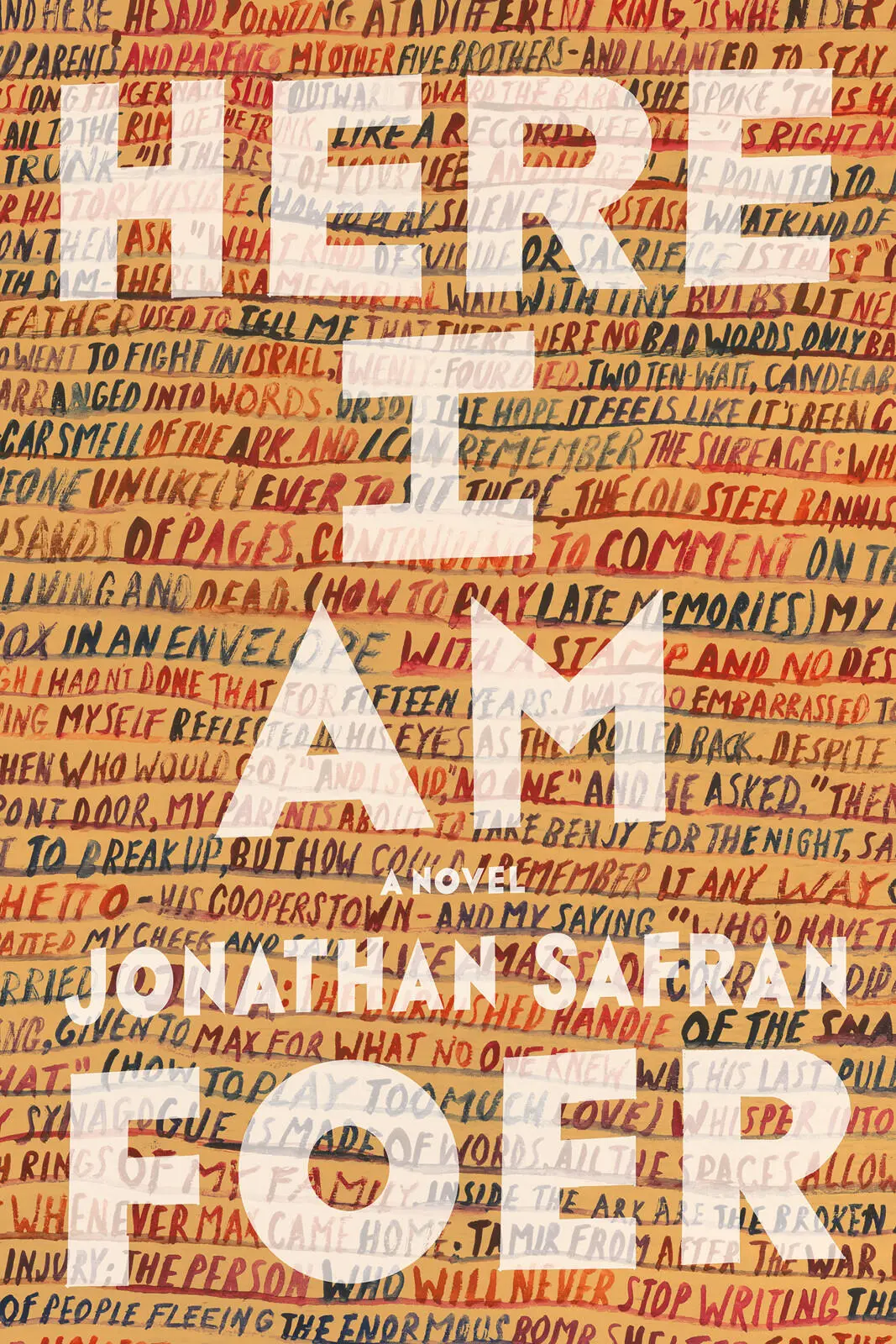
- Название:Here I Am
- Автор:
- Издательство:Hamish Hamilton
- Жанр:
- Год:2016
- ISBN:нет данных
- Рейтинг книги:5 / 5. Голосов: 1
-
Избранное:Добавить в избранное
- Отзывы:
-
Ваша оценка:
Here I Am: краткое содержание, описание и аннотация
Предлагаем к чтению аннотацию, описание, краткое содержание или предисловие (зависит от того, что написал сам автор книги «Here I Am»). Если вы не нашли необходимую информацию о книге — напишите в комментариях, мы постараемся отыскать её.
How do we fulfill our conflicting duties as father, husband, and son; wife and mother; child and adult? Jew and American? How can we claim our own identities when our lives are linked so closely to others’? These are the questions at the heart of Jonathan Safran Foer’s first novel in eleven years-a work of extraordinary scope and heartbreaking intimacy.
Unfolding over four tumultuous weeks in present-day Washington D.C.,
is the story of a fracturing family in a moment of crisis. As Jacob and Julia and their three sons are forced to confront the distances between the lives they think they want and the lives they are living, a catastrophic earthquake sets in motion a spiraling conflict in the Middle East. At stake is the very meaning of home — and the fundamental question of how much life one can bear.
Showcasing the same high-energy inventiveness, hilarious irreverence, and emotional urgency that readers and critics loved in his earlier work,
is Foer’s most searching, hard-hitting, and grandly entertaining novel yet. It not only confirms Foer’s stature as a dazzling literary talent but reveals a mature novelist who has fully come into his own as one of the most important writers of his generation.
Here I Am — читать онлайн бесплатно полную книгу (весь текст) целиком
Ниже представлен текст книги, разбитый по страницам. Система сохранения места последней прочитанной страницы, позволяет с удобством читать онлайн бесплатно книгу «Here I Am», без необходимости каждый раз заново искать на чём Вы остановились. Поставьте закладку, и сможете в любой момент перейти на страницу, на которой закончили чтение.
Интервал:
Закладка:
“What was Moses crying about? Was he crying for himself? Out of hunger or fear? Was he crying for his people? Their bondage, their suffering? Or were they tears of gratitude? Perhaps Pharaoh’s daughter didn’t hear him crying because he wasn’t crying until she opened the wicker basket.
“How should we mourn Isaac Bloch? With tears — what kind of tears? With silence — what silence? Or with what kind of song? Our answer will not save him, but it might save us.”
With all three, of course. Jacob could see the rabbi’s moves from five thousand years away. With all three, because of the tragedy, because of our reverence, because of our gratitude. Because of everything that was necessary to bring us to this moment, because of the lies that lie ahead, because of the moments of joy so extreme they have no relation to happiness. With tears, with silence, with song, because he survived so we could sin, because our religion is as gorgeous, and opaque, and brittle, as the stained glass of Kol Nidre, because Ecclesiastes was wrong: there isn’t time for every purpose.
What do you want? Anything. Tell me. I want you to have the thing that you want.
Jacob cried.
He wailed.
THE NAMES WERE MAGNIFICENT
Jacob carried the casket with his cousins. It was so much lighter than he’d imagined it would be. How could someone with such a heavy life weigh so little? And the job was surprisingly awkward: they nearly fell over a few times, and Irv was only a half teeter from tumbling into the grave with his father.
“This is the worst cemetery ever ,” Max said to no one in particular, but loud enough for everyone to hear.
Finally, they were able to position the simple pine coffin on the broad strips of fabric that eased it into the grave.
And there it was: the fact of it. Irv bore the responsibility — the privilege of the mitzvah — of shoveling the first dirt onto his father’s coffin. He took a heaping mound, turned his body to the hole, and tipped the shovel, letting it fall. It was louder than it should have been, and more violent, as if every particle of soil hit the wood at once, and as if it had been dropped from a far greater height. Jacob winced. Julia and the boys winced. Everyone winced. Some were thinking of the body in the coffin. Some were thinking of Irv.
HOW TO PLAY EARLY MEMORIES
My earliest memories are hidden around my grandfather’s final house like afikomens: dish-soap bubble baths; knee-football games in the basement with the grandchildren of survivors — they always ended in injury; the seemingly moving eyes of Golda Meir’s portrait; instant-coffee crystals; pearls of grease on the surface of every liquid; games of Uno at his kitchen table, just us two humans, just yesterday’s bagel, last week’s Jewish Week , and juice from concentrate from whenever in history was the last significant sale. I always beat him. Sometimes we’d play one hundred games a night, sometimes both nights of the weekend, sometimes three weekends a month. He always lost.
What I think of as my earliest memory couldn’t possibly be my earliest memory — it’s too far into my life. I am confusing foundational with earliest, in the same way that, as Julia used to point out, the first floor of a house is usually the second, and sometimes the third.
This is my earliest memory: I was raking the leaves in front of the house when I saw something against the side door. Ants were beginning to envelop a dead squirrel. For how long had it been there? Had it eaten poison? What poison? Had a neighborhood dog killed it and then, full of a dog’s remorse, delivered his shame? Or perhaps his pride? Or had the squirrel died trying to get in?
I ran inside and told my mother. Her glasses were steamed over; she was stirring a pot she couldn’t see. Without looking up she said, “Go tell Dad to take care of it.”
Through the open door — on the safe side of the threshold — I watched my father cover his hand with the clear plastic bag that the morning’s Post had come in, pick up the squirrel, and then pull his hand out, turning the bag inside out with the squirrel in it. While my father washed his hands in the bathroom sink, I stood at his side and asked him question after question. I was always being taught lessons, and so came to assume that everything conveyed some necessary piece of information, some moral.
Was it cold? When do you think it died? How do you think it died? Didn’t it bother you?
“Bother me?” my father asked.
“Gross you out.”
“Of course.”
“But you just went out there and did it like it was nothing.”
He nodded.
I followed his wedding ring through the soap.
“Did you think it was disgusting?”
“I did.”
“It was so gross.”
“Yes.”
“I couldn’t have done it.”
He laughed a father’s laugh and said, “One day you’ll do it.”
“What if I can’t?”
“When you’re a dad, there’s no one above you. If I don’t do something that has to be done, who is going to do it?”
“I still couldn’t do it.”
“The more you won’t want to do it, the more of a dad you’ll be.”
The closet was filled with hundreds of plastic bags. He had chosen a clear one to teach me a lesson.
I obsessed over that squirrel for a few days, and then didn’t think about it again for a quarter century, until Julia was pregnant with Sam, at which point I started having a recurrent dream of dead squirrels lining the streets of our neighborhood. There were thousands of them: pushed against curbs, filling public garbage cans, prone in final poses while automatic sprinkler systems soaked through their fur. In the dream I was always returning home from somewhere, always walking up our street, it was always the end of the day. The window shades of the house were illuminated like TV screens. We didn’t have a working fireplace, but smoke poured from the chimney. I had to walk on tiptoes to avoid stepping on squirrels, and sometimes it couldn’t be avoided. I apologized — to whom? There were squirrels on the windowsills, and on stoops, and pouring from the gutters. I could see their silhouettes on the undersides of awnings. They hung halfway out of mail slots, in apparent attempts to find food or water, or simply to die inside — like that squirrel that had wanted to die inside my childhood home. I knew I was going to have to take care of all of them.
Jacob wanted to go to his father’s side, as he had as a child, and ask him how he managed to shovel dirt into his father’s grave.
Did you think it was disgusting?
I did , his father would have said.
I couldn’t have done it.
His father would have laughed a father’s laugh and said, One day you’ll do it.
What if I can’t?
Children bury their dead parents, because the dead need to be buried. Parents do not need to bring their children into the world, but children need to bring their parents out of it.
Irv handed the shovel to Jacob. Their eyes met. The father whispered into the son’s ear: “Here we are and will be.”
When Jacob imagined his children surviving him, he felt no version of immortality, as it’s sometimes unimaginatively put, usually by people who are trying to encourage others to have children. He felt no contentment or peace or satisfaction of any kind. He felt only the overwhelming sadness of missing out. Death felt less fair with children, because there was more to miss. Whom would Benjy marry? (Despite himself, Jacob couldn’t shake his Jewish certainty that of course he would want to marry, and would marry.) To what ethical and lucrative profession would Sam be drawn? What odd hobbies would Max indulge? Where would they travel? What would their children look like? (Of course they would want to have children, and have children.) How would they cope and celebrate? How would each die? (At least he would miss their deaths. Maybe that was the compensation for having to die himself.)
Читать дальшеИнтервал:
Закладка:
Похожие книги на «Here I Am»
Представляем Вашему вниманию похожие книги на «Here I Am» списком для выбора. Мы отобрали схожую по названию и смыслу литературу в надежде предоставить читателям больше вариантов отыскать новые, интересные, ещё непрочитанные произведения.





Обсуждение, отзывы о книге «Here I Am» и просто собственные мнения читателей. Оставьте ваши комментарии, напишите, что Вы думаете о произведении, его смысле или главных героях. Укажите что конкретно понравилось, а что нет, и почему Вы так считаете.