Jonathan Foer - Here I Am
Здесь есть возможность читать онлайн «Jonathan Foer - Here I Am» весь текст электронной книги совершенно бесплатно (целиком полную версию без сокращений). В некоторых случаях можно слушать аудио, скачать через торрент в формате fb2 и присутствует краткое содержание. Год выпуска: 2016, Издательство: Hamish Hamilton, Жанр: Историческая проза, на английском языке. Описание произведения, (предисловие) а так же отзывы посетителей доступны на портале библиотеки ЛибКат.
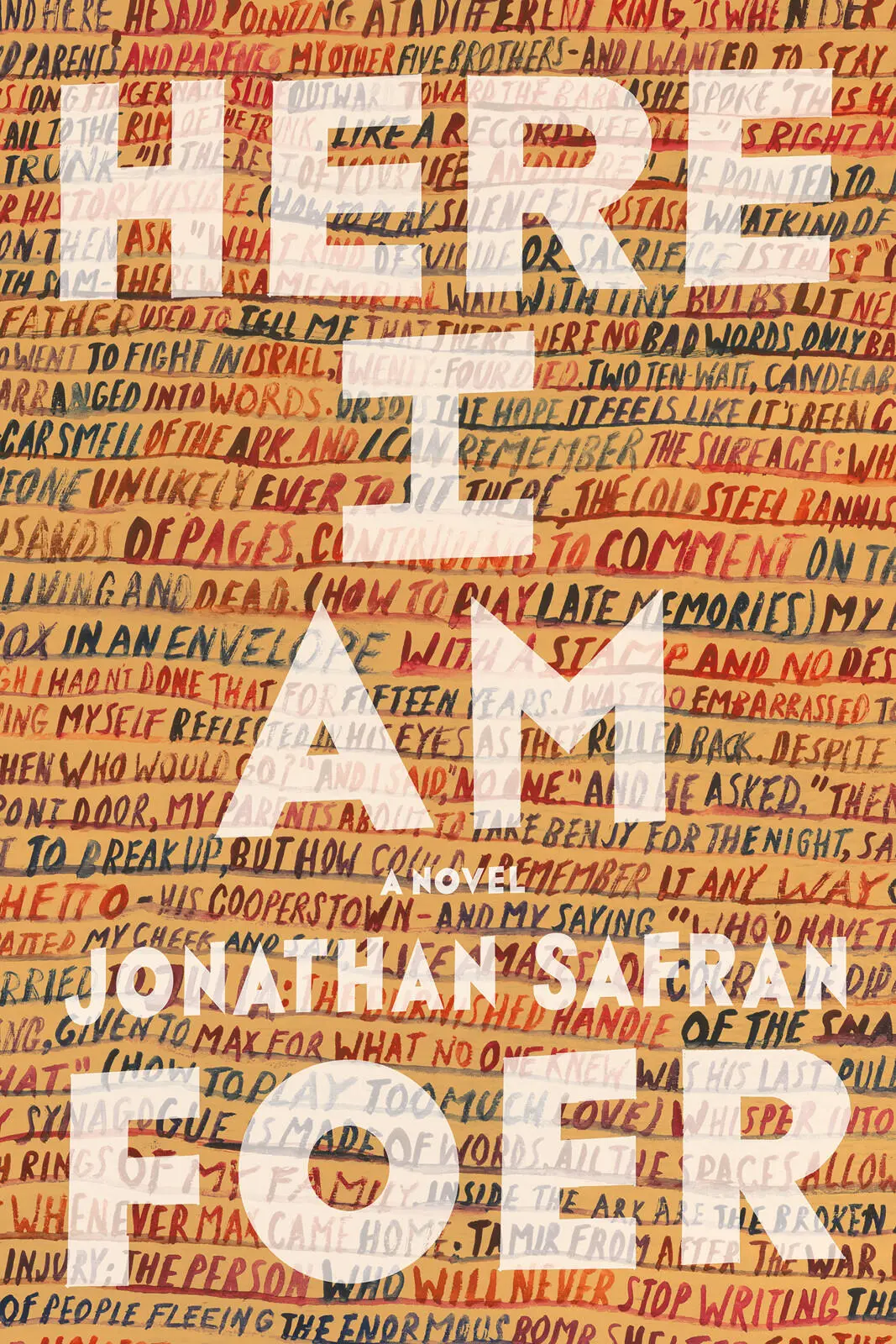
- Название:Here I Am
- Автор:
- Издательство:Hamish Hamilton
- Жанр:
- Год:2016
- ISBN:нет данных
- Рейтинг книги:5 / 5. Голосов: 1
-
Избранное:Добавить в избранное
- Отзывы:
-
Ваша оценка:
Here I Am: краткое содержание, описание и аннотация
Предлагаем к чтению аннотацию, описание, краткое содержание или предисловие (зависит от того, что написал сам автор книги «Here I Am»). Если вы не нашли необходимую информацию о книге — напишите в комментариях, мы постараемся отыскать её.
How do we fulfill our conflicting duties as father, husband, and son; wife and mother; child and adult? Jew and American? How can we claim our own identities when our lives are linked so closely to others’? These are the questions at the heart of Jonathan Safran Foer’s first novel in eleven years-a work of extraordinary scope and heartbreaking intimacy.
Unfolding over four tumultuous weeks in present-day Washington D.C.,
is the story of a fracturing family in a moment of crisis. As Jacob and Julia and their three sons are forced to confront the distances between the lives they think they want and the lives they are living, a catastrophic earthquake sets in motion a spiraling conflict in the Middle East. At stake is the very meaning of home — and the fundamental question of how much life one can bear.
Showcasing the same high-energy inventiveness, hilarious irreverence, and emotional urgency that readers and critics loved in his earlier work,
is Foer’s most searching, hard-hitting, and grandly entertaining novel yet. It not only confirms Foer’s stature as a dazzling literary talent but reveals a mature novelist who has fully come into his own as one of the most important writers of his generation.
Here I Am — читать онлайн бесплатно полную книгу (весь текст) целиком
Ниже представлен текст книги, разбитый по страницам. Система сохранения места последней прочитанной страницы, позволяет с удобством читать онлайн бесплатно книгу «Here I Am», без необходимости каждый раз заново искать на чём Вы остановились. Поставьте закладку, и сможете в любой момент перейти на страницу, на которой закончили чтение.
Интервал:
Закладка:
A chuckle. He was winning.
“And then he said, ‘Rabbi, I feel no despair anymore. For seventy years I had only nightmares, but I have no nightmares anymore. I feel only gratitude for my life, for every moment I lived. Not only the good moments. I feel gratitude for every moment of my life. I have seen so many miracles.’”
This was either the most audacious heaping and steaming mountain of Jewshit ever shoveled by a rabbi or anyone, or a revelatory glimpse into Isaac Bloch’s consciousness. Only the rabbi knew for sure — what was accurately recounted, what was embellished, what was fabricated out of whole tallis. Had anyone ever heard Isaac use the word despair ? Or gratitude ? He’d have said, “It was horrible, but it could have been worse.” But would he have said that ? Thankful for what ? And what were all these miracles he’d witnessed?
“Then he asked me if I spoke Yiddish. I told him no. He said, ‘What kind of rabbi doesn’t speak Yiddish?’”
A proper laugh.
“I told him my grandparents spoke Yiddish to my parents, but my parents would never let me hear it. They wanted me to learn English. To forget Yiddish. He told me he’d done the same, that he was the last Yiddish-speaker in his family, that the language would be in the casket, too. And then he put his hand on my hand and said, ‘Let me teach you a Yiddish expression.’ He looked me in the eye and said, ‘Kein briere iz oich a breire.’ I asked him what it meant. He took back his hand and said, ‘Look it up.’”
Another laugh.
“I did look it up. On my phone, in his bathroom.”
Another laugh.
“ Kein briere iz oich a breire . It means ‘Not to have a choice is also a choice.’”
No, those words couldn’t have been his. They were too faux-enlightened, too content with circumstance. Isaac Bloch was many things, and resigned was not one of them.
If having no choice were a choice, Isaac would have run out of choices once a day after 1938. But the family needed him, especially before the family existed. They needed him to turn his back on his grandparents, his parents, and five of his brothers. They needed him to hide in that hole with Benny, to walk with rigid legs toward Russia, eat other people’s garbage at night, hide, steal, forage. They needed him to forge documents to board the boat, and tell the right lies to the U.S. immigration officer, and work eighteen-hour days to keep the grocery profitable.
“Then,” the young rabbi said, “he asked me to pick up toilet paper for him at the Safeway, because they were having a sale.”
Everyone chuckled.
“I told him he didn’t need to buy toilet paper anymore. It would be taken care of by the Jewish Home. He gave me a knowing smile and said, ‘But that price…’”
A louder, freer laugh.
“‘That’s it?’ I asked. ‘That’s it,’ he said. ‘Was there something you wanted to hear? Something you wanted to say?’ He said, ‘There are two things that everybody needs. The first is to feel that he is adding to the world. Do you agree?’ I told him I did. ‘The second,’ he said, ‘is toilet paper.’”
The loudest laugh yet.
“I’m thinking about a Hasidic teaching that I learned as a rabbinical student. There are three ascending levels of mourning: with tears, with silence, and with song. How do we mourn Isaac Bloch? With tears, with silence, or with song? How do we mourn the end of his life? The end of the Jewish epoch that he participated in and exemplified? The end of Jews who speak in that music of broken instruments; who arrange their grammar counterclockwise and miss the point of every cliché; who say mine instead of my, the German people instead of Nazis , and who implore their perfectly healthy relatives to be healthy instead of feeling silent gratitude for health? The end of hundred-and-fifty-decibel kisses, of that drunken European script. Do we shed tears for their disappearance? Silently grieve? Or sing their praises?
“Isaac Bloch was not the last of his kind, but once gone, his kind will be gone forever. We know them — we have lived among them, they have shaped us as Jews and Americans, as sons and daughters, grandsons and granddaughters — but our time of knowing them is nearly complete. And then they will be gone forever. And we will only remember them. Until we don’t.
“We know them. We know them with tears for their suffering, with silence for all that cannot be said, and with song for their unprecedented resilience. There will be no more old Jews who interpret a spot of good news as the guarantee of imminent apocalypse, who treat buffets like grocery stores before blizzards, who touch a finger to the bottom lip before turning a page of their people’s Maxwell House epic.”
Jacob’s hatred was softening — not evaporating, not even melting, but losing its shape.
The rabbi paused, brought his hands together, and sighed. “As we stand at Isaac Bloch’s grave, there is a war going on. There are two wars. One is on the brink of breaking out. The other has been happening for seventy years. The imminent war will determine the survival of Israel. The old war will determine the survival of the Jewish soul.
“Survival has been the central theme and imperative of Jewish existence since the beginning, and not because we chose it to be that way. We have always had enemies, always been hunted. It’s not true that everyone hates Jews, but in every country we’ve ever lived, in every decade of every century, we have encountered hatred.
“So we’ve slept with one eye open, kept packed suitcases in the closet and one-way train tickets in the breast pockets of our shirts, against our hearts. We’ve made efforts not to offend or be too noisy. To achieve, yes, but not to draw undue attention to ourselves in the process. We’ve organized our lives around the will to perpetuate our lives — with our stories, habits, values, dreams, and anxieties. Who could blame us? We are a traumatized people. And nothing else has trauma’s power to deform the mind and heart.
“If you were to ask one hundred Jews what was the Jewish book of the century, you would get one answer: The Diary of Anne Frank . If you were to ask what was the Jewish work of art of the century, you would get the same answer. This despite it having been created neither as a book nor as a work of art, and not in the century in which the question was asked. But its appeal — symbolically, and on its own terms — is overpowering.”
Jacob looked around to see if anyone else was as surprised by the direction this was taking. No one seemed fazed. Even Irv, whose head only ever rotated on the axis of disagreement, was nodding.
“But is it good for us? Has it been good to align ourselves with poignancy over rigor, with hiding over seeking, victimization over will? No one could blame Anne Frank for dying, but we could blame ourselves for telling her story as our own. Our stories are so fundamental to us that it’s easy to forget that we choose them. We choose to rip certain pages from our history books, and coil others into our mezuzot. We choose to make life the ultimate Jewish value, rather than differentiate the values of kinds of life, or, more radically, admit that there are things even more important than being alive.
“So much of Judaism today — regarding Larry David as anything beyond very funny, the existence and persistence of the Jewish American Princess, the embrace of klutziness, the fear of wrath, the shifting emphasis from argument to confession — is the direct consequence of our choice to have Anne Frank’s diary replace the Bible as our bible. Because the Jewish Bible, whose purpose is to delineate and transmit Jewish values, makes it abundantly clear that life itself is not the loftiest ambition. Righteousness is.
Читать дальшеИнтервал:
Закладка:
Похожие книги на «Here I Am»
Представляем Вашему вниманию похожие книги на «Here I Am» списком для выбора. Мы отобрали схожую по названию и смыслу литературу в надежде предоставить читателям больше вариантов отыскать новые, интересные, ещё непрочитанные произведения.





Обсуждение, отзывы о книге «Here I Am» и просто собственные мнения читателей. Оставьте ваши комментарии, напишите, что Вы думаете о произведении, его смысле или главных героях. Укажите что конкретно понравилось, а что нет, и почему Вы так считаете.