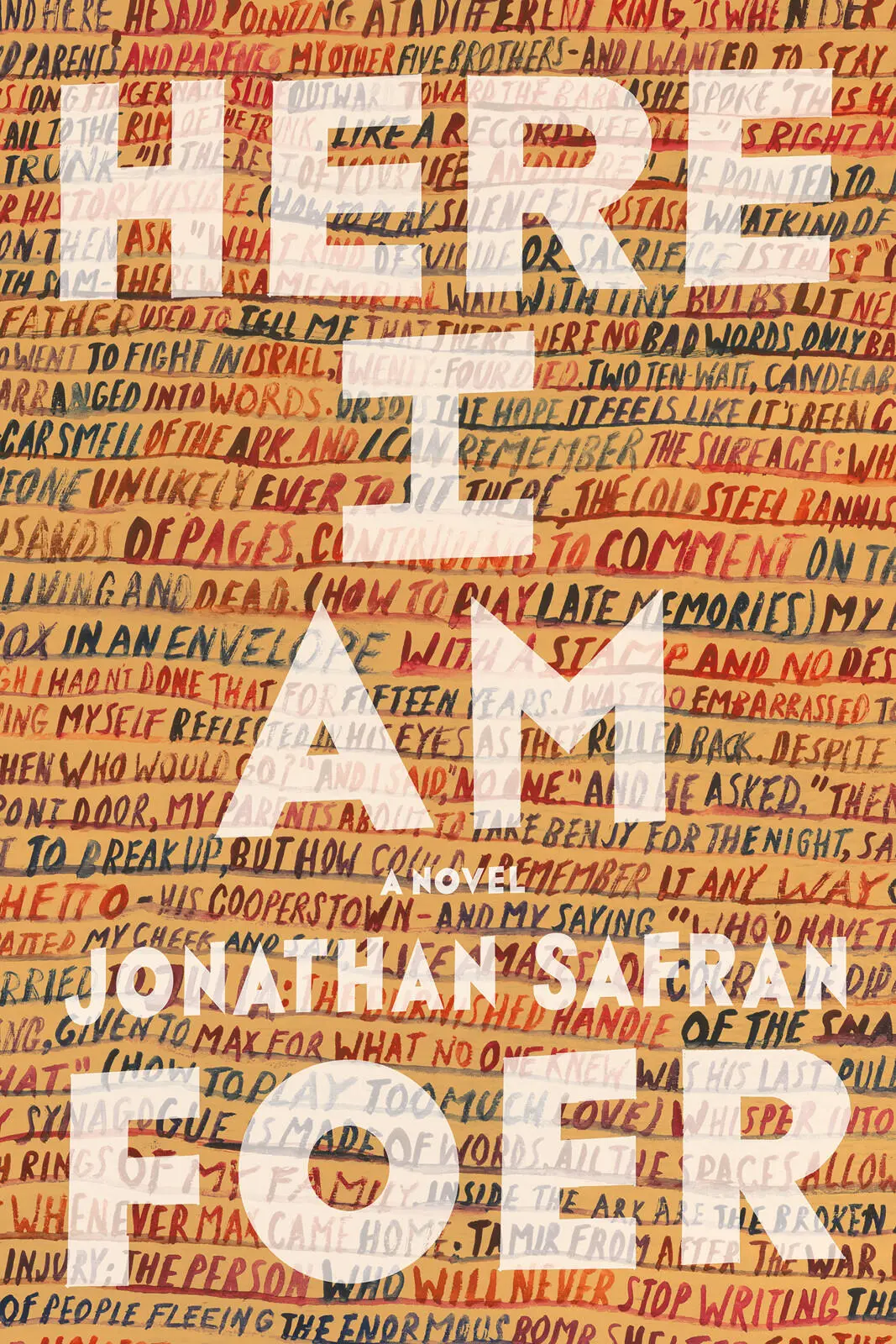
Jonathan Foer - Here I Am
Здесь есть возможность читать онлайн «Jonathan Foer - Here I Am» весь текст электронной книги совершенно бесплатно (целиком полную версию без сокращений). В некоторых случаях можно слушать аудио, скачать через торрент в формате fb2 и присутствует краткое содержание. Год выпуска: 2016, Издательство: Hamish Hamilton, Жанр: Историческая проза, на английском языке. Описание произведения, (предисловие) а так же отзывы посетителей доступны на портале библиотеки ЛибКат.
- Название:Here I Am
- Автор:
- Издательство:Hamish Hamilton
- Жанр:
- Год:2016
- ISBN:нет данных
- Рейтинг книги:5 / 5. Голосов: 1
-
Избранное:Добавить в избранное
- Отзывы:
-
Ваша оценка:
Here I Am: краткое содержание, описание и аннотация
Предлагаем к чтению аннотацию, описание, краткое содержание или предисловие (зависит от того, что написал сам автор книги «Here I Am»). Если вы не нашли необходимую информацию о книге — напишите в комментариях, мы постараемся отыскать её.
How do we fulfill our conflicting duties as father, husband, and son; wife and mother; child and adult? Jew and American? How can we claim our own identities when our lives are linked so closely to others’? These are the questions at the heart of Jonathan Safran Foer’s first novel in eleven years-a work of extraordinary scope and heartbreaking intimacy.
Unfolding over four tumultuous weeks in present-day Washington D.C.,
is the story of a fracturing family in a moment of crisis. As Jacob and Julia and their three sons are forced to confront the distances between the lives they think they want and the lives they are living, a catastrophic earthquake sets in motion a spiraling conflict in the Middle East. At stake is the very meaning of home — and the fundamental question of how much life one can bear.
Showcasing the same high-energy inventiveness, hilarious irreverence, and emotional urgency that readers and critics loved in his earlier work,
is Foer’s most searching, hard-hitting, and grandly entertaining novel yet. It not only confirms Foer’s stature as a dazzling literary talent but reveals a mature novelist who has fully come into his own as one of the most important writers of his generation.
Here I Am — читать онлайн бесплатно полную книгу (весь текст) целиком
Ниже представлен текст книги, разбитый по страницам. Система сохранения места последней прочитанной страницы, позволяет с удобством читать онлайн бесплатно книгу «Here I Am», без необходимости каждый раз заново искать на чём Вы остановились. Поставьте закладку, и сможете в любой момент перейти на страницу, на которой закончили чтение.
Интервал:
Закладка:
Before returning to the car, Jacob went for a walk. He read the gravestones like pages in an enormous book. The names were magnificent — because they were Jewish haiku, because they traveled in time machines while those they identified were left behind, because they were as embarrassing as pennies collected in paper rolls, because they were as beautiful as boats in bottles brought over on boats, because they were mnemonics: Miriam Apfel, Shaindel Potash, Beryl Dressler … He wanted to remember them, to use them later. He wanted to remember all of it, to use it all: the rabbi’s shoelaces, the untied melodies of grief, the hardened footprints of a visitor in the rain.
Sidney Landesman, Ethel Keiser, Lebel Alterman, Deborah Fischbach, Lazer Berenbaum …
He would remember the names. He wouldn’t lose them. He would use them. He would make something of the no longer anything.
Seymour Kaiser, Shoshanna Ostrov, Elsa Glaser, Sura Needleman, Hymie Rattner, Simcha Tisch, Dinah Perlman, Ruchel Neustadt, Izzie Reinhardt, Ruben Fischman, Hindel Schulz …
Like listening to a Jewish river. But you can step in it twice. You can — Jacob could; he believed he could — take all that was lost and re-find it, reanimate it, breathe new life into the collapsed lungs of those names, those accents, those idioms and mannerisms and ways of being. The young rabbi was right: no one would ever have such names again. But he was wrong.
Mayer Vogel, Frida Walzer, Yussel Offenbacher, Rachel Blumenstein, Velvel Kronberg, Leah Beckerman, Mendel Fogelman, Sarah Bronstein, Schmuel Gersh, Wolf Seligman, Abner Edelson, Judith Weisz, Bernard Rosenbluth, Eliezer Umansky, Ruth Abramowicz, Irving Perlman, Leonard Goldberger, Nathan Moskowitz, Pincus Ziskind, Solomon Altman …
Jacob had once read that there are more people alive now than have died in all of human history. But it didn’t feel that way. It felt as if everyone were dead. And for all the individuality — for the extreme idiosyncrasy of the names of those extremely idiosyncratic Jews — there was only one fate.
And then he found himself where two walls met, at the corner of the vast cemetery, at the corner of the vast everything.
He turned to face the immensity, and only then did it occur to him, or only then was he forced to acknowledge what he’d forced himself not to: He was standing among suicides. He was in the ghetto for those unfit to be buried with the rest. This corner was where the shame was cordoned off. This was where the unspeakable shame was put beneath the ground. Milk on one set of plates, meat on the other: never the two should meet.
Miriam Apfel, Shaindel Potash, Beryl Dressler …
He had some vague awareness of the prohibition against taking one’s own life, and the price — beyond death — for having done so. The punishment wasn’t for the criminal, but the victims: those left behind and now forced to bury their dead in the other-earth. He remembered it like he remembered the prohibition against tattoos — something about desecrating the body — which would also land you in the other-earth. And — less spiritual, but every bit as religious — the prohibition against drinking Pepsi, because Pepsi chose to market to Arab countries and not Israel. And the prohibition against touching a shiksa in any of the ways one was dying to, because it was a shanda. And the prohibition against resisting when elders touched any part of your body they wanted, in any way they wanted, because they were dying, perpetually dying, and it was a mitzvah.
Standing in that unwalled ghetto, he thought about eruvs — a wonderfully Jewish loophole that Julia had shared, before he even knew the prohibition it was circumventing. She’d learned about them not in the context of a Jewish education, but in architecture school: an example of a “magical structure.”
Jews can’t “carry” on Shabbat: no keys, no money, no tissues or medicine, no strollers or canes, not even children who can’t yet walk. The prohibition against carrying is technically against carrying from private to public domains. But what if large areas were made to be private? What if an entire neighborhood were a private domain? A city? An eruv is a string or wire that encloses an area, making it private, and thus permitting carrying. Jerusalem is enclosed by an eruv. Virtually all of Manhattan is enclosed by an eruv. There is an eruv in nearly every Jewish community in the world.
“In D.C.?”
“Of course.”
“I’ve never seen it.”
“You’ve never looked for it.”
She took him to the intersection of Reno and Davenport, where the eruv turned a corner and was most easy to see. There it was, like dental floss. They followed it down Davenport to Linnean, and Brandywine, and Broad Branch. They walked beneath the string as it ran from street sign to lamppost to power pole to telephone pole.
As he stood among the suicides, his pockets were full: a paper clip that Sam had somehow bent into an airplane, a crumpled twenty, Max’s yarmulke from the funeral (apparently acquired at the wedding of two people Jacob had never heard of), the dry-cleaning ticket for the pants he was wearing, a pebble Benjy had taken from a grave and asked Jacob to hold, more keys than there were locks in his life. The older he got, the more he carried, the stronger it should have made him.
Isaac was buried in a pocketless shroud, six hundred yards from his wife of two hundred thousand hours.
Seymour Kaiser : loving brother, loving son; head in the oven. Shoshanna Ostrov : loving wife; wrists slit in the bath. Elsa Glaser : loving mother and grandmother; hanging from the ceiling fan. Sura Needleman : loving wife, mother, and sister; walked into a river, pockets full of stones. Hymie Rattner : loving son; wrists slit over the bathroom sink. Simcha Tisch : loving father, loving brother; steak knife in the gut. Dinah Perlman : loving grandmother, mother, and sister; leaped from the top of the stairs. Ruchel Neustadt : loving wife and mother; letter opener in the neck. Izzie Reinhardt : loving father, husband, and brother; jumped from Memorial Bridge. Ruben Fischman : loving husband; drove his car into a tree at one hundred miles per hour. Hindel Schulz : loving mother; serrated bread knife across the wrist . Isaac Bloch : loving brother, husband, father, grandfather, and great-grandfather; hanging by a belt in his kitchen.
Jacob wanted to pull the thread from his black suit, tie it around the tree in the corner, and walk the perimeter of the suicide ghetto, enclosing it as he unraveled. And then, when the public had been made private, he would carry away the shame. But to where?
Every landmass is surrounded by water. Was every coast an eruv?
Was the equator an eruv around the earth?
Did Pluto’s orbit enclose the solar system?
And the wedding ring still on his finger?
REINCARNATION
> So what’s new?
> You’re the one in the middle of a crisis.
> That isn’t new.
> Everything’s the same here, except my great-grandfather is dead.
> Your family is OK?
> Yeah. I think my dad is pretty upset, but it’s hard to tell, because he always seems a bit upset.
> Right.
> And it’s not like it was his dad, anyway. Just his grandfather. Which is still sad, but less sad. Far less sad.
> Right.
> I really do like it when people repeat bits of language. Why is that?
> I don’t know.
> Your dad and brother seem to be having a good time. They’re worried about you, obviously. They talk about you constantly. But if they can’t be there, it’s good that they’re here.
Читать дальшеИнтервал:
Закладка:
Похожие книги на «Here I Am»
Представляем Вашему вниманию похожие книги на «Here I Am» списком для выбора. Мы отобрали схожую по названию и смыслу литературу в надежде предоставить читателям больше вариантов отыскать новые, интересные, ещё непрочитанные произведения.








Обсуждение, отзывы о книге «Here I Am» и просто собственные мнения читателей. Оставьте ваши комментарии, напишите, что Вы думаете о произведении, его смысле или главных героях. Укажите что конкретно понравилось, а что нет, и почему Вы так считаете.