Jonathan Foer - Here I Am
Здесь есть возможность читать онлайн «Jonathan Foer - Here I Am» весь текст электронной книги совершенно бесплатно (целиком полную версию без сокращений). В некоторых случаях можно слушать аудио, скачать через торрент в формате fb2 и присутствует краткое содержание. Год выпуска: 2016, Издательство: Hamish Hamilton, Жанр: Историческая проза, на английском языке. Описание произведения, (предисловие) а так же отзывы посетителей доступны на портале библиотеки ЛибКат.
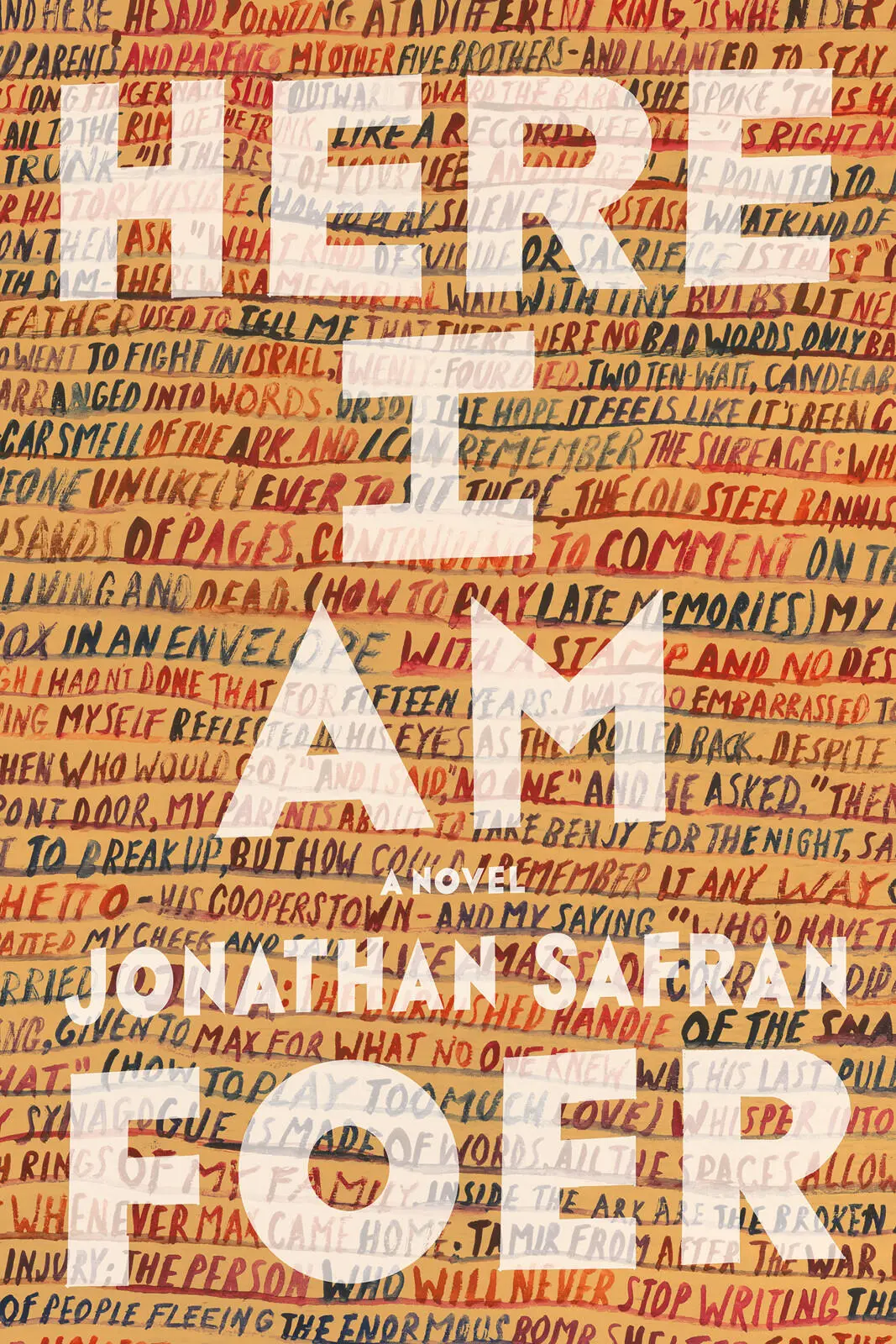
- Название:Here I Am
- Автор:
- Издательство:Hamish Hamilton
- Жанр:
- Год:2016
- ISBN:нет данных
- Рейтинг книги:5 / 5. Голосов: 1
-
Избранное:Добавить в избранное
- Отзывы:
-
Ваша оценка:
Here I Am: краткое содержание, описание и аннотация
Предлагаем к чтению аннотацию, описание, краткое содержание или предисловие (зависит от того, что написал сам автор книги «Here I Am»). Если вы не нашли необходимую информацию о книге — напишите в комментариях, мы постараемся отыскать её.
How do we fulfill our conflicting duties as father, husband, and son; wife and mother; child and adult? Jew and American? How can we claim our own identities when our lives are linked so closely to others’? These are the questions at the heart of Jonathan Safran Foer’s first novel in eleven years-a work of extraordinary scope and heartbreaking intimacy.
Unfolding over four tumultuous weeks in present-day Washington D.C.,
is the story of a fracturing family in a moment of crisis. As Jacob and Julia and their three sons are forced to confront the distances between the lives they think they want and the lives they are living, a catastrophic earthquake sets in motion a spiraling conflict in the Middle East. At stake is the very meaning of home — and the fundamental question of how much life one can bear.
Showcasing the same high-energy inventiveness, hilarious irreverence, and emotional urgency that readers and critics loved in his earlier work,
is Foer’s most searching, hard-hitting, and grandly entertaining novel yet. It not only confirms Foer’s stature as a dazzling literary talent but reveals a mature novelist who has fully come into his own as one of the most important writers of his generation.
Here I Am — читать онлайн бесплатно полную книгу (весь текст) целиком
Ниже представлен текст книги, разбитый по страницам. Система сохранения места последней прочитанной страницы, позволяет с удобством читать онлайн бесплатно книгу «Here I Am», без необходимости каждый раз заново искать на чём Вы остановились. Поставьте закладку, и сможете в любой момент перейти на страницу, на которой закончили чтение.
Интервал:
Закладка:
There were at least a dozen cousins — many from Deborah’s side, a few from Julia’s. The younger ones unpacked all the board games, one at a time — not to play them, but to unpack them and commingle the small pieces. Every now and then one would spontaneously freak out. The older cousins were surrounding Barak as he performed virtuosic acts of extreme violence on a TV so large one had to sit against the opposite wall to see its edges.
Benjy was on his own, stuffing crumpled Monopoly money between the venetian blinds.
“You’re being very generous with the window,” Jacob said.
“It’s not real money.”
“No?”
“I know you’re joking.”
“You haven’t seen Mom around, have you?”
“No.”
“Hey?”
“What?”
“Have you been crying, buddy?”
“No.”
“Are you sure? You look like you have.”
“Holy shit!” a cousin shouted.
“Language!” Jacob shouted back.
“I haven’t,” Benjy said.
“Are you sad about Great-Grandpa?”
“Not really.”
“So what’s upsetting you?”
“Nothing.”
“Dads know these things.”
“Then why don’t you know what’s upsetting me?”
“Dads don’t know everything.”
“Only God does.”
“Who told you that?”
“Mr. Schneiderman.”
“Who’s that?”
“My Hebrew school teacher.”
“ Schneiderman . Right.”
“He said that God knows everything. But that didn’t make sense to me.”
“It doesn’t make sense to me, either.”
“But that’s because you don’t believe in God.”
“I only ever said I was unsure. But if I did believe in God, it still wouldn’t make sense to me.”
“Right, because if God knows everything, why do we have to write notes to put in the Wall?”
“That’s a good point.”
“Mr. Schneiderman said that God knows everything but sometimes forgets. So the notes are to remind him of what’s important.”
“God forgets? Really?”
“That’s what he said.”
“What do you think about that?”
“It’s weird.”
“I think so, too.”
“But that’s because you don’t believe in God.”
“If I believed in God, he would be a remembering God.”
“Mine would, too.”
Despite being as agnostic about God’s existence as he was about the question’s meaning (could any two people really be referring to the same thing when speaking about God?), Jacob wanted Benjy to believe. Or Dr. Silvers did, anyway. For several months, Benjy’s anxiety about death had been slowly and steadily ramping up, and now risked tipping from adorable to problematic. Dr. Silvers said, “He has the rest of his life to form answers to theological questions, but he’ll never get back this time of developing his first relationship to the world. Just make him feel safe.” That struck Jacob as right, even if the thought of evangelizing made him squirm. The next time Benjy raised his fear of death, just when Jacob’s instinct urged him to agree that an eternity of nonexistence was certainly the most horrible of all things to imagine, Jacob remembered Dr. Silvers’s command: Just make him feel safe .
“Well, you know about heaven, right?” Jacob said, causing a nonexistent angel to lose its wings.
“I know that you think it isn’t real.”
“Well, no one knows for sure. I certainly don’t. But you know what heaven is?”
“Not really.”
So Jacob gave his most comforting explanation, sparing neither extravagance nor intellectual integrity.
“And if I wanted to stay up late in heaven?” Benjy asked, now planking on the sofa.
“As late as you want,” Jacob said, “every single night.”
“And I could probably eat dessert before dinner.”
“You wouldn’t have to eat dinner at all.”
“But then I wouldn’t be healthy.”
“Health won’t matter.”
Benjy turned his head to the side: “Birthdays.”
“What about them?”
“What are they like?”
“Well, they’re never-ending, of course.”
“Wait, it’s always your birthday?”
“Yes.”
“You have a party and get presents every day?”
“All day every day.”
“Wait, do you have to write thank-you notes?”
“You don’t even have to say thank you.”
“Wait, does that mean you’re zero, or infinity?”
“What do you want to be?”
“Infinity.”
“Then you’re infinity.”
“Wait, is it always everyone’s birthday?”
“Only yours.”
Benjy rose to his feet, raised his hands above his head, and said, “I want to die right now!”
Just don’t make him feel too safe.
In Irv and Deborah’s basement, facing a more nuanced theological question, Jacob again resisted his instinct for truth in favor of Benjy’s emotional safety: “Maybe God does remember everything but sometimes chooses to forget?”
“Why would he do that?”
“So that we remember,” Jacob said, pleased with his improvisation. “Like the wishes,” he continued. “If God knew what we wanted, we wouldn’t have to.”
“And God wants us to know for ourselves.”
“Could be.”
“I used to think Great-Grandpa was God,” Benjy said.
“You did?”
“Yeah, but he’s dead, so obviously he wasn’t God.”
“That’s one way to think about it.”
“I know Mom isn’t God.”
“How is that?”
“Because she would never forget about me.”
“You’re right,” Jacob said, “she wouldn’t.”
“No matter what.”
“No matter what.”
Another round of expletive mutterings from the cousins.
“Anyway,” Benjy said, “that’s what was making me cry.”
“Mom?”
“My note for the Wailing Wall.”
“Because you were thinking about how God is forgetful?”
“No,” Benjy said, pointing at the TV, which wasn’t displaying a video game, as Jacob had thought, but the effects of the most recent, and most severe, aftershock, “because the Wall crumbled.”
“The Wall ?”
They came spilling into the world: every wish tucked into every crevice, but also every wish tucked into every Jew’s heart.
“No more proof of how great they were,” Benjy said.
“What?”
“The thing you told me about the Romans.”
How much do the children know, and how much do they remember?
“Jacob!” Irv called from upstairs.
“The Wailing Wall,” Jacob said, as if by saying its name aloud, it would exist again.
Jacob could make his children feel safe. But could he keep them safe?
Benjy shook his head and said, “Now it’s just the Wailing.”
LOOK! A CRYING HEBREW BABY
Tamir’s presence had not only made a full reckoning impossible, it required Julia to be a buoyant host. And the death of Jacob’s grandfather required her to at least perform love and care, when all she felt was sadness and doubt. She was good enough to manage her blossoming resentment, good enough, even, to suppress her passive-aggression, but at a certain point, the requirements of being a good person inspire hatred for oneself and others.
Like any living person, she had fantasies. (Although her immense guilt about being human required a constant reminder — that she was “like any living person.”) The houses she designed were fantasies, but there were others.
She imagined a week alone in Big Sur. Maybe at the Post Ranch Inn, maybe one of the ocean-facing rooms. Maybe a massage, maybe a facial, maybe a “treatment” that treats nothing. Maybe she’d walk through a redwood tunnel, the growth rings bending around her.
Читать дальшеИнтервал:
Закладка:
Похожие книги на «Here I Am»
Представляем Вашему вниманию похожие книги на «Here I Am» списком для выбора. Мы отобрали схожую по названию и смыслу литературу в надежде предоставить читателям больше вариантов отыскать новые, интересные, ещё непрочитанные произведения.









Обсуждение, отзывы о книге «Here I Am» и просто собственные мнения читателей. Оставьте ваши комментарии, напишите, что Вы думаете о произведении, его смысле или главных героях. Укажите что конкретно понравилось, а что нет, и почему Вы так считаете.