Jonathan Foer - Here I Am
Здесь есть возможность читать онлайн «Jonathan Foer - Here I Am» весь текст электронной книги совершенно бесплатно (целиком полную версию без сокращений). В некоторых случаях можно слушать аудио, скачать через торрент в формате fb2 и присутствует краткое содержание. Год выпуска: 2016, Издательство: Hamish Hamilton, Жанр: Историческая проза, на английском языке. Описание произведения, (предисловие) а так же отзывы посетителей доступны на портале библиотеки ЛибКат.
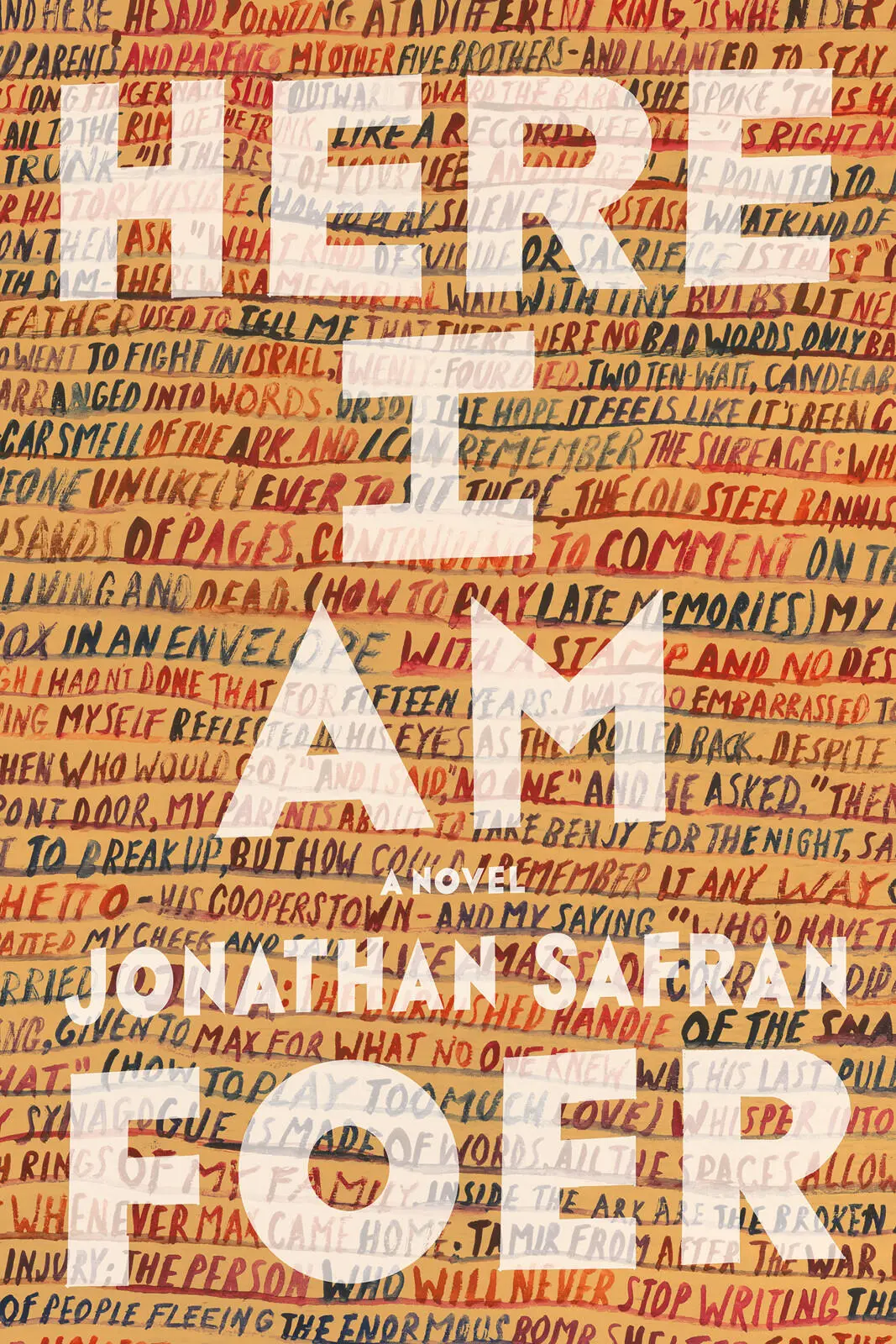
- Название:Here I Am
- Автор:
- Издательство:Hamish Hamilton
- Жанр:
- Год:2016
- ISBN:нет данных
- Рейтинг книги:5 / 5. Голосов: 1
-
Избранное:Добавить в избранное
- Отзывы:
-
Ваша оценка:
Here I Am: краткое содержание, описание и аннотация
Предлагаем к чтению аннотацию, описание, краткое содержание или предисловие (зависит от того, что написал сам автор книги «Here I Am»). Если вы не нашли необходимую информацию о книге — напишите в комментариях, мы постараемся отыскать её.
How do we fulfill our conflicting duties as father, husband, and son; wife and mother; child and adult? Jew and American? How can we claim our own identities when our lives are linked so closely to others’? These are the questions at the heart of Jonathan Safran Foer’s first novel in eleven years-a work of extraordinary scope and heartbreaking intimacy.
Unfolding over four tumultuous weeks in present-day Washington D.C.,
is the story of a fracturing family in a moment of crisis. As Jacob and Julia and their three sons are forced to confront the distances between the lives they think they want and the lives they are living, a catastrophic earthquake sets in motion a spiraling conflict in the Middle East. At stake is the very meaning of home — and the fundamental question of how much life one can bear.
Showcasing the same high-energy inventiveness, hilarious irreverence, and emotional urgency that readers and critics loved in his earlier work,
is Foer’s most searching, hard-hitting, and grandly entertaining novel yet. It not only confirms Foer’s stature as a dazzling literary talent but reveals a mature novelist who has fully come into his own as one of the most important writers of his generation.
Here I Am — читать онлайн бесплатно полную книгу (весь текст) целиком
Ниже представлен текст книги, разбитый по страницам. Система сохранения места последней прочитанной страницы, позволяет с удобством читать онлайн бесплатно книгу «Here I Am», без необходимости каждый раз заново искать на чём Вы остановились. Поставьте закладку, и сможете в любой момент перейти на страницу, на которой закончили чтение.
Интервал:
Закладка:
She imagined having a personal chef. Vegans live longer, and are healthier, and have better skin, and she could do that; it would be easy, if someone shopped, cooked, and cleaned for her.
She imagined Mark noticing small things about her that she’d never noticed about herself: lovably misused idioms, what her feet do when she flosses, her funny relationship to dessert menus.
She imagined going for walks without destinations, thinking about things of no logistical importance, like whether Edison bulbs are actually obnoxious.
She imagined a secret admirer anonymously subscribing her to a magazine.
She imagined the disappearance of crow’s feet, like the disappearance of crow’s footprints from a dusty road.
She imagined the disappearance of screens — from her life, from her children’s lives. From the gym, from doctors’ offices and the backs of cabs, hanging behind bars and in the corners of diners, the iWatches of people holding iPads on the Metro.
She imagined the deaths of her air-filled clients and their dreams of heavier and heavier kitchen appliances.
She fantasized about the death of the so-called teacher who chuckled at one of Max’s answers four years ago, requiring a month of bedtime talks to reinstill his enjoyment of school.
Dr. Silvers would have to die at least a couple of times.
She imagined Jacob’s sudden disappearance — from the house, from existence. She imagined him dropping dead at the gym. Which required imagining him going to the gym. Which required imagining him once again possessing a desire to be attractive in ways other than professional success.
Of course, she didn’t actually want him to die, no part of her did, not even subconsciously, and when she fantasized about his death, it was always painless. Sometimes he would panic in awareness as he tried to reach through his chest to grab his stammering heart. Sometimes he would think of the children. The end of sometimes: he would be gone forever. And she would be alone, and finally unalone, and people would grieve for her.
She would cook all the meals (as she already did), do all the cleaning (as she already did), buy the graph paper for Benjy’s solutionless mazes, the teriyaki-roasted seaweed snacks for Max, a cool-but-not-trying-too-hard messenger bag for Sam when the last one she bought for him fell apart. She would dress them in end-of-the-year Zara and Crewcuts sale clothing and get them off to school (as she already did). She would have to support herself (which she couldn’t, with her present lifestyle, but wouldn’t have to, given Jacob’s life insurance policy). Her imagination was strong enough to hurt her. She was weak enough to keep the hurt to herself.
And then came the most hurtful thought, the thought that can never be touched with even the whorls of the fingers of one’s brain: the deaths of her children. She’d had the most horrible thought many times since she became pregnant with Sam: imagined miscarriages; imagined SIDS; imagined tumbles down stairs, trying to shield his body from the treads as they fell; imagined cancer every time she saw a child with cancer. There was the knowledge that every school bus she ever put one of her children on was going to roll down the side of a hill and into a frozen lake, whose ice would re-form around its silhouette. Every time one of her children was put under general anesthesia, she said goodbye to him as if she were saying goodbye to him. She wasn’t naturally anxious, much less apocalyptic, but Jacob was right when, after Sam’s injury, he said it was too much love for happiness.
Sam’s injury. It was the place she was unwilling to go, because there was no road back. And yet the trauma center of her brain was always pushing her there. And she was always never fully returning. She’d found peace with why it happened — there was no why — but not how. It was too painful, because whatever the sequence of events, it wasn’t necessary or inevitable. Jacob never asked her if she had been the one to open the door. (It was far too heavy for Sam to have opened himself.) Julia never asked Jacob if he had closed it on Sam’s fingers. ( Maybe Sam could have gotten it moving, and inertia would have taken care of the rest?) It was five years ago, and the journey — the century-long morning in the ER, the twice-a-week visits to the plastic surgeon, the year of rehab — brought them closer than they’d ever been. But it also created a black hole of silence, from which everything had to keep a safe distance, into which so much was swallowed, a teaspoon of which weighed more than a million suns consuming a million photos of a million families on a million moons.
They could talk about how lucky they were (Sam very nearly lost his fingers), but never how unlucky. They could speak in generalities, but never recount the details: Dr. Fred repeatedly sticking needles into Sam’s fingers to test for feeling, while Sam looked into his parents’ eyes and begged, pleaded, for it to stop. When they came home, Jacob put his bloody shirt in a plastic bag and walked it to the garbage can on the corner of Connecticut. Julia put her bloody shirt in an old pillowcase and tucked it halfway into a stack of pants.
Too much love for happiness, but how much happiness was enough? Would she do it all again? She always believed that her ability to endure pain was greater than anyone else’s — certainly than her children’s or Jacob’s. A burden would be easiest carried by her, and regardless, it would ultimately be carried by her anyway. Only men can unhave babies. But if she could do it all again?
She often thought of those retired Japanese engineers who volunteered to go into failing nuclear plants to fix them after the tsunami. They knew they’d be exposed to fatal amounts of radiation, but given that their life expectancies were shorter than the time it would take for the cancer to kill them, they saw no reason not to get the cancer. In the hardware gallery, Mark had said it wasn’t too late in life for happiness. When, in Julia’s life, would it be late enough for honesty?
* * *
It was amazing how little changed as everything changed. The conversation was continually expanding, but it was no longer clear what they were talking about. When Jacob showed her listings for places to which he might move, was it any more real than when he used to show her listings for places to which they might move? When they shared their visions for happy independent lives, was it any less make-believe than when they used to share their visions for living together happily? The rehearsal of how they would tell the kids took on a quality of theater, as if they were trying to get the scene right, rather than get life right. She had the sense that to Jacob it was a kind of game, that he enjoyed it. Or worse, that planning their separation was a new ritual that kept them together.
Domestic life stagnated. They talked about Jacob starting to sleep elsewhere, but Tamir was in the guest room, Barak was on the sofa, and leaving for a hotel after everyone was asleep and arriving before anyone woke up felt both cruel and profligate. They talked and talked about what kind of schedule was most likely to facilitate good stretches with the kids, and good transitions, and as little missing as possible — but they didn’t take any steps either to repair what was broken or to leave it behind.
After the funeral …
After the bar mitzvah …
After the Israelis leave …
After the semester ends …
There was a nonchalance to their desperation, and maybe talking about it was enough for now. It could wait until it couldn’t.
But funerals, like airplane turbulence and fortieth birthdays, force the issue of mortality. Had it been another day, she and Jacob would have found ways to continue living inside their purgatory. They would have created errands to run, diversions, emotional escape hatches, fantasies. The funeral made a conversation almost a crime, but it also inspired an unrelenting questioning in Julia. All that could be deferred on any other day was now urgent. She remembered Max’s obsession with time, how little there was. “I’m wasting my life!”
Читать дальшеИнтервал:
Закладка:
Похожие книги на «Here I Am»
Представляем Вашему вниманию похожие книги на «Here I Am» списком для выбора. Мы отобрали схожую по названию и смыслу литературу в надежде предоставить читателям больше вариантов отыскать новые, интересные, ещё непрочитанные произведения.








Обсуждение, отзывы о книге «Here I Am» и просто собственные мнения читателей. Оставьте ваши комментарии, напишите, что Вы думаете о произведении, его смысле или главных героях. Укажите что конкретно понравилось, а что нет, и почему Вы так считаете.